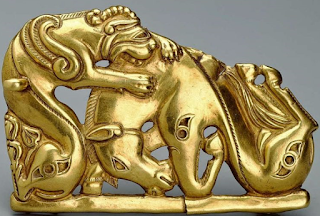
A Dutch court ruled to hand over gold artifacts unearthed in annexed Crimea to Ukraine, dealing a blow to Russia’s claims. Both Moscow and Kiev claimed ownership of the Scythian treasures, which were loaned to Amsterdam’s Allard Pierson Museum. The museum’s “Crimea: Gold and Secrets of the Black Sea” exhibit opened in February 2014, one month before Russia seized the Black Sea peninsula from Ukraine. The treasures remain in "safe storage" in the Allard Pierson museum pending appeal.
The collection dates to the Scythian era in the fourth century B.C.
A Dutch court ruled that Ukraine was the rightful owner of the ancient treasure and it should not be returned to the territory while it is occupied by Russia. Moscow claimed that as Crimea is part of Russia, the artifacts should be returned. Moscow had accused the Netherlands of seizing the gold artifacts illegally, as they were claimed by the Kremlin following Russia's annexation of Crimea.
Pompeii is a buried Roman town near modern Naples. When Mt. Vesuvius erupted in 79 AD, Pompeii was burned and buried in ash, while nearby Herculaneum was destroyed by pyroclastic flow. The area was buried under 4 to 6m (13 to 20 ft) of ash and pumice. Pompeii was lost until its rediscovery in 1599 and broader rediscovery in 1748.
The objects that lay beneath the city have been well preserved.
Marble statue from the Temple of Isis.
Helmet of a Thrax gladiator. Bronze.
Mosaic (detail) from Pompeii.
Apollo as an Archer
Diana as an Archer.
A gold bracelet bears an inscription. On its inside face are the words dominus ancillae suae – from the master (dominus) to his slave-girl (ancilla).
In Hindu mythology, a rakshasa is a malignant demon, especially one of a band of demons at war with Rama and Hanuman. The word rakshasa comes from the Sanskrit rākṣasa, meaning ‘demon’. The rakshasa was later incorporated into Buddhism. Rakshasas are also called 'Maneaters'. A female rakshasa is known as a Rakshasi.
They were insatiable cannibals that could smell the scent of human flesh. Some drank blood with their palms or from a human skull.
Generally they could fly, vanish, and had Maya (magical powers of illusion), which enabled them to change size at will and assume the form of any creature.
The crab fossil record extends to the Early Jurassic epoch, more than 200 million years ago. Fossils of nonmarine crabs are sparse, until now with the discovery of Cretapsara athanata, a previously unknown true crab preserved in Cretaceous amber from Myanmar. The 5-mm-long crab is the oldest and the most complete fossil crab found. Well-developed gills indicate an aquatic to semi-aquatic crab.
Previous fossil records of crabs suggested that crabs ventured onto land and adapted to freshwater about 75 to 50 million years ago. This crab most likely died in brackish or freshwater near the coast or an estuary. This demonstrates that crabs became terrestrial about 100 mya — much earlier than previously thought.
Archaeopteryx (meaning "ancient wing") is a very early prehistoric bird, dating from about 150 million years ago during the Jurassic period. The first, and one of the most complete fossils of archaeopteryx is known as the London specimen. It was discovered in 1861, just two years after Darwin published On the Origin of Species, and made a stir being a transitional form.
Only 12 of these curious creatures have ever been found.
They are going under the glare of a giant X-ray machine - to find out what lies buried beneath the surface. Using a new "camera obscura" technique scientists have captured some of the clearest ever images of Archaeopteryx. For the first time, they can see the complete skeleton in 3D. Not just the surface outlines, but all the hidden bones and feathers. Could Archaeopteryx fly? The answer grows closer as new, microscopic details of its anatomy emerge.
Blood vessels within the bones, for example, can be compared to modern birds.
The sixth century was a rough time to be on earth: low temperatures triggered crop failure, famine, and widespread death. The culprit, say scientists, were back-to-back volcanic eruptions, one in 536 C.E. and another around 540 C.E. The first likely happened in Iceland or North America. But the location of the second was a mystery.
Izalco Volcano is in western El Salvador on the southern slope of Santa Ana. It is the most active volcano in Central America, having erupted more than 50 times since 1770. Its black symmetrical cone reaches a height of 6,004 feet (1,830 metres). During the 19th century, sailors set their course by the continuous glow from Izalco’s summit, nicknaming it the “Lighthouse of the Pacific.” Multiple measurements on the remains of trees yielded precise dates. The trees all died between 500 and 545 C.E.
The temple and ofrendatarios may be related to deities worshipped by the Muisca. Muisca metalwork inspired the legend of El Dorado.
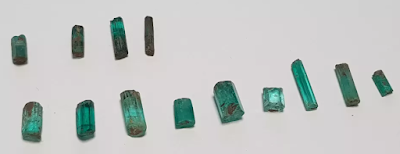
Archaeologists in Colombia have found eight ceramic jars, with metallic figurines and emeralds inside, within a temple and its adjacent graves. The Muisca (also called the Chibcha) crafted the jars called "ofrendatarios" about 600 years ago. The Muisca were famous for their metal working skills. The temple and graves were in an ancient Muisca town located near Bogotá.
The Greek word for money, chrema, carries an English translation that falls short. It means ‘to need’ and ‘to use’ explains Nicholas Stampolidis, director of theMuseum of Cycladic Art. It's latest exhibition is called, “Money: Tangible Symbols in Ancient Greece.”
The Athenian museum is exhibiting a display of 85 ancient coins from around the Mediterranean basin, Asia Minor and Central Asia. They date as far back as the 7th century BC.
The first Greek coin, produced on Aegina Island, is stamped with a sea turtle—chosen because it was the longest-living animal the islanders knew of. During Alexander the Great’s reign, his profile remained absent from any coin. A pupil of Aristotle, who warned against hubris, Alexander put the ancient gods on his coins instead.
Alexander the Great’s successors had no such restraints.
In the first century BC, the port town of Delos was a tax haven attracting sea-faring trade.
A excavation in 1991 of a local tavern reveals broken wine jugs with a pile of coins with markings from dozens of different societies—the savings of prostitutes after servicing clients from around the world.
Two men have been charged relating to a Viking hoard of coins and silver worth almost £1m. The hoard was seized in raids on properties in County Durham and Lancashire in 2019. Roger Pilling, 73, and Craig Best, 44, denied conspiring to convert criminal property between September 2018 and May 2019. The haul contained silver ingots and coins of Alfred the Great of Wessex and Ceolwulf II of Mercia. King Alfred defeated the Vikings in AD 878, and experts believe the coins belong to an undeclared hoard consistent with the location of the Viking army at that time. When the coins were recovered they were described as a "nationally important hoard".


 The collection dates to the Scythian era in the fourth century B.C.




 Only 12 of these curious creatures have ever been found.