Tuesday, May 17, 2022

Salt mining


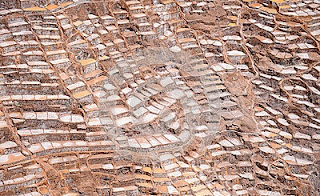
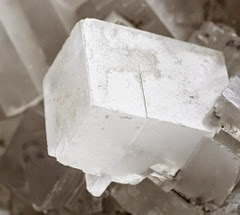
Halite rock salt (NaCl)
Salt is a mineral made up of cube-shaped crystals composed of two elements, sodium and chlorine. It is translucent, colourless, and odourless. For centuries salt had a permanent place in the life of human beings. Salt was considered sacred, a gift from the Gods; it was used to confirm oaths and sacrifices. Salt served as money at various times and places, and the quest for salt has been the cause of warfare. Offering bread and salt to visitors is a sign of hospitality.

This made salt a valuable commodity throughout history.
Prior to industrialization, it was expensive and labor intensive to harvest the mass quantities of salt necessary for food preservation and seasoning. Mining salt caused rapid dehydration. Other problems related to accidental excessive sodium intake.
Entire economies were based solely on salt production and trade.
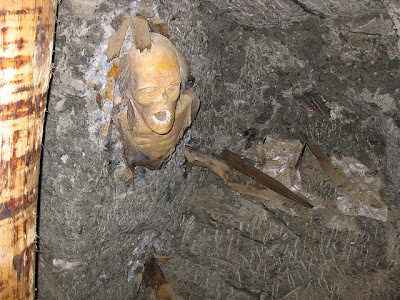
The 'Man in Salt' greets visitors at the Salzwelten Hallstatt Mine, Austria. In 1734 a corpse preserved in salt was discovered in the deposit.
At the Chehrabad Salt Mine, Iranian miners recently uncovered the 6th salt man to be found in the last 15 years. Salt men are ancient corpses killed or crushed in the cave and mummified by the extreme conditions. Hair, flesh and bone are all preserved by the dry salinity of the cave, and even internal organs have been found intact. The first salt man, dated to 300 A.D., was discovered in 1993, sporting a long white beard, iron knives and a single gold earring. In 2004 another mummy was discovered 50 feet away, followed by another in 2005 and a "teenage" boy later that year. The oldest of the salt men found is truly ancient and has been carbon dated to 9550 B.C.
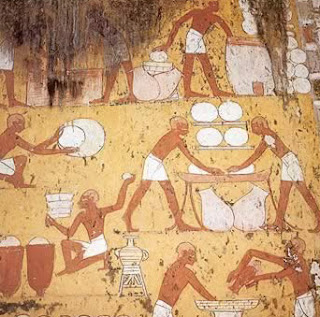
Egyptians may have been the first civilization to preserve fish and meat with salt. Food that could be preserved was highly valuable. Recognizing the worth of preserving food, Egyptians turned to trade. The Egyptians did not export salt by itself, it was bulky and difficult to transport, but rather food that was salted, which transported easily without spoiling and had a value added. Ancient Egypt's trade started a 4000 history of trade involving salt and food.

Boiling brine into pure salt in China.
In the Iron Age evaporated salt was obtained by boiling seawater or brine in clay pots over a fire. Roman salt making entailed boiling seawater in large lead-lined pans. In ancient Rome, salt on the table was a mark of a very rich patron; those who sat nearer the host were "above the salt," and those less favored were "below the salt". Roman salt mining was often done by slave or prison labor, and life expectancy was low.
Malta Roman salt flats

Ancient Roman Glass Salt Dishes
The Roman historian Pliny the Elder stated as an aside in his Natural History's discussion of sea water, that "[I]n Rome ... the soldier's pay was originally salt and the word 'salary' derives from it ..."

Roman Salt Pans in Hortales.

Monday, May 16, 2022

Persia: Ancient Iran and the Classical World

An exhibition at the Getty Villa in Los Angeles is entitled "Persia: Ancient Iran and the Classical World".
Achaemenid relief with a lion and bull, dated to between 359 and 338 BC.

Achaemenid earrings with inlays, dated to between the late 400s and early 300s BC.
See ----->https://www.getty.edu/art/exhibitions/persia/index.html

Thursday, May 12, 2022

Greek Armor

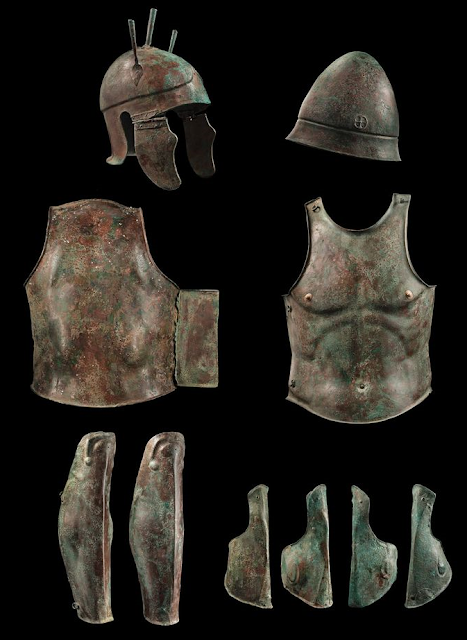
Surviving bronzes from Greece’s classical period are rare, with knowledge based on Roman marble copies. Functional items such as 4th century BC cavalry armour—helmet, cuirass and greaves, all highly decorated ... are rare survivals. As combat in ancient Greece was mainly hand to hand, armor was light and allowed for free movement.
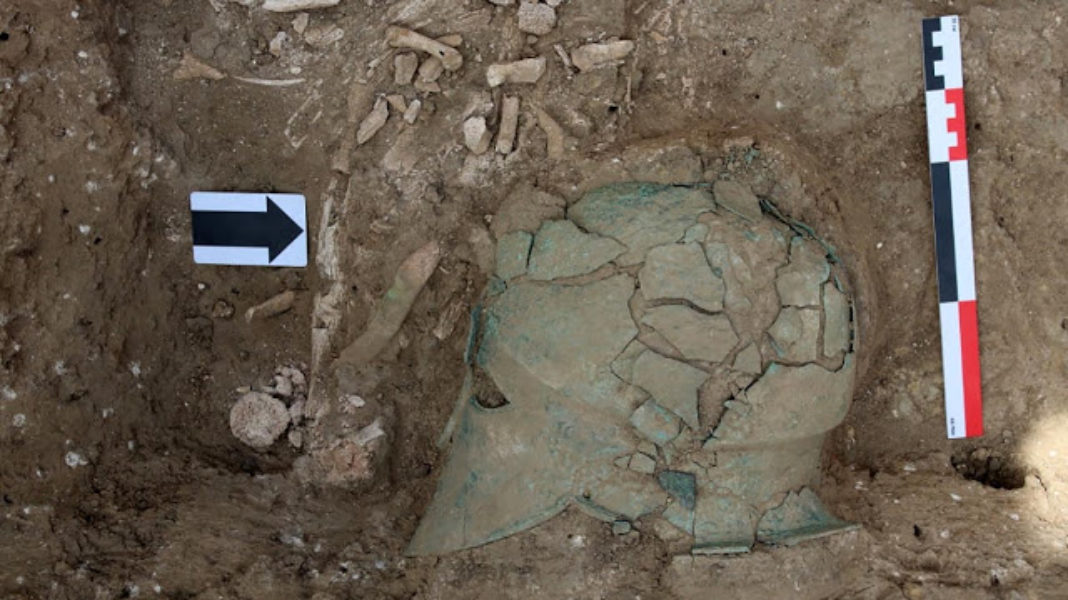
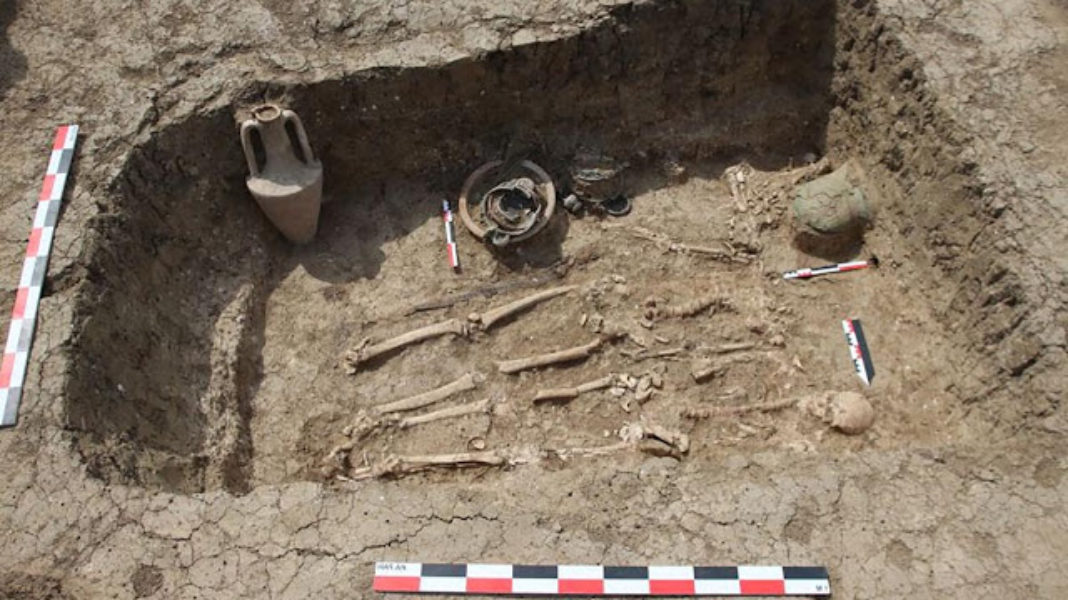
In 2017 an ancient Greek Corinthian helmet was found in a 5th century BC grave in the Taman Peninsula. Corinthian helmets appeared in Greece around the 6th century BC.
Greek Attic helmet of domed form, circa 300 BC, hammered bronze. Estimate £60,000-£90,000.

In 2007 a well-preserved ancient Greek helmet was found near the Israeli city of Haifa. Crafted in the sixth century B.C., this helmet was likely used during the Persian Wars, which pitted Greek city-states against the Persian Empire in a series of clashes between 492 and 449 B.C.

Sunday, May 8, 2022

Ancient Egyptian Sculpture at Sotheby's


$ 60k to $ 90k
Sotheby's sale of Ancient Egyptian Sculpture and Works of Art 2018 totaled a strong $8,986,500, over the high pre-sale estimate. The top lot was the monumental Granite Figure of Sekhmet, which sold for $4.17m.

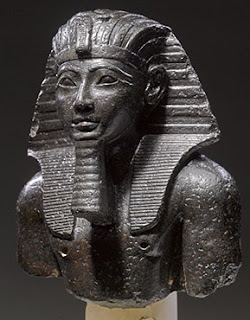
Highlights included a fine small-scale basalt bust of King Tuthmosis III, an imposing over-lifesize fragmentary red granite head of King Amenhotep III from the last ten years of his reign, and an elegant steatite statuette of the Lady Iset , priestess of the god Sobek, dating to the early 19th Dynasty.

Black Basalt Head Of Tuthmosis III, 18th Dynasty, 1479-1426 B.C. $250k

Wood mask with inlaid eyes, 25th/26th Dynasty. $ 1.4m

Limestone mask, 30th Dynasty/early Ptolemaic Period. $200k to $ 300k

Granite enthroned figure of the goddess Sekhmet. $ 4.1m

Statuette of the Lady Iset , priestess of the god Sobek, dating to the early 19th Dynasty. $760k

A record for an ancient Egyptian work of art was set at Christie’s in 2012 when a 29 inch sculpture of the goddess, Isis, dating from the Late Period Dynasty, c 664 - 525 BC, sold for £3.7 million.
A 30-inch statue representing the god Sekhemka broke the world record for highest auction price of an Egyptian artwork in 2014. The statue was estimated to sell for $7 to $11 million, but sold for $27 million. 

An Egyptian Green Peridotite Head of a Man

Egyptian blue-glazed steatite figure of Taweret, goddess of childbirth

Block statue of a man and the sacred baboon of Thoth, Egyptian, serpentine, 26th/30th Dynasty, 664-342 B.C. Sold for $856k in 2006

Sphinx of Egyptian queen, green porphry, Roman Imperial, circa A.D. 81-96. $5.2m.

Egyptian steatite figure of Sobek

Djehuty-Mose (Tothmes), polychrome limestone ushabti, 1292-1190 B.C. $1.3m.

Black granite or basalt relief fragment from the 30th Dynasty/Early Ptolemaic Period, reign of Nectanebo II /Ptolemy I, 360-282 B.C. $211k in 1998

Limestone figure of lion, 30th Dynasty/Ptolemaic Period, 380-30 B.C. $154,250 in 2001.

Friday, May 6, 2022

King Nebuchadnezzar II

Babylonian King Nebuchadnezzar II was the longest-reigning and most powerful monarch of the Neo-Babylonian Empire. Between 589-586 BCE, he laid siege to Jerusalem, eventually entering the city and razing it and its Holy Temple complex to the ground. The Babylonian king's two sieges of Jerusalem (in 597 and 587 BC) are depicted in 2 Kings 24–25. The Book of Jeremiah calls Nebuchadnezzar the "destroyer of nations". In 605 BCE, after the battle of Carchemish, Judah became a vassal state under Nebuchadnezzar.
Egyptian military success against Babylon in 601 prompted vassal states, including Judah, to rebel.
This led to Nebuchadnezzar besieging Jerusalem in 597 BCE and conquering the city. Nebuchadnezzar appointed Zedekiah as a puppet king, but he also rebelled against his Babylonian rulers. As a consequence the Babylonian army besieged Jerusalem again, and this time they destroyed the city and the temple in 586 BCE.
Babylonian King Nebuchadnezzar II destroyed the temple, but it seems he did so out of neccessity in order to protect his interests as ruler, since the kings of Judah kept rebelling. The prophets make it clear that Nebuchadnezzar was an instrument used by God to punish the Israelites for their sins against God.

Monday, May 2, 2022

Buried treasures in Wales

Buried treasure has been unearthed at sites all over Wales in recent years. Fifteen finds of gold, silver and ancient tools posted on website Portable Antiquities have been deemed so important they were judged to be of national importance and placed in museums. One gold and 14 silver coins from the reigns of Edward III, Henry VI and other periods were found in Bronington, Wrexham, in December 2013. The group as a whole was lost or deposited after 1465.

These silver ingots were found in Llandwrog, Gwynedd
Silver ingots found in Llandwrog, Gwynedd weighed 115g. Nicks on the sides were evidence that they had been used in commercial transactions before burial.

A copper alloy axe was discovered in Llancarfan, in the Vale of Glamorgan, in December 2013. It is of a kind known as the “Croxton type.”
A 3cm long piece of metal is polished unevenly and dates from the first half of the 17th century. It was found in Llanasa, Flintshire, in March 2013, and appears to show a female saint.

Silver bodkin. A bent silver dress pin is hallmarked with a letter ‘W’ and dates from the 17th century.

Oval silver brooch made from silver alloy and decorated with a substance called niello. Similar jewellery has been found throughout Wales.

Sunday, May 1, 2022

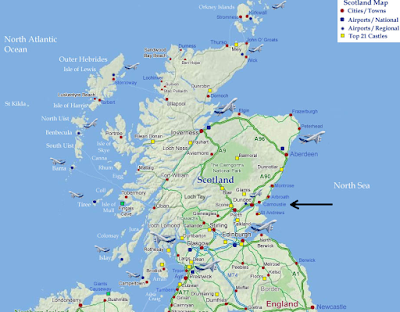
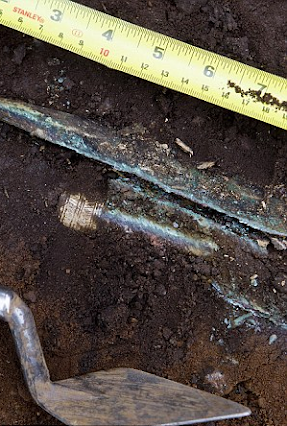
Gold-hilted sword beneath a Scottish soccer field

Excavations in 2016 revealed a trove of ancient artifacts, which could date back to the Bronze Age. Diggers moved into the site in Carnoustie after relics were found while laying foundations for a new sports field.

Famed for its golfing heritage the small Tayside town could now hold the key to how Scots lived as early as 2000BC. Evidence for Bronze Age dwellers in Scotland is widespread.


Facial reconstruction of Ava
A recreation of a skeleton indicated the people who inhabited the Scottish Highlands at this time looked similar to today's citizens. Known as 'Ava', the Bronze Age woman died more than 3,700 years ago, but was brought back to life in a two-dimensional image.