Thursday, June 16, 2022

Cambodia the ancient ‘Land of Gold’?

Over two decades ago, in the remote reaches of Cambodia's Baset district, a group of villagers discovered a slab covered in ancient carvings, then three more. Soon they found themselves excavating the ruins of an ancient temple. What they found are clues to the location of the fabled ‘Land of Gold’, the ancient realm of Suvarnabhumi.
One inscription praised King Isanavarman I of the Chenla Empire, dated to the year 633. “The great King Isanavarman is full of glory and bravery. He is the King of Kings, who rules over Suvarnabhumi until the sea, which is the border, while the kings in the neighbouring states honour his order to their heads.”
Many have puzzled over the whereabouts of Suvarnabhumi, with references dating back to ancient Buddhist accounts.
Most of the inscriptions, like many others found in Southeast Asia, praises the king for his godlike power and dominion over the land, but the mention of Suvarnabhumi directly is a surprise to researchers.

The Minister of Culture and Fine Arts requested to move the tablets to the National Museum in Phnom Penh. Locals objected due to 'ill omens.' Monks were retained to arrange the required rituals and “avoid any curse”.

Tuesday, June 14, 2022

Amazing artifacts at Heritage

1862 Civil War Diary of Private Edward H. Ingraham. He saw extensive action and survived the war. He suffered from mental illness and died in an insane asylum on July 15, 1894 at age 62. Union Corporal's Forage Cap & Frock Coat Set.
World War I Propaganda by James Montgomery Flagg (Leslie-Judge Co., 1917)

D-Day: First American Flag Planted on Normandy Beachhead.
Imperial German Oldenburg Infantry Regiment No. 91 Model 1895 NCO Spiked Helmet.

Bullet-Struck Wood Linked to Gettysburg. Pair of wood pieces (each approximately 3.5" tall) with bullet and canister shot imbed in each. Each with paper labels inscribed "Cut From Fence Post Gettysburg John Pannick".

Sunday, June 12, 2022

Assyrian Empire collapsed due to climate change

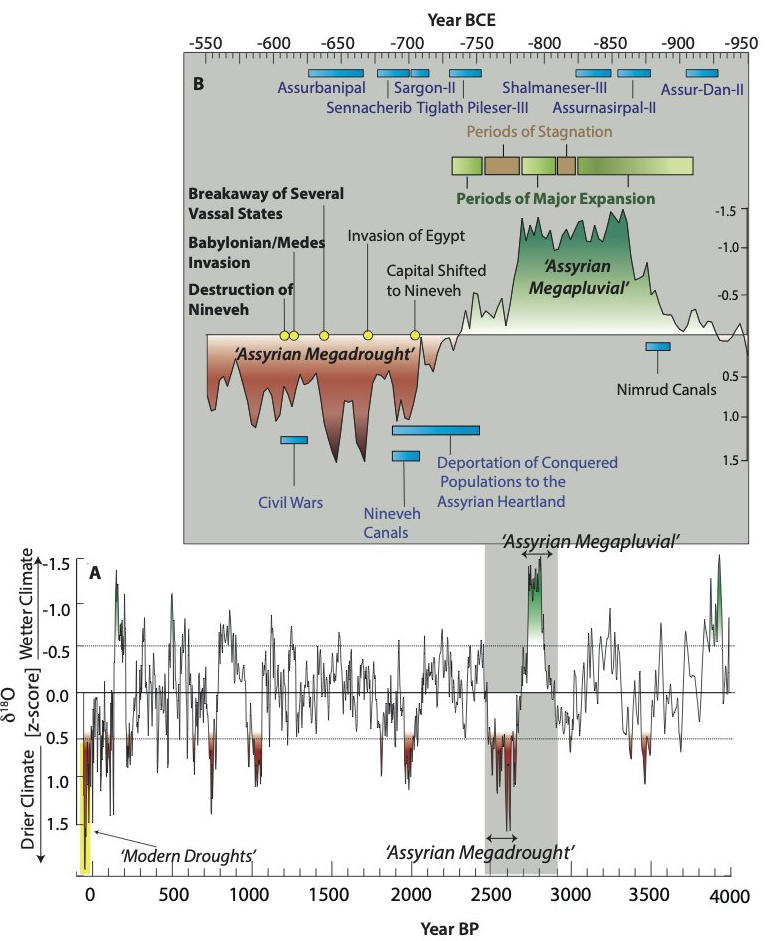
Ancient Mesopotamia, the land between the Tigris and the Euphrates rivers, was the center of the Neo-Assyrian Empire. The ancient superpower was the largest empire of its time, lasting from 912 BC to 609 BC in what is now Iraq and Syria. At its height, the Assyrian state stretched from the Mediterranean and Egypt in the west to the Persian Gulf and western Iran in the east. Then a reversal of fortune, and the Neo-Assyrian Empire plummeted from its zenith (650 BC) to complete collapse within the span of a few decades. The reasons why were a mystery. Research shows that climate change was the double-edged sword that first helped the meteoric rise of the Neo-Assyrian Empire and then lead to its precipitous collapse.
Rainfall patterns over Mesopotamia were deduced from cave stalagmites. These are the cone-like structures from the cave floor. They grow slowly, as rainwater drips down from the cave ceiling.
Oxygen isotope ratios build a timeline of how conditions changed, but don't reveal the amount of time that elapsed between them. Stalagmites trap uranium. Over time, uranium decays into thorium at a predictable pace. Experts made high-precision uranium-thorium measurements. The Neo-Assyrian state expanded during a 200 year interval of anomalously wet climate. This was followed by serious droughts in the early-to-mid-seventh century BC. This period marked the swift collapse of the Neo-Assyrian Empire. Repeated crop failures likely exacerbated political unrest in Assyria, crippled its economy and empowered adjacent rivals.

Friday, June 10, 2022

Treasures of Ancient Nubia


Gilt-silver mummy mask of Queen Malakaye (664–653 BC)
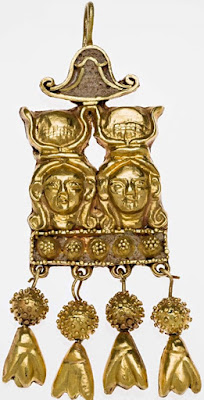
An exhibition at the Museum of Fine Arts, Boston, titled 'Gold and the Gods: Jewels of Ancient Nubia', provided insight into the meticulous craftsmanship of Ancient Nubia. The show included more than 100 treasures from the MFA’s collection of jewelry from Ancient Nubia. The MFA’s collection dates from 1700 BC to AD 300 and is considered the most comprehensive of any outside of Khartoum. Gold and the Gods showcased elaborate necklaces, amulets, stacked bracelets, and earrings discovered inside the tombs of Nubian kings and queens.

Ancient Nubia ruled the entire Nile Valley during the apex of its power in the eighth century BC. Nubian artisans turned out some of the most sophisticated, finely crafted jewelry of the ancient world.
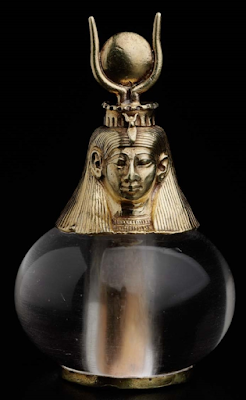
Hathor-headed crystal pendant (743–712 BC)
The exhibition included jewelry made with lapis lazuli, blue chalcedony, amethystine quartz, and carnelian. Some pieces incorporate enamel and glass, rare and valuable materials. Owners valued jewels as signs of wealth and status, but also for magical powers that protected them in life and the afterlife.
Nubian goldsmiths and jewelers employed methods that wouldn’t be reinvented in Europe for another thousand years.
Wednesday, June 8, 2022

Ancient Egyptian statue of Sekhemka

A 4,000-year-old Egyptian statue, controversially sold by a local council for £15.76m, had been blocked from export by the government in the hope it could be kept in the UK. The statue of Sekhemka, a limestone figure 75cm high, was given to Northampton Museum by the Marquess of Northampton in the late 19th century. It was sold in 2017, selling for almost £10m more than the guide price, breaking the record for ancient Egyptian art at auction.

There was outrage when Northampton council sold it through Christie’s in London.
The statue is now believed to be in the U.S. The culture minister, Ed Vaizey, announced a four-month temporary export bar on the figure, which dates from c2400BC and is considered the finest example of its kind anywhere in the world and of “outstanding aesthetic importance”. The Sekhemka statue is a tomb model of a high official, wearing a short kilt and tight-fitting wig, surrounded by his wife, son and seven offering-bearers. He holds a papyrus on his knees on which are inscribed a list of offerings designed to serve the needs of the dead, including beer and cakes.

Tuesday, June 7, 2022

Amazing discoveries in 2016

A small lump of amber found at a market in Burma landed in the hands of a paleontologist, who announced that it contained the first known piece of a dinosaur’s tail. Dating back 99 million years, the tail was originally mistaken as a bit of plant material. Closer inspection showed that it was actually bone and soft tissue covered with delicate feathers.
Hundreds of ancient human footprints were unveiled in Tanzania at a site known as Engare Sero. Dated somewhere between 5,000 and 19,000 years old, the prints show signs of early humans jogging and traveling in distinct groups. Tanzania has been an invaluable source of information about the earliest days of human existence.
Scientists unveiled the largest marine crocodile ever. Based on a fossil skull and other bones discovered in Tunisia, the croc was more than 30 feet long and weighed around three tons.

Dubbed Machimosaurus rex, the 120 myo animal offers clues to a possible mass extinction event at the end of the Jurassic period, about 145 myo.

Physicists at the Laser Interferometer Gravitational Wave Observatory (LIGO) confirmed the existence of gravitational waves. We learned that spacetime is not a rigid box. Instead it’s a rippling ocean, alive with subatomic waves generated when black holes, neutron stars, and other massive objects collide.

Give Albert Einstein credit, he’s the one who conceived gravitational waves when he penned his theory of general relativity in 1916.
The secret to radical life extension may come from the Greenland shark, a deep-sea swimmer that can live up to 400 years. Radiocarbon dating analysis of 28 female Greenland sharks showed that these animals are by far the longest-lived vertebrates on the planet, with the oldest individual falling somewhere between 272 and 512 years of age. It's believed the animal’s extremely low metabolism, resulting in slow growth and reproductive maturation, is the reason. Unfortunately, being chilled to an almost cryogenic state is probably a key component.

Tuesday, May 31, 2022

Death masks of Mycenae

Gold funerary masks like the ones found at Mycenae have not been found anywhere else.The death masks of Mycenae are golden funerary masks found on bodies within a burial site titled Grave Circle A, located within the ancient Greek city of Mycenae. There are seven masks in total, found with the burials of six adult males and one male child. They were discovered by Heinrich Schliemann during his 1876 excavation of Mycenae.

Monday, May 30, 2022

Kushite Pharaohs


The Triad of Osorkon
Nubia, the region south of Egypt, was conquered by the pharaohs. It was freed when the Egyptian empire collapsed around 1100 BC. It then rose to provide a line of Egyptianized kings. King Piankhy established the 25th Dynasty. These kings faced repeated Assyrian invasions, battling the famous King Ashurbanipal. They were pushed out of Egypt around 660 B.C.

Friday, May 27, 2022

Ancient gold coins, gold plate, found in India

A total of 117 gold coins, a small gold plate and two silver anklets were found in an agricultural field in a village in Kadambur block in Sathyamangalam taluk in 2012. The coins reportedly belong to the period of the Vijayanagara dynasty. A group of workers stumbled on a pot which contained the treasure when they were harvesting tapioca tuber in a field in Karaliyam, a village located inside the Kadambur forests.
The Vijayanagara empire was an Indian empire that existed from 1336 through 1660. It was founded by Harihara (Hakka) and his brother Bukka Raya. The empire is named after its capital city Vijayanagara, now Hampi in modern Karnataka, India.