Friday, February 21, 2025

Ancient Helmets

The most vulnerable part of the soldier in battle was his head, so the search for protection by some form of helmet goes back to the earliest times. Helmets were purpose-built to protect the wearer against the specific weapons he faced.

Flattened copper helmet and skull found in the Royal Tomb at Ur
At first, ancient helmets seem to have been pointed at the top, to deflect the downward force. When the ax became popular as a weapon, the shape of the helmet was modified to counter the cutting edge of a downward-falling blade.

Stele of Vultures circa 2500 BC. King Eannatum of Lagash leads a phalanx of soldiers with metal helmets, armed with spears and socketed axes. They are trampling over the bodies of their enemies.
The technology of armor was constantly evolving. By 3,000 BC metal workers were making helmets of copper. 500 years later the Sumerians had bronze helmets, spears and axes.


Egyptian soldier in the act of killing a warrior of the 'Sea Peoples' in the Medinet Habu temple relief

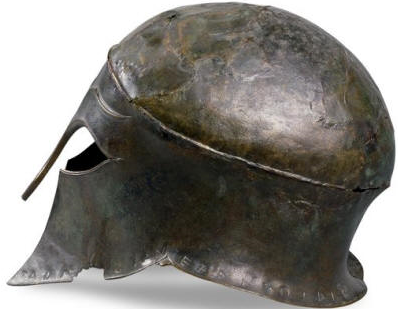
Corinthian helmet

The Helmet of Agighiol is a Geto-Dacian silver helmet dating from the 5th century BC.

Sutton Hoo helmet reconstructed

The Golden Helmet of Coţofeneşti
This 2,600-year-old bronze helmet was discovered in the waters of Haifa Bay, Israel in 2012. When it was made Greek colonies dotted the Mediterranean coast, stretching from the Black Sea to southern France.

This warrior was likely one of Egyptian pharaoh Necho II's mercenaries, which he sent through Israel accompanied by a fleet of ancient ships. The pharaoh was involved in military campaigns in the region for nearly a decade, operations in which this warrior and his group likely were involved.
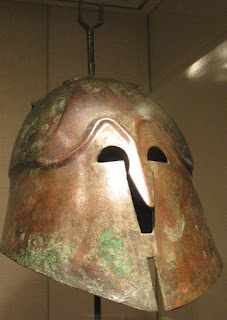
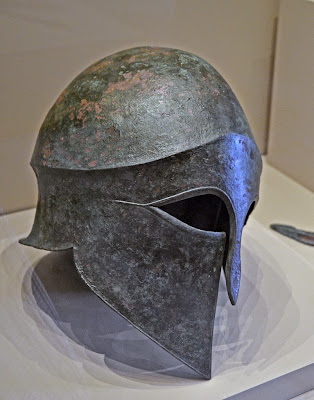
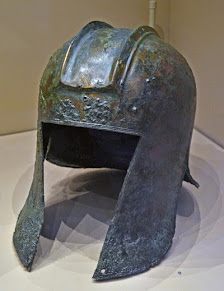
Ancient Greek helmets from the Archaic period (800 BC – 480 BCE). A Corinthian-type. The second is a Illyrian-type. The third is from Agia Paraskevi. All are made of bronze.
The Crosby Garrett Helmet is a copper alloy Roman cavalry helmet dating from the late 2nd or early 3rd century AD. 

Bronze Helmet from Ancient Greece, around 460 BC

Roman horseman's helmet.

Gladiator helmet

Greek Spartan Crest Helmet

Spanish morion (helmet)

Helmet of the Chou Dynasty, Emperor Wu Wang tomb complex at Laoyang, circa 1020 BC.

Japanese helmet, circa 1590–1640.

Helmet of a Yuan Dynasty officer

Chinese chichak-style helmet, Ming Dynasty


Helmet from 7th century Viking boat grave
A myth about Vikings was that they wore horned helmets. There is  no proof that Viking helmets had horns. The reason their helmets didn't have horns was because they would have gotten in the way in battle and would injure the wearer.

Real Viking helmets had protective metal down and around the ears and some helmets found in burial mounts had a metal mask in front.

German helmet by famous armorsmith Jörg Seusenhofer ca. 1540

Wednesday, February 19, 2025

Hellhounds

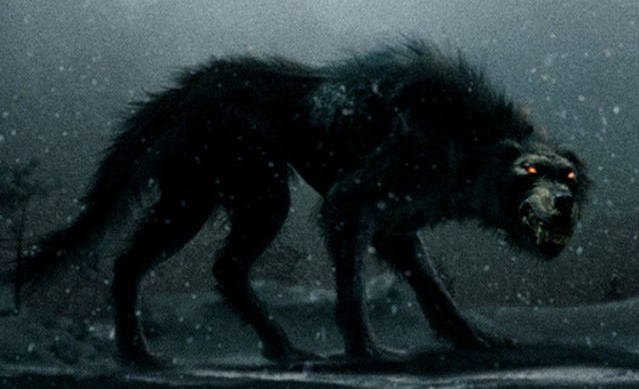
A hellhound is a supernatural dog in folklore. A wide variety of hellish dogs occur in mythologies around the world. Some European legends state that if someone stares into a hellhound's eyes twice or more, that person will surely die.

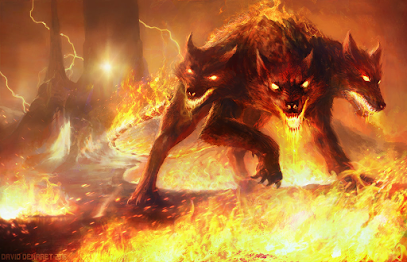
Hellhounds often have fire-based abilities and appearance. They are often assigned to guard the entrances to the world of the dead, such as graveyards and burial grounds, or undertake other duties such as hunting lost souls. In European legends, seeing a hellhound or hearing it howl is an omen or even a cause of death. They are said to be the protectors of the supernatural. Hellhounds of myth is common across Great Britain and Western Europe.
In southern Mexico and Central America folklore, the Cadejo haunts travelers who walk late at night.
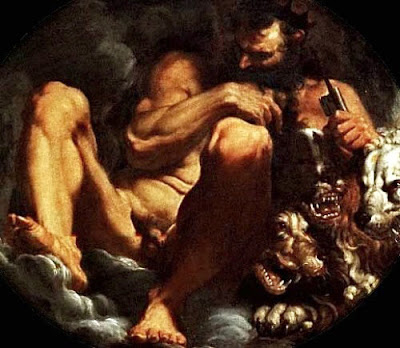
The Bearer of Death is a term often used in describing the Hellhound. Hellhounds are said to be as black as coal with a smell of burning brimstone. They leave behind a burned area wherever they go. In Greek mythology the hellhound belonged to Hades, the Greek god of death and the underworld. It's name in Greek mythology is Cerberus. It has three heads and guards the gates of hell. The three heads were meant to symbolize the past, present and future. 

Hades with Cerberus - Pluto Carricci painting
Cerberus is a well known creature in ancient mythology. Hades’ loyal guard dog, Cerberus only had an appetite for living flesh and so would only allow dead spirits to pass, while consuming any living mortal who was foolish enough to come near. Cerberus was the offspring of the monsters Echidna and Typhon, and was usually described as having a serpent for a tail, and snakes protruding from his body.
Cerberus is best known as the twelfth and final labor of Heracles. Heracles must enter the underworld, wrestle the beast using no weapons, and then bring Cerberus to the surface world, alive, to present to the Mycenaean king Eurystheus. Although Eurystheus commanded him to bring back Cerberus, it was not from any desire to see Cerberus, but only because Eurystheus thought that the task was impossible. Heracles made his descent into the underworld through an entrance at Tainaron, the most famous of the various Greek entrances to the underworld. It took its name from the mythical son of Zeus, Taenarus, who built a town named Taenarum after himself. A cave network was believed to be an entrance to Hades. This gate was guarded by Cerberus, a beast that prevented the dead from escaping and the living from entering.
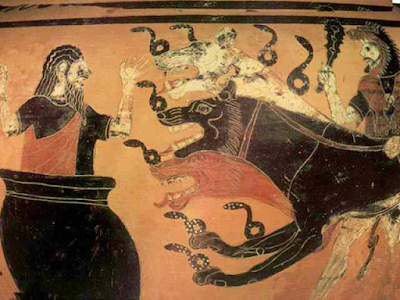
Heracles tackled the beast, throws it over his shoulder and drags him to the mortal world. Upon seeing Cerberus, Eurystheus was so terrified that he hid in a large vase and begged Heracles to return the hell hound back to Hades.
The domain of Hades in Greek mythology was not only hell, but was the whole of the afterlife. The realm was Tartarus (hell), the Asphodel Meadows (nothingness), and the Elysian Fields (paradise).

Shroud of Turin Fake

The Shroud of Turin is one of Catholicism’s most controversial and mysterious artifacts. Its believed by some to have shrouded the body of Jesus Christ, while others consider it a hoax perpetrated by medieval con men. Despite testing using radiocarbon dating, pollen testing, microscopic analysis and image enhancement, scientists have not said whether the object is legitimate or not.

For some, it comes down to a question of faith.
Researchers used a volunteer to simulate the position of the body that would be required to create the stains found on the shroud.
It is impossible for the stains to have been made by wrapping a dead body. A volunteer created a range of bloodstained materials from simulated wounds to the head, hands, feet, back and waist, mirroring those suffered by Jesus. When the volunteer was laid out on a shroud, each wound made specific marks that could be cross-referenced with the shroud.


Blood splatters on the cloth were inconsistent, suggesting the stains had been made with several different poses and likely by a standing person—not a corpse lying flat.

Peruvian Gold: Ancient Treasures

Rich natural resources in ancient Peru gave rise to the earliest Andean civilizations. Artisans crafted extraordinary objects, including gold ceremonial and funerary masks, beakers, and jewelry.

From 1250 B.C. to A.D. 1450 spectacular objects were created.
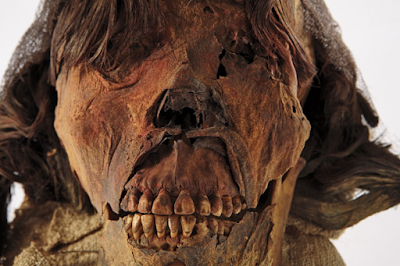
She died in her twenties some 1,700 years ago, and is believed to have ruled over a desert valley in ancient Peru where her elaborately tattooed body was buried with weapons and gold. A glimpse of the former priestess, the Lady of Cao, can be seen in a replica of her face. Using 3D imaging technology and forensics archaeology, the replica, based on the Lady of Cao's skull structure, was unveiled in 2017.

The discovery of the Lady of Cao's mummified remains in 2005 shattered the belief that the ancient Moche society, which occupied the Chicama Valley from about 100 to 700 A.D., was patriarchal. Several Moche female mummies have been found since in graves with objects denoting high political and religious standing. Archaeologists believe the Lady of Cao died due to complications of childbirth.