Monday, May 26, 2025

Nymphs of Ancient Greece

For ancient Greeks, every waterway was protected by nymphs. These were ageless young girls who existed even before the Olympic gods — and long before the arrival of mortals. Not all nymphs were immortal. Some died after living for centuries. They existed in a world between mortals and the gods. Nymphs were generally harmless, but not always. For a young man there was a risk of being bewitched and becoming their enslaved lovers. The most famous nymphs were the Pleiades, seven sisters who were immortalized by Zeus when he turned them into the Pleiades constellation. Nymphs were charged with protecting the earth, but their influence went beyond this.
A sea nymph named Thetis was the mother of Achilles. To make him invulnerable she dipped baby Achilles in the river Styx. She held him by one heel, which remained dry and unprotected. He was later killed in the Trojan War by an arrow shot by Paris that struck that spot. This is the origin of the phrase, “to have an Achilles heel.” Two of the best known nymphs were Circe and Kalypso. They helped Odysseus overcome seemingly impossible barriers to return home following the Trojan War.

Friday, May 23, 2025

The Lamassu

A lamassu is an Assyrian protective deity, often depicted as having a human's head, a body of an ox or a lion, and bird's wings. The creature was said to symbolize strength, freedom, and intelligence.It
The Lammasu or Lumasi represent the zodiacs, parent-stars or constellations. Large lamassu figures up to 5 metres high are showpieces in Assyrian sculpture, where they are the largest figures known to have been made.
In art, lamassu were depicted as hybrids, either winged bulls or lions with the head of a human male.
The motif of a winged animal with a human head is common to the Near East, first recorded in Ebla around 3000 BC. The lamassu appears frequently in Mesopotamian art. The lamassu and shedu were household protective spirits of the common Babylonian people, becoming associated later as royal protectors, and were placed as sentinels at entrances.

Thursday, May 22, 2025

Ancient Helmets

The most vulnerable part of the soldier in battle was his head, so the search for protection by some form of helmet goes back to the earliest times. Helmets were purpose-built to protect the wearer against the specific weapons he faced.

Flattened copper helmet and skull found in the Royal Tomb at Ur
At first, ancient helmets seem to have been pointed at the top, to deflect the downward force. When the ax became popular as a weapon, the shape of the helmet was modified to counter the cutting edge of a downward-falling blade.

Stele of Vultures circa 2500 BC. King Eannatum of Lagash leads a phalanx of soldiers with metal helmets, armed with spears and socketed axes. They are trampling over the bodies of their enemies.
The technology of armor was constantly evolving. By 3,000 BC metal workers were making helmets of copper. 500 years later the Sumerians had bronze helmets, spears and axes.


Egyptian soldier in the act of killing a warrior of the 'Sea Peoples' in the Medinet Habu temple relief

Corinthian helmet

The Helmet of Agighiol is a Geto-Dacian silver helmet dating from the 5th century BC.

Sutton Hoo helmet reconstructed

The Golden Helmet of Coţofeneşti
This 2,600-year-old bronze helmet was discovered in the waters of Haifa Bay, Israel in 2012. When it was made Greek colonies dotted the Mediterranean coast, stretching from the Black Sea to southern France.

This warrior was likely one of Egyptian pharaoh Necho II's mercenaries, which he sent through Israel accompanied by a fleet of ancient ships. The pharaoh was involved in military campaigns in the region for nearly a decade, operations in which this warrior and his group likely were involved.
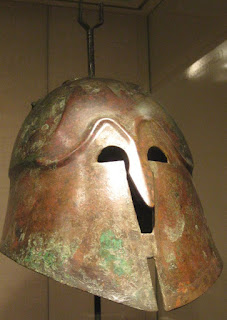
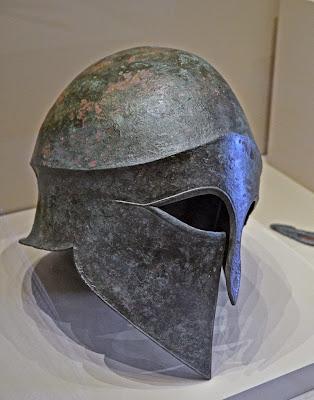
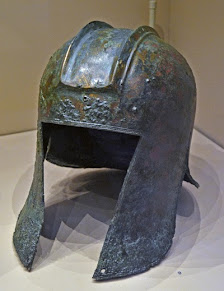
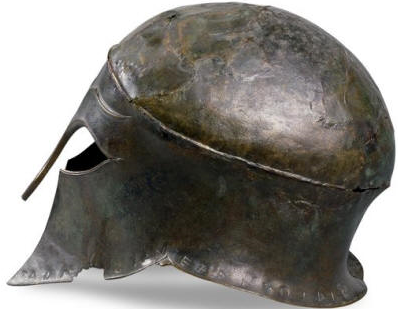
Ancient Greek helmets from the Archaic period (800 BC – 480 BCE). A Corinthian-type. The second is a Illyrian-type. The third is from Agia Paraskevi. All are made of bronze.
The Crosby Garrett Helmet is a copper alloy Roman cavalry helmet dating from the late 2nd or early 3rd century AD. 

Bronze Helmet from Ancient Greece, around 460 BC

Roman horseman's helmet.

Gladiator helmet

Greek Spartan Crest Helmet

Spanish morion (helmet)

Helmet of the Chou Dynasty, Emperor Wu Wang tomb complex at Laoyang, circa 1020 BC.

Japanese helmet, circa 1590–1640.

Helmet of a Yuan Dynasty officer

Chinese chichak-style helmet, Ming Dynasty


Helmet from 7th century Viking boat grave
A myth about Vikings was that they wore horned helmets. There is  no proof that Viking helmets had horns. The reason their helmets didn't have horns was because they would have gotten in the way in battle and would injure the wearer.

Real Viking helmets had protective metal down and around the ears and some helmets found in burial mounts had a metal mask in front.

German helmet by famous armorsmith Jörg Seusenhofer ca. 1540
A Greek bronze Corinthian Helmet. Archaic Period. Circa 7th Century B.C. $106,250
A Greek Chalcidian Type. $ 40k.
A Greek Illyrian helmet. circa 550-500 B.C. $27,500
A Greek bronze helmet. Corinthian type. Circa 2nd half of 6th century B.C. USD 205k.

Greek hoplite helmet. Macedonian 3rd century BC.
The Chalcidian helmet was an improvement on the earlier Corinthian and Illyrian types. Its lighter design allowed for greater mobility, while its curves around the ears maximized the soldier’s ability to hear. This helmet dates to around 450 and 400 BC.

An extremely rare Roman bronze cavalry parade helmet. The Crosby Garrett Helmet. Circa late 1st-2nd century. GBP 2,281,250 in 2010.

Monday, May 19, 2025

Ancient Glass

Glass is common today. In ancient times it was reserved for kings and the elite, valued only slightly lower than silver and gold and about the same as precious gemstones.
Archaeologists have found glass beads dating to as early as the third millenium BCE. Glazes and technology date earlier still. In the Late Bronze Age, 1600 to 1200 BCE, the use of glass took off. Glass of those times was opaque and saturated with color. The source of the silica was crushed quartz pebbles, not sand. Ancient glass makers used ash of desert plants, which contain high levels of salts such as sodium carbonate or bicarbonates. The plants also contain lime, calcium oxide, that made the glass more stable. They also added materials to color glass, such as cobalt for dark blue, or lead antimonate for yellow.
Egypt is favored as the birth place of glass making. But by the 1980s, thinking changed to the Near East after loads of glass was found at Nuzi, a Late Bronze Age provincial town in modern-day Iraq, thought to date from the 1500s BCE.

The raw glass blocks were Egyptian, based on the concentration of trace metals.
Glass was a cornerstone of international trade. In the early 1980s, divers found a sunken vessel from the 1300s BCE off the coast of Turkey. The Uluburun shipwreck contained a load of colored glass — 175 unfinished blocks, called ingots, for glassworking. Most of the ingots were cobalt-colored deep blue, but purple and turquoise ingots were also found.