Saturday, June 21, 2025

The Battle of Marathon

The Battle of Marathon took place in 490 BC, during the first Persian invasion of Greece. It was fought between the citizens of Athens, aided by Plataea, and a Persian force commanded by Datis and Artaphernes. The battle was the first attempt by Persia, under King Darius I, to subjugate Greece. The Greek army decisively defeated the more numerous Persians, marking a turning point in the Greco-Persian Wars. The Greeks marched to Marathon and blocked the two exits from the plain of Marathon. With marshes and mountains, the Persian cavalry couldn't join the Persian infantry.
Miltiades ordered an attack. He reinforced his flanks, luring the Persians' best fighters into his center. The inward wheeling flanks enveloped the Persians, routing them.
The Persian army broke in panic towards their ships, and huge numbers were slaughtered. The defeat at Marathon marked the end of the first Persian invasion of Greece.
The next two hundred years saw the rise of the Classical Greek civilization.
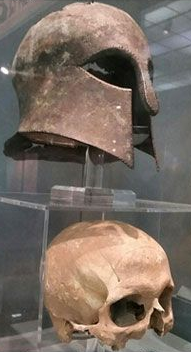
Corinthian Helmet and Skull from the Battle of Marathon 490 BCE – Royal Ontario Museum, Canada. A pivotal moment in Ancient Greek history, the battle of Marathon saw a smaller Greek force, mainly made up of Athenian troops, defeat an invading Persian army. A fierce and bloody battle, with numerous casualties, it appears that this helmet (with skull inside) belonged to a Greek hoplite (soldier) who died during the fighting.

The story of the man who ran back to Athens with the news of the victory became synonymous with the long distance running event in the Olympics.

Friday, June 20, 2025

Rare Roman horse race mosaic

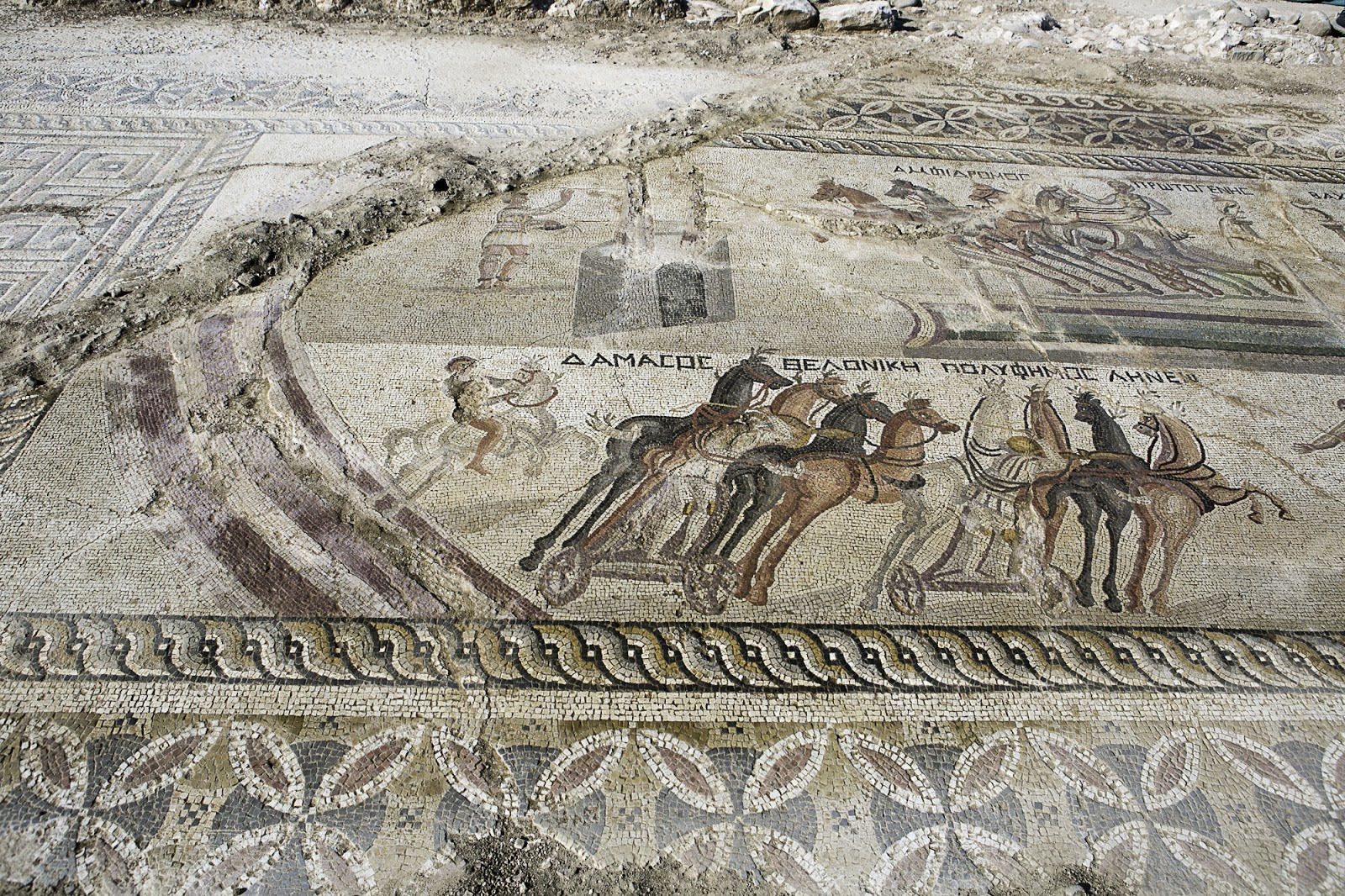
Scenes from a chariot race are depicted in a rare Roman mosaic found in rural Cyprus in 2017. Dating from the 4th Century AD, it is in Akaki, a village not far from Nicosia. Only nine similar mosaics - showing a hippodrome chariot race - have been found at ancient Roman sites.

The ornate 26-metre-long (85ft) mosaic was probably part of a wealthy man's villa.

Thursday, June 19, 2025

Jewels in ancient Egypt

Jewelry making in ancient Egypt dates to the Predynastic Period along the Nile River Delta in 3100 BC.

Pectoral is inlaid with colored glass and semi-precious stones. The motif of the scarab pushing solar disc is elaborated to form "Nebkheprure".
The earlier Badarian culture inhabited Upper Egypt between 4500 BC and 3200 BC. From 2950 BC to the end of Pharaonic Egypt in 395 AD, there were a total of thirty-one dynasties, spanning 3,345 years.
Pectoral of King Senusret II from the tomb of Sit-Hathor Yunet, daughter of Senusret II.

A rebus pectoral scarab worn by King Tut-ankh-amun from Thebes. It symbolizes the birth of the moon and the sun and was part of the king's coronation regalia.

Queen Amanishaketo's bracelet

19th Dynasty inlaid diadem, or wig.
Winged Isis pectoral 538–519 B.C. gold. The ancient Egyptians placed great importance on the religious significance of certain sacred objects, which was heavily reflected in their jewelry motifs. Gem carvings known as "glyptic art" typically took the form of anthropomorphic religious symbols.

The collar of Khnumet
The Egyptian lapidary would use emery fragments or flint to carve softer stones, while bow-driven rotary tools were used on harder gems. Jewelry coloration was extremely important to the ancient Egyptians, and each color had a different symbolic meaning.

According to the "Book of the Dead" a deceased person would wear a red-colored necklace which was meant to satisfy the God Isis' need for blood.
Jewelry that featured the color green was meant to symbolize fertility and the success of new crops.

Bracelet with image of Hathor 100 B.C. Gold, enamel.
One insignificant king's treasure remained intact for thousands of years. That king was the now famous Pharaoh Tutankhamun, son of either Amenhotep III or Akhenaten.

His short reign as Pharaoh began at age 9. Although he ruled for only 9 years (1336—1327 BC), he was able to amass a modest legacy of wealth and treasure that lives on today.

Pectoral belonging to Tutankhamun


Monday, June 16, 2025

Monsters on ancient coins

Medusa often appears on ancient coins. One of three sisters known as Gorgons, they appeared with wings, snakes for hair, and expressions that bore sharp fangs and a tongue. Mortals were in grave danger by merely looking at them because they turned to stone. The image of Medusa also had protective qualities and was a popular motif.
CRETE, Knossos. Stater (11.93g). about 425 – 360 BCE. Product of a union between Queen Pasiphaë and a white bull, the Minotaur was a ferocious man-eating beast, imprisoned in the Labyrinth of Daedalus. Theseus slew the Minotaur. This is a rare coin with less than 20 known.
Crete, Phaistos AR Stater. Mid-Late 4th century BCE. Herakles (his Latin name is Hercules) was the champion monster-slayer. In a fit of madness, Herakles killed his family; to atone for this crime he undertook a series of heroic quests. The Lernaean Hydra was one. Sever one of the Hydra’s heads and two grew back, making the monster hard to kill. Herakles slew the Hydra, helped by his companion Iolaus, who cauterized the neck with a torch as each head was cut off.
SIKYONIA, Sikyon. Circa 335-330 BCE. Bellerophon, riding Pegasus, killed the fire-breathing Chimaera (or Chimaira) with a block of lead impaled on a spear he lodged in the beast’s throat. The fire melted the lead, choking the beast. The Greek city of Sicyon, near Corinth adopted the chimaera as a symbol on coins, which are relatively common, from c. 430 down to about 280 BCE
Cerberus (or Kerberos) is a ferocious three-headed dog who guards the gateway to the land of the dead. He is often depicted as the companion of Hades (or Pluto,) god of the underworld. As his 12th Labor, Herakles wrestles Cerberus into submission and drags him back to the land of the living. Cerberus appears on a magnificent electrum stater of Cyzicus (c. 500-450 BCE).

Sunday, June 15, 2025

U.K. detectorist unearths rare gold Crispus thrymsa

A metal detectorist landed the coin, dating from 650-700AD, in a field in South Cambridgeshire. It measures half an inch in diameter and weighs 1.3grams. It is one of just eight known examples of the 'Crispus' thrymsa. The design of the coin is based on an obsolete Roman coin of the emperor Crispus from the 4th century AD. Crispus (born c. 305—died 326, Pola, Venetia) was the eldest son of Constantine the Great. He was executed under mysterious circumstances on his father’s orders.
The most famous discovery of thrymsas was at the Sutton Hoo ship burial in 1939.

Graded Extremely Fine and centrally struck with all the inscriptions visible, the Crispus thrymsa realized £18,600 ($24,483 U.S.) against an estimate of £8,000 to £10,000.
See ----->The Sutton Hoo Treasure

Yehud coins discovered in Jerusalem

Five coins dating to the time of Ezra were found in Jerusalem in 2018. They are Yehud coins, the first to be minted by Jewish authorities. The discovery dates to the 4th century B.C. A sifting project began in 2004 to remove artifacts from 9,000 tons of earth removed from the Temple Mount in the area known as Solomon’s stables. The dirt was dumped in the nearby Kidron Valley. Using wet sifting, the project recovered more than 6,000 ancient coins.
Yehud coins are the first Jewish coins. They are minuscule, fractional silver pieces minted in and around Jerusalem from roughly the 4th to 3rd centuries BCE.
The coins are inscribed with the letters YHD, which reference the name for the Persian province of Yehud. The Persians ruled the kingdom during the time the coins were minted. These coins would have been made around the time when the Jews were allowed by Persian king Cyrus to return to Jerusalem in 538 B.C. to build the temple.
Standard of Cyrus the Great
Genuine silver Yehud coins sell for between $700 and $2,500 USD with condition and rarity determining price.

Friday, June 13, 2025

Mycenaean Greece: The world of Agamemnon

Agamemnon's world, primarily depicted in Greek mythology, centered around the Bronze Age city of Mycenae (or Argos) and the Trojan War. He was a king, a warrior, and a commander, leading the Greek forces in the epic conflict.
The Schloss Karlsruhe Museum hosted the exhibition "Mycenaean Greece: The legendary world of Agamemnon" in 2018. Over 400 exhibits were loaned from Greece, many of which are shown for the first time outside of the country.Mycenae Lion Gate
Paris, the son of king of Troy, Priam, kidnapped Helen, incurring the wrath of the king of Mycenae, Agamemnon. The events depicted in Homer's Illiad led to the Trojan War, which took place from circa 1260 to 1180 BC.
Button from the 16th century BCGold cup was found by Heinrich Schliemann in one of the shaft graves of Mycenae.“Eyes of Agamemnon” mask.

Mycenaean Earring