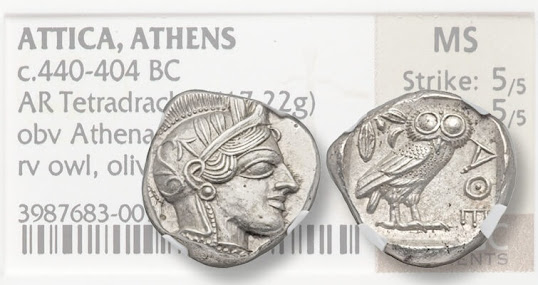
![]() | Following the city’s defeat of the Persians at the Battle of Marathon in 490 B.C., Athens entered a period where it was the principal city of the Greek world. Athens controlled the nearby Laurium silver mines and was able to produce high-quality silver coinage in vast quantities. |
Monday, July 7, 2025
The Athenian Owl Tetradrachm
The Athenian Owl tetradrachm was minted for over 400 years, beginning around 512 B.C.
The Athenian Owl gained widespread use due to it's high silver content and high production. The Athenian government minted coins at a profit, building state coffers. The Athenian Owl tetradrachm would remain the dominant currency in the ancient world until Roman coinage replaced it in the 1st century B.C.
Sunday, July 6, 2025
Crippled Pompeii man suffocated
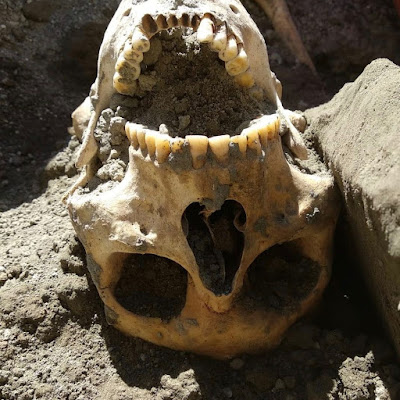
![]() | With his skull in hand, experts believe that the man died from being suffocated by the volcanic ash that rained down on Pompeii, rather than being squashed by the rock. | ![]() The skeleton was found in an area of new excavations in 2019, close to a newly-discovered alleyway of houses with balconies. |
![]() | Excavations of the ancient Roman city of Pompeii have revealed the skeleton of a man who may have been decapitated by a large stone block as he fled from the catastrophic 79 C.E. eruption of Mount Vesuvius. Possibly hampered by a bone infection, he fled through an alleyway after surviving the first ejections that rained down on the city. He was thought to met his demise when struck by a stone. His body was found at roughly the same height as the second floor of a nearby building, suggesting he ventured outside after the first phase of raining ash had settled. Lesions at the tibia suggest he was suffering from a chronic bone infection. This could have hindered his movements and stopped him leaving Pompeii when the volcano first erupted. |
Saturday, July 5, 2025
The aureus
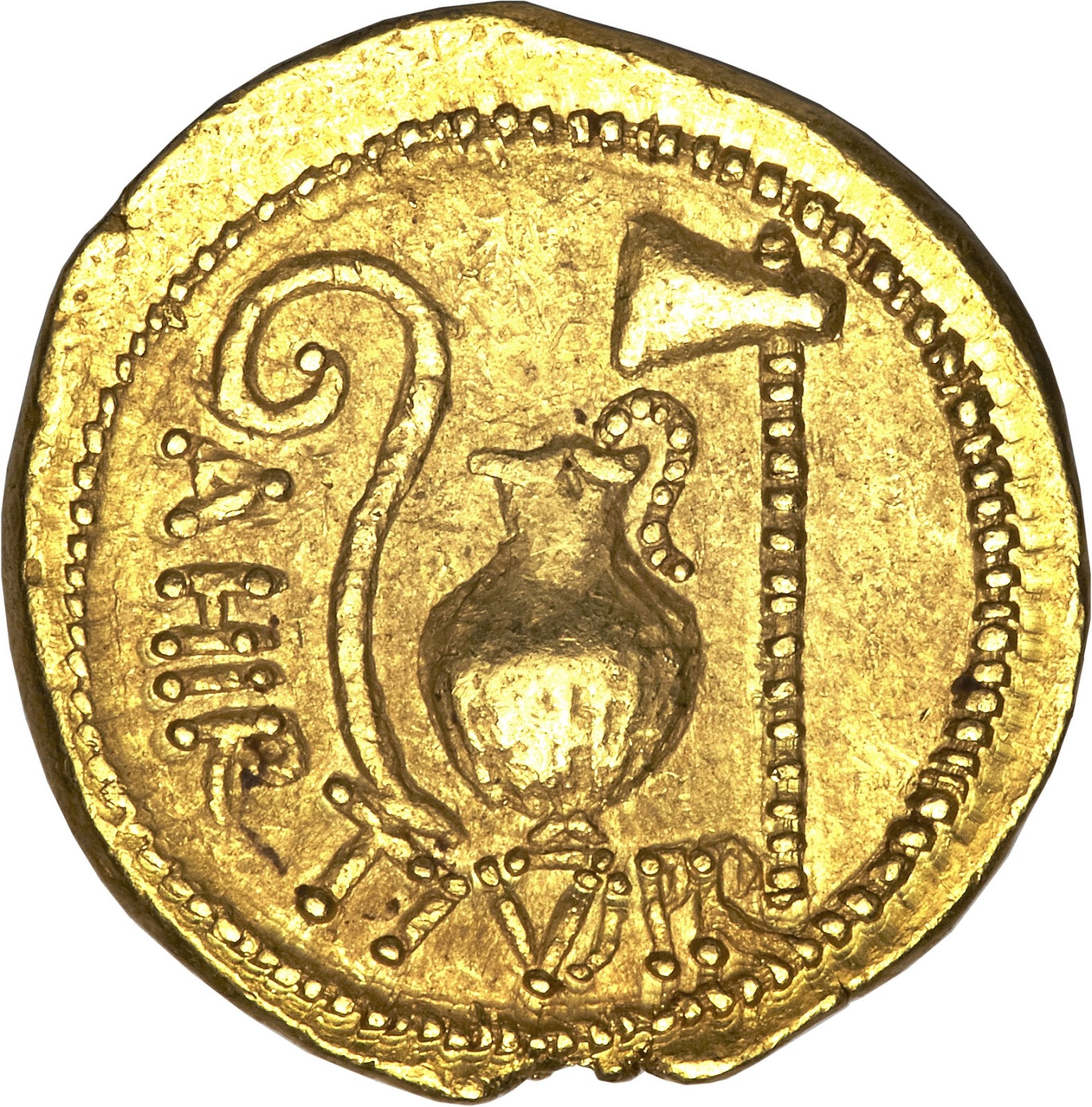
![]() This unique gold aureus of Augustus Caesar realized $781,675 U.S. | Augustus (29 BC – 14 AD) decreed the value of the sestertius as 1/100th of an aureus. The aureus was decreased to 1/45th of a pound (7.3 g) during the reign of Nero (54–68). | ![]() |
![]() | This aureus celebrates Trajan’s war against the Parthians between 114 and 117 CE. The Romans temporarily conquered important cities such as Ctesiphon and Seleucia, but these were subsequently retaken after his death. After the reign of Marcus Aurelius (161–180) the weight of the aureus fell to 1/50th of a pound (6.5 g). |
![]() | The solidus was introduced by Diocletian (284–305) around 301 AD, struck at 60 to the Roman pound (5.5 g) and with an initial value equal to 1,000 denarii. The solidus was reintroduced by Constantine I (306–337) in 312 AD, permanently replacing the aureus as the gold coin of the Roman Empire. The solidus was struck at a rate of 72 to a Roman pound of pure gold, 4.5 grams of gold. Inflation was affected by the debasement of the silver denarius, which by the mid-3rd century had practically no silver left in it. |
Spinosaurus, largest of all the carnivorous dinosaurs
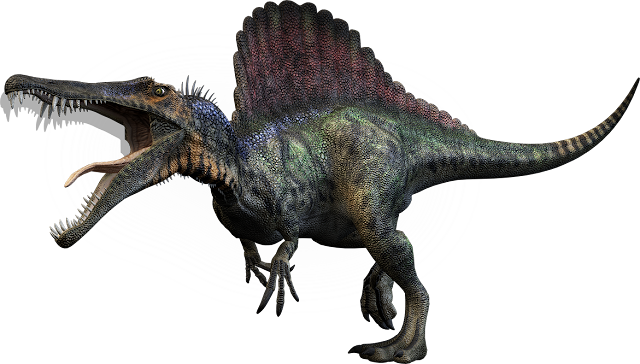
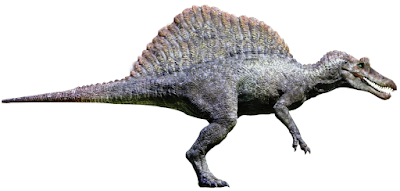
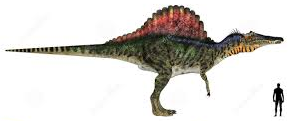
The largest dinosaur predator that ever stalked Earth was also the strangest. Spinosaurus aegyptiacus was the largest carnivore dinosaur of all time. It measured 18 meters (50 feet) long, 4.9 to 7.7 meters (16 to 25 feet) tall and 12 tons. Spinosaurus lived in Cretaceous North Africa from 102 to 93 mya ![]() | |
| It was roughly 2.5 metres longer than T-rex and equally massive. | ![]() The distinctive spines of Spinosaurus, which were long extensions of the vertebrae, grew to at least 1.65 meters (5.4 ft) long and likely had skin connecting them. |
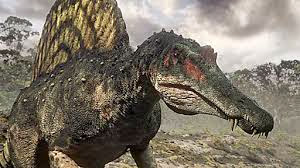
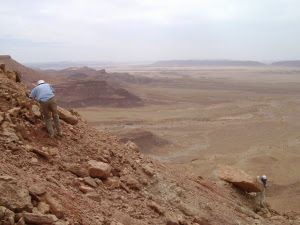
![]() ![]() | Spinosaurus is the only known carnivorous dinosaur adapted for a semi-aquatic lifestyle. Spinosaurus roamed the swamps of what is now North Africa. Spinosaurus terrorized a vast North African river system from Morocco to Egypt. Spinosaurus's environment was "the most dangerous place in the history of our planet." | ![]() |
![]() | Spinosaurus was the undisputed king of waterways teeming with sharks and 11-metre crocodilians. Flying reptiles with wingspans of seven meters soared overhead. It may not have been very agile on land but would have taken down anything unfortunate enough to be in it's path. |
Friday, July 4, 2025
Gold of Tutankhamun
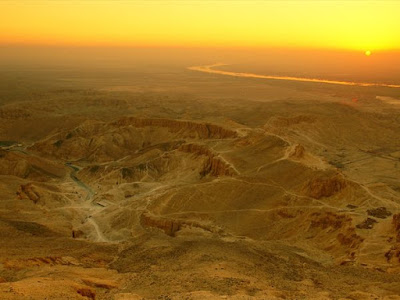
![]() | In 1922, the tomb of Tutankhamun was discovered by British archaeologist Howard Carter. It was in the fall of 1917 when Carter and his sponsor, Lord Carnarvon, began excavating in earnest in the Valley of the Kings. | ![]() |
![]() ![]() | Carter stated there were items bearing the name Tutankhamun - a faience cup, a piece of gold foil, and a cache of funerary items, that convinced him that the tomb had not yet been found. Carter was determined to search down to the bedrock. By late 1922, Carter began his fifth and final season in the Valley of the Kings by having his workers expose the workmen's huts at the base of the tomb of Rameses VI. After exposing the huts, Carter and his workmen began to excavate the ground beneath them. By the fourth day of work, they had found something - a step that had been cut into the rock.![]() | ![]() ![]() |
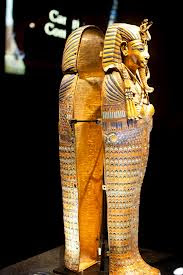
![]() ![]() | Work feverishly continued and 12 stairs leading downwards were revealed; and in front of them, stood the upper portion of a blocked entrance. Carter had discovered an ancient royal Egyptian tomb, one that had lain nearly undisturbed for over 3,300 years. When the boy king was found he rested inside three golden coffins. The first two were carved in wood. The coffin was first overlaid with sheet gold on a thin layer of plaster. Narrow strips of gold, placed on edge, were then soldered to the base to form cells in which small pieces of colored glass, fixed with cement, were laid.The third coffin is 296 pounds (135Kg) of gold.![]() | ![]() ![]() |
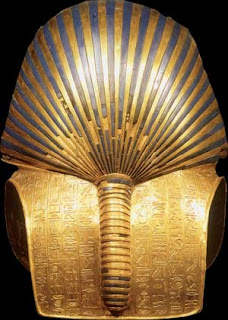
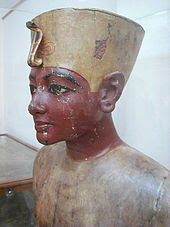
| The death mask is solid gold, beaten and burnished, and was placed over the head and shoulders of Tutankhamun's mummy, outside the linen bandages in which the whole body was wrapped. It weighs about 24 pounds. (10.9kg) The stripes of the headdress are made of blue glass. The vulture's head upon the brow, symbolizing sovereignty over Upper Egypt, is also solid gold, apart from the beak, which is made of horn-colored glass, and the inlay of the eyes, which is missing. By its side is the cobra, symbolizing sovereignty over Lower Egypt, its body made of solid gold, its head of dark blue faience, its eyes of gold cloisonne inlaid with translucent quartz backed with a red pigment, and its hood inlaid with carnelian, lapis lazuli, turquoise-colored glass, and quartz. | ![]() ![]() Wooden bust of the boy king. |
![]() | ![]() |
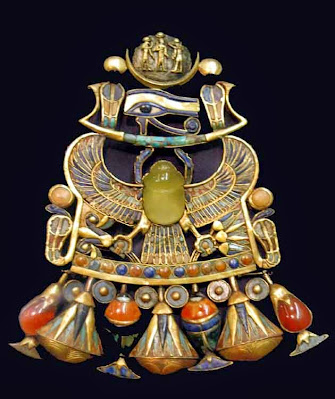
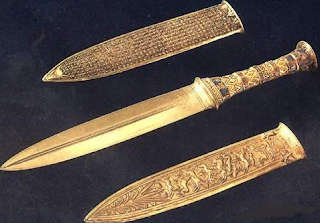
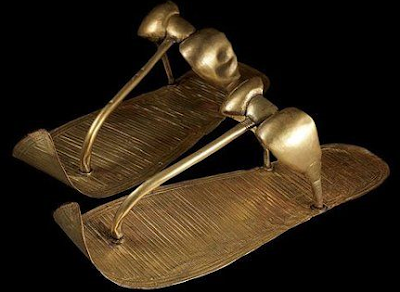
![]() A rebus pectoral scarab worn by King Tut-ankh-amun from Thebes. It symbolizes the birth of the moon and the sun and was part of the king's coronation regalia. | ![]() ![]() Gold Dagger and Sheath | ![]() ![]() King Tut's golden sandals |
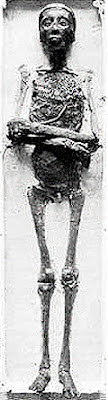
![]() | In 2014 new evidence suggested pharaoh King Tutankhamen was killed by a chariot that smashed his rib cage, shattered his pelvis, and crushed his internal organs, including his heart. After being sealed in his tomb in 1323 B.C. His mummified body caught fire and burned from flammable chemicals that built up in his decomposing body. | ![]() |
Subscribe to:
Posts (Atom)