Sunday, August 10, 2025

Fast food counter in Pompeii - termopolium

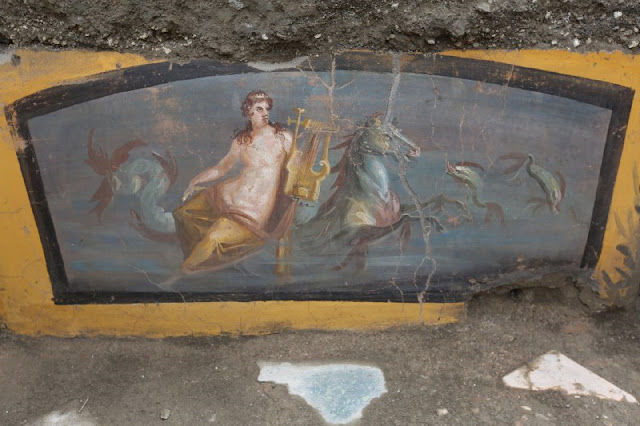
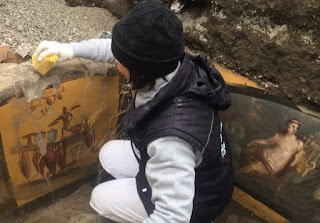
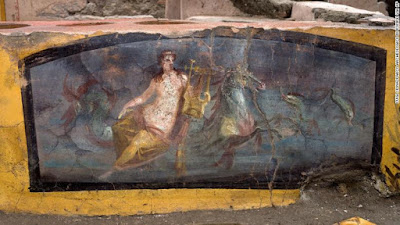
In 2019 archaeologists discovered a well-preserved “fast food” counter at Pompeii. The frescoed counter was found in one of 150 thermopolia, Roman cook-shops, which were discovered in the Regio V area of the city.
In ancient Rome, fast food parlors served those who could not afford to install kitchens at their homes. Menus typically included coarse bread with salty fish, baked cheese, lentils, and mulled spiced wine.
The termopolium was fully excavated and unveiled in late 2020 in the Regio V site, which is not open the public. The hot food and drinks shop served ancient fast food.
The front of the counter was decorated with bright frescoes, some depicting animals on the menu.
Archaeologists found a decorated bronze drinking bowl known as a patera, ceramic jars used for cooking stews and soups, wine flasks and amphora. Traces of food were found in some of the deep terra cotta jars. It is the first time such a stand has been entirely uncovered.

Friday, August 8, 2025

Prometheus: The Creator of Man

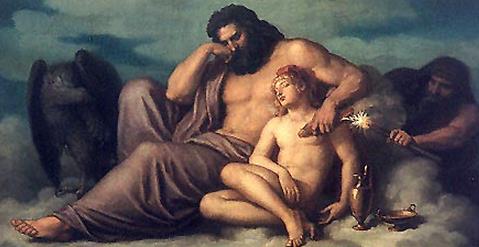
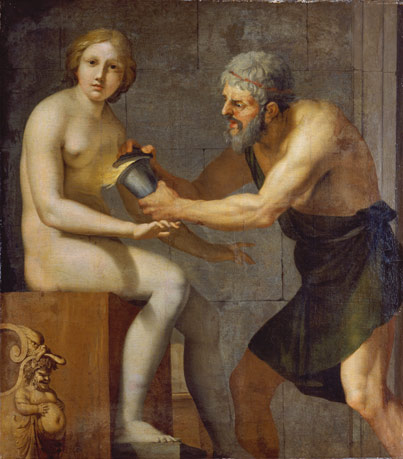
In Greek mythology, Prometheus is a Titan, hero, and trickster figure who is credited with the creation of man from clay, and who defies the gods by stealing fire and giving it to humanity, an act that enabled civilization.
Prometheus is known for his intelligence and as a champion. The punishment of Prometheus as a consequence of the theft is eternal torment. The immortal Prometheus was bound to a rock, where each day an eagle, the emblem of Zeus, was sent to feed on his liver, which would then grow back overnight to be eaten again the next day. Prometheus is freed at last by the hero Heracles (Hercules).

Thursday, August 7, 2025

Harpy

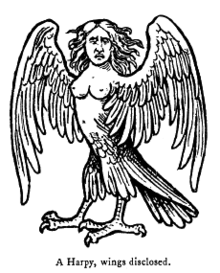
In Greek and Roman mythology, a harpy was a half-human and half-bird personification of storm winds. Their name means "snatchers" or "swift robbers".
They were generally depicted as birds with the heads of maidens, faces pale with hunger and long claws on their hands. Roman and Byzantine writers detailed their ugliness. Pottery art depicting the harpies featured beautiful women with wings. They are described as human-vultures.
The most celebrated story in which the Harpies play a part is that of King Phineus of Thrace, who was given the gift of prophecy by Zeus.
Angry that Phineus gave away his secret plan, Zeus punished him by blinding him and putting him on an island with a buffet of food which he could never eat because the harpies always stole the food out of his hands. Harpies remained vivid into the Middle Ages. In Dante's Inferno, the tortured woodland was infested with harpies, where the suicides have their punishment in the seventh ring of Hell.

Monday, August 4, 2025

Golden Kingdoms: Luxury and Legacy in the Ancient Americas

"Golden Kingdoms: Luxury and Legacy in the Ancient Americas" was an exhibit at the Metropolitan Museum of Art in 2018. It brought together hundreds of luxury craft goods of the Incas, Aztecs and their predecessors. The exhibition included more than 300 objects from 52 institutions across the world.

The exhibit traced the development of goldworking from Peru in the south to Mexico in the north from around 1000 B.C. to the arrival of Europeans in the early 16th century.

Highlights included exquisite gold ornaments of the Lord of Sipán, the richest unlooted tomb in the ancient Americas.

Sunday, August 3, 2025

Archaeopteryx

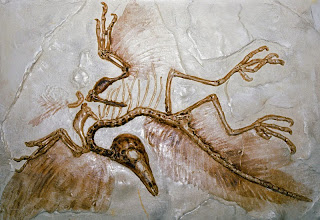
Archaeopteryx ("ancient wing") is a very early prehistoric bird, dating from about 150 million years ago during the Jurassic period.
The first, and one of the most complete fossils of archaeopteryx is known as the London specimen. It was discovered in 1861, just two years after Darwin published On the Origin of Species, and made a stir being a transitional form.
Only 12 of the curious creatures have been found. Now they are going under the glare of a giant X-ray machine - to find out what lies buried beneath the surface. Using a new "camera obscura" technique - inspired by Leonardo da Vinci - scientists have captured some of the clearest ever images of Archaeopteryx. For the first time, they can see the complete skeleton in 3D. Not just the surface outlines, but all the hidden bones and feathers too. The question is could Archaeopteryx fly or not?
The answer grows closer as new, microscopic details of its anatomy emerge from ever more precise scans.
Blood vessels within the bones, for example, can be compared to modern birds.

Saturday, August 2, 2025

The Second Punic War

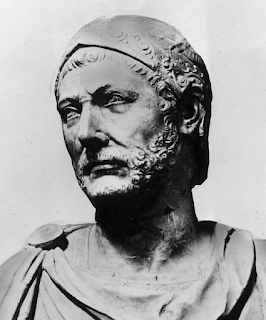
The Second Punic War formally began when the Carthaginian general Hannibal and his army crossed the Alps in November of 218 BCE and descended into Northern Italy.
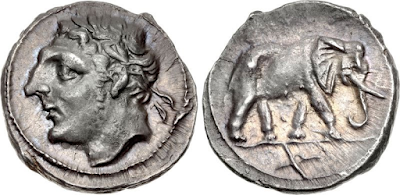
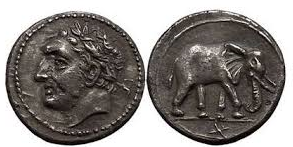
Battles raged on Italian soil for nearly 15 years until Hannibal and what remained of his army sailed for North Africa in the summer or fall of 203 BCE. Carthaginian coinages for this war were issued in electrum, silver, debased silver (billon) and copper. They were struck in a wide variety of locations.
The first Punic War was so financially demanding that the Romans struck gold coins for the first time in their history.
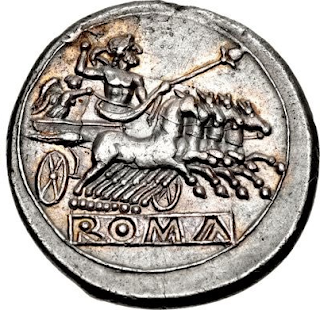
Roman coinage underwent great change during the Second Punic War. In addition to issuing gold coins for the first time, the Romans greatly increased output of silver and bronze coins.
In 212 or 211 BCE, the ‘quadrigatus’ was replaced with a new, lighter coin called the denarius. This coin would stand the test of time as the main Roman silver coin of the next 450 years. Hannibal’s army sailed from Italy late in 203 BCE. In a series of engagements, culminating in the Battle of Zama in 202, the Roman general Scipio Africanus defeated Hannibal. Peace terms were negotiated in 201, after which the war officially came to a close.

Friday, August 1, 2025

Evolution of Lipstick

While there's no evidence, historians say it’s likely that lipstick evolved from prehistoric times when humans started to smear plant juices on their faces for religious ceremonies.
As early as 2500 BC, and certainly by 1000 BC, Sumerian men and women in southern Mesopotamia invented and wore lipstick. They are thought to have crushed gemstones and used them to decorate their faces, mainly on the lips and around the eyes. Egyptians also adopted this fashion craze. According to records, they mixed a red dye extracted from seaweed with iodine and bromine mannite, which can be highly toxic. Over time a safer lipstick made from crushed carmine beetles and ants was used.
In ancient Greece only prostitutes were allowed to flaunt scarlet lip paint. This led to the first known law related to lipstick, which dictated that prostitutes could be punished for improperly posing as ladies if they appeared in public without their designated lip paint.
In ancient Rome both genders used lipstick to distinguish social class and rank. Around 1000 AD famed physician and chemist Abu al-Qasim al-Zahrawi perfected a formula for solid lipsticks. These perfumed sticks became the basis for today’s cosmetics.
For the next 1,000 years lipstick was both revered and despised. During the Middle Ages religious groups condemned makeup for “challenging God and his workmanship.”

In the 1500s, English pastors denounced lip painting as “the devil’s work,” but that didn’t stop Queen Elizabeth I from using a mix of cochineal, gum Arabic, egg white and fig milk to produce crimson lips that became the rage. In 1770, Britain passed a law that condemned lipstick on the grounds that “women found guilty of seducing men into matrimony by cosmetic means could be tried for witchcraft.”
It wasn’t until the late 1800s that lipstick started coming out of the closet. Famed actress Sarah Berhardt shocked the world by daring to apply lipstick in public. By 1912, suffragettes marched down the streets of New York proudly wearing their bright red lipstick. Red lipstick became the 'it' symbol of female rebellion.

According to various studies and surveys, the average woman today will use 9 pounds of lipstick in her lifetime and nearly half say they own more than 20 at any given time. Lipstick has truly arrived.

Tuesday, July 29, 2025

Ancient Greek murder victim unusual

About 2,000 years ago, a heavily muscled man was murdered on a Greek island. The killer drove a spear into the man's chest with such force that it left a nearly perfect circle in his sternum.
Such an injury is rare according to researchers. Archaeologists found the man's remains in 2002 while excavating a section of an ancient necropolis in Thasos, the northernmost Aegean island.
The murder weapon was likely an ancient spear — known as a styrax. The pointed end of a thrusting spear wasn't thrown at the victim from a distance. Instead, it was likely thrust inward at close range and with precision, possibly for an execution.
An injury like that would have caused cardiac shock and arrest, likely killing the man within a minute. A dental analysis showed that just before the man's death, his diet worsened, suggesting that he was a prisoner or captive in his last days.