Friday, September 19, 2025

Spectacular Ancient Bronze

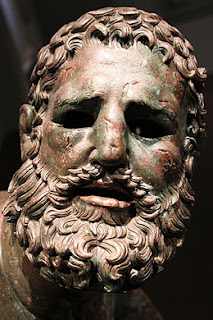
Dated to 330 BC, the Boxer at Rest is a sculpture of a sitting nude boxer at rest, still wearing his caestus, a type of leather hand-wrap, in the National Museum of Rome.
The Boxer was discovered in 1885, possibly from the remains of the Baths of Constantine.
“Portrait of Seuthes III” (310-300 B.C.), Greek. Bronze, copper, calcite, alabaster, and glass. Seuthes III was a ruler of the Odrysian kingdom of Thrace from 331 BC to ca. 300 BC. This bronze was found in his tomb.

“The Medici Riccardi Horse” About 350 B.C. Italian Bronze and gold.
The bronze "Chimera of Arezzo" is one of the best known examples of the art of the Etruscans. It was found in Arezzo, an ancient Etruscan and Roman city in Tuscany, in 1553. Inscribed on its right foreleg is an inscription, TINSCVIL, showing that the bronze was a votive object dedicated to the supreme Etruscan god of day, Tin or Tinia. The statue is thought to have been made around 400 BC.
The over-lifesize "Dancing Satyr" of Mazara del Vallo is a Greek bronze statue recovered from the sea floor at a depth of 500m (1600 ft.) off the southwestern coast of Sicily in 1998.

The satyr is depicted in mid-leap, head thrown back ecstatically and back arched, his hair swinging with the movement of his head. The figure is highly refined; the whites of his eyes are inlays of white alabaster.
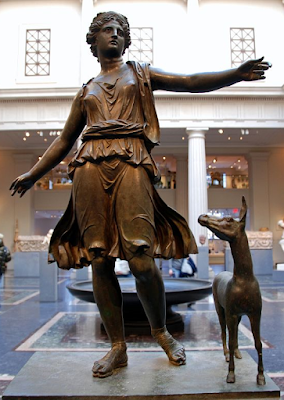
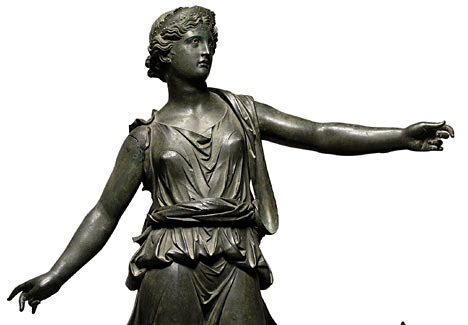
Artemis and the Stag is an early Roman Imperial or Hellenistic bronze sculpture of the ancient Greek goddess Artemis. In June 2007 the statue fetched $28.6 million at auction, the highest sale price of any sculpture at the time. The statue depicts Artemis, the Greek goddess of hunting and wild animals. She stands in a pose that suggests she has just released an arrow from her bow. At some point in its history, the bow was separated from the sculpture and was lost.
Alexander the Great on Horseback, 100-1 B.C., bronze and silver.

Victorious Athlete, "The Getty Bronze" 300-100 B.C.

Statue of Athene (“The Peiraeus Athena”). Bronze. 340—330 BCE
The Artemesium Zeus
The horses of St Mark's Basilica. 2nd or 3rd century AD.
The Riace Bronzes (The Riace Warriors) Around 460 BC.

British woman accused of stealing ancient tiles from Pompeii

In 2019 Caprice Arnold, then 21 from Tunbridge Wells, Kent thought it would be great idea to loot tiles from Pompeii. She climbed over a barrier and used a sharp object to cut 20 tiles from a floor.
A caretaker of the grounds spotted her. The guard stopped her and asked for her details to make a report, but she walked away, leaving the mosaic pieces on the ground. "The woman showed no remorse" said a statement. Back in the UK, she claims she only bent down to 'inspect loose tiles.' She cannot explain how 3 tiles ended up in her bag. "It ruined the trip from then on and I was not able to enjoy it" she said.
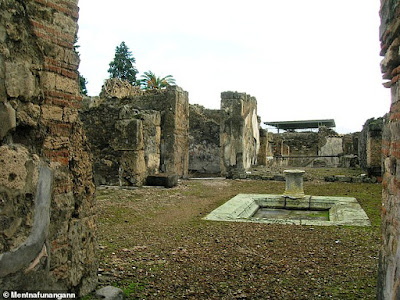
Authorities spotted Arnold scaling the security rail at the House of the Anchor, one of the most famous homes at the ancient historical site. The house is known for the mosaic tile anchor design at the front of the residence.
The damage is thought to be around $5k. It is far from the first time Italian police has taken action on tourists vandalizing and looting the historic city.
Caprice Arnold never took responsibilty or apologized for her looting.

Tuesday, September 16, 2025

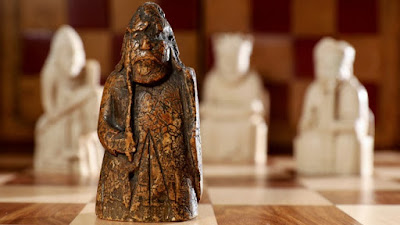
Lewis Chessmen 'Rook' brings £735,000

The rook is a warder holding a sword and was bought by an antiques dealer in 1964 for £5 in Edinburgh. It was catalogued in his purchase ledger that he had bought an ‘Antique Walrus Tusk Warrior Chessman.’
The piece, carved out of walrus ivory, was then inherited by the dealer's daughter when he died. For many years it resided in a drawer in her home where it had been wrapped in a small bag.

The piece was sold by Sotheby's in 2019 for £735,000. The Lewis Chessmen are four sets of chess pieces which were found on the Isle of Lewis, off the coast of Scotland, in 1831. The British Museum holds 82 pieces, the National Museum of Scotland holds 11 and until this sale, 5 pieces were missing.

It was described by the auction house as the "most famous chess pieces to have survived from the medieval world".
One knight and three warders are still missing.

Friday, September 12, 2025

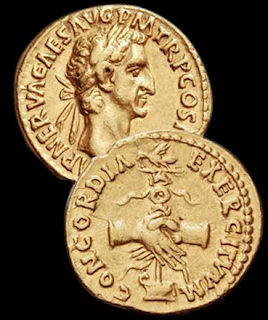
Roman Emperor Nerva

Nerva, started the period known as the "Five Good Emperors". He brought stability to the empire precisely when it was needed.
Nerva was Roman emperor from 96 to 98. Nerva became emperor at age 66 after a lifetime of imperial service under Nero. On 18 September 96, Domitian was assassinated in a palace conspiracy involving the Praetorian Guard. On the same day, Nerva was declared emperor by the Roman Senate.

A gold aureus of Nerva reflects the delicate balance of power in ancient Rome at the time. The circa A.D. 97 gold coin features a portrait of Nerva on the obverse, with clasped hands holding a legionary eagle set upon a prow on the reverse. Nerva gold is rare and expensive.
Nerva’s reign was greatly assisted by his predecessor’s decision to increase wages for soldiers from 225 denarii to 300 denarii, annually. In addition, the coins used to pay the wages were of increased weight and purity compared to previous coins, so the payout was even better.
Nerva's reign was marred by financial difficulties and his inability to assert full control over the Roman army. A revolt by the Praetorian Guard in October 97 forced him to adopt an heir. Nerva adopted Trajan, a young and popular general, as his successor.
Nerva died of natural causes shortly after and was succeeded by Trajan.

Wednesday, September 10, 2025

Montefortino - style helmet found

A remarkably well preserved "Montefortino"-style helmet was found in an underwater excavation in the Aegadian Islands off the coast of Sicily. The helmet was likely lost in the Battle of the Egadi Islands (also known as the Aegates Islands) in the First Punic War in 241 B.C.
This style of helmet was introduced to the Romans by the Celts and was a popular armor choice from the fourth century B.C. through the first century A.D. Notably, the Montefortino-style helmet has a small knob on the top where plumes were attached. It also had a projecting bill, like a modern baseball hat, and hinged cheek plates.

On March 10, 241 B.C., Carthage and Rome engaged in the Battle of the Aegates, the Latin name for the islands off the west coast of Sicily. According to the ancient historian Polybius, although the Carthaginians outnumbered the Roman army, the Romans were better trained and defeated them. As a result, Carthage surrendered Sicily, and the First Punic War came to an end after 23 years. Last year, a Roman "rostrum" — a naval battering ram that would have been attached to the bow of a warship — was also cleaned and studied. This revealed a new inscription "Ser.Solpicio C.F. Quaestor Probavi(t)", linking the ram with Gaius Sulpicius Gallus, a Roman magistrate during the First Punic War.

Tuesday, September 9, 2025

Devil's Coulee - Alberta

Devil’s Coulee is the richest dinosaur nesting site in Canada and the third nesting site discovered in North America.
The site was found in May 1987 near Warner, Alberta when ten fossilized Hadrosaur eggs were found. The site was designated a Provincial Historic Resource the same year.
Finds at the site include young dinosaurs, eggs, embryonic bones, and nests of hadrosaurs.
The find dates from the Late Cretaceous. (100-65 mya). Hadrosaurids, or duck-billed dinosaurs, were a common herbivore in the period. The Royal Tyrrell Museum reports the Devil’s Coulee site is rich with ancient nests of at least two separate duck-billed dinosaurs and five different Cretaceous-era carnivores.

The Devil's Coulee area was once part of a vast inland sea.

Monday, September 8, 2025

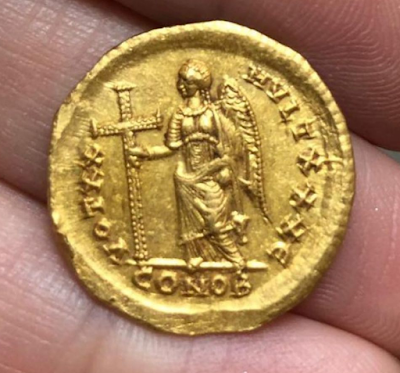
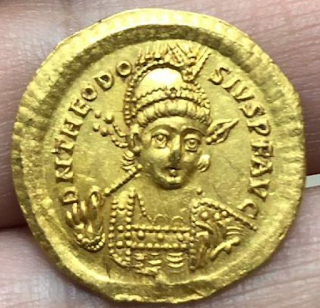
Rare Byzantine gold coin found by schoolboys in Israel

A rare Byzantine gold coin was found by a group of schoolboys in northern Israel in 1999.
The coin was found along a stream in the Galilee region. The coin is a solidus minted by the emperor Theodosius II in Constantinople around 420–423 CE. Theodosius II was named to the throne as an infant in 402 and ruled until 450 when he died in a riding accident. A high quality (AU) Theodosius II solidus would expect to make at least $1500.

Saturday, September 6, 2025

Assyrian Empire collapsed due to climate change

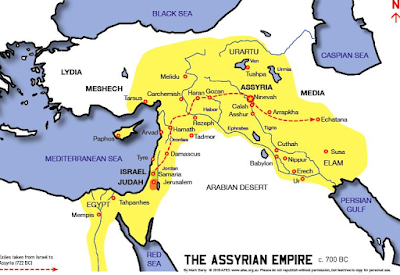
Ancient Mesopotamia, the land between the Tigris and the Euphrates rivers, was the center of the Neo-Assyrian Empire.
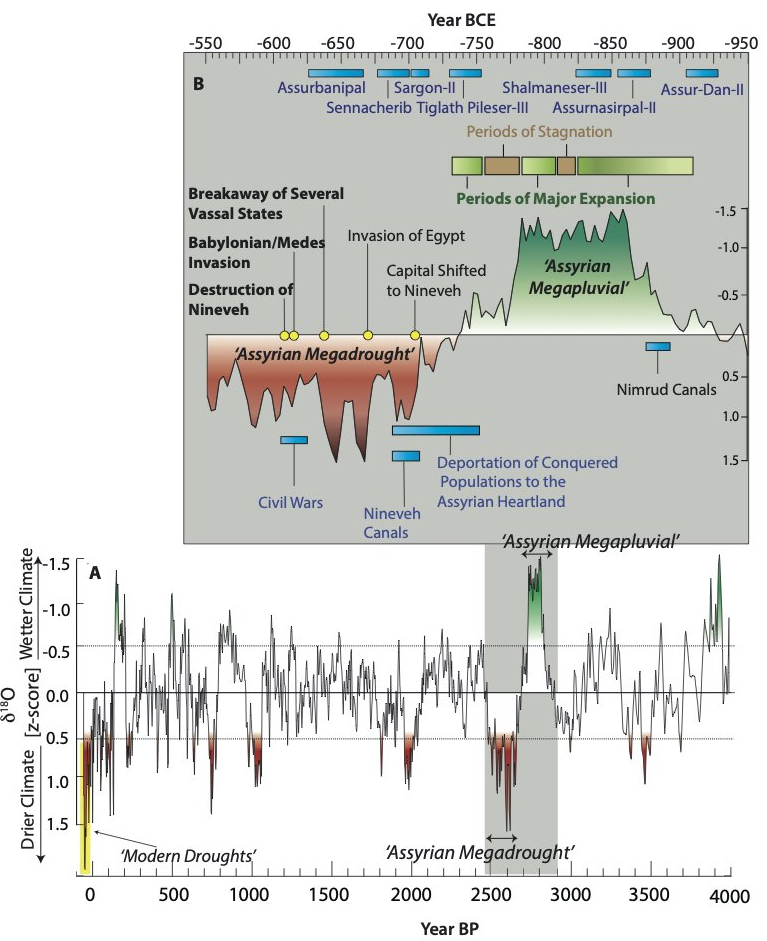
The ancient superpower was the largest empire of its time, lasting from 912 BC to 609 BC in what is now Iraq and Syria. At its height, the Assyrian state stretched from the Mediterranean and Egypt in the west to the Persian Gulf and western Iran in the east. Then a reversal of fortune, and the Neo-Assyrian Empire plummeted from its zenith (circa 650 BC) to complete collapse within the span of a few decades. The reasons why were a mystery. New research shows that climate change was the double-edged sword that first helped the meteoric rise of the Neo-Assyrian Empire and then lead to its precipitous collapse.
Rainfall patterns over Mesopotamia were deduced from cave stalagmites. These are the cone-like structures from the cave floor. They grow slowly, as rainwater drips down from the cave ceiling. Oxygen isotope ratios build a timeline of how conditions changed, but don't reveal the amount of time that elapsed between them. Stalagmites also trap uranium. Over time, uranium decays into thorium at a predictable pace. Experts made high-precision uranium-thorium measurements.
The Neo-Assyrian state expanded during a 200 year interval of anomalously wet climate. This was followed by major droughts in the early-to-mid-seventh century BC.
The period marked the swift collapse of the Neo-Assyrian Empire.
Repeated crop failures likely exacerbated political unrest in Assyria, crippled its economy, and empowered adjacent rivals.

Thursday, September 4, 2025

Skull of bear held captive to fight Roman gladiators discovered

The skull of a brown bear discovered near a Roman amphitheater in Serbia reveals that the wild animal had been kept in captivity for years and was fighting off an infection when it died around 1,700 years ago. The find is the first direct evidence of the use of bears in the gladiatorial arenas in the Roman Empire. The fragmented skull of a brown bear (Ursus arctos) was excavated in 2016 near the amphitheater at Viminacium, a Roman frontier military base in present-day Serbia.
The amphitheater at Viminacium was built in the second century A.D. Oval-shaped with high walls, it could seat about 7,000.
Bears had a variety of roles. They could be made to fight "venatores," gladiators who specialized in hunting; to brawl with other animals; to execute convicts; or to give trained performances. Unlike traditional gladiators who fought other humans, venatores demonstrated skill with weapons like spears with the beasts. The venatio spectacles were a popular form of entertainment.
The Siberian brown bear weighs as much as 360 kg (800 pounds), and approximates the size of the North American grizzly.

Wednesday, September 3, 2025

Ephesus

Ephesus was an ancient Greek city on the coast of Ionia, three kilometres southwest of present-day Selçuk in İzmir Province, Turkey.
It was constructed in the 10th century BC by Attic and Ionian Greek colonists. During the Classical Greek era it was one of the twelve cities of the Ionian League.

The city flourished after it came under the control of the Roman Republic in 129 BC. Ephesus was famed for the nearby Temple of Artemis (completed circa 550 BC), one of the Seven Wonders of the Ancient World.
Among many monumental buildings are the Library of Celsus, and a theatre capable of holding 25,000 spectators. Ephesus was one of the seven churches of Asia cited in the Book of Revelation. The Gospel of John may have been written there.
The Romans made Ephesus the capital of the Asian State, and the city became one of the biggest settlements in Anatolia. Today Ephesus is one of Turkey’s leading tourist attractions.
A extremely rare ancient Ephesus coin (625-600 B.C.) crossed the block in New York in 2018. The electrum coin was a 'foundation deposit' and could be related to the god of light, Phanes. There are only two other known examples. It made $300k.