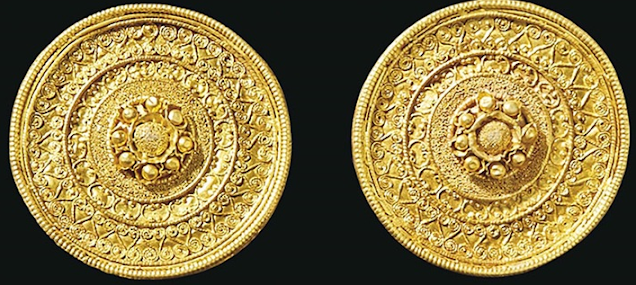
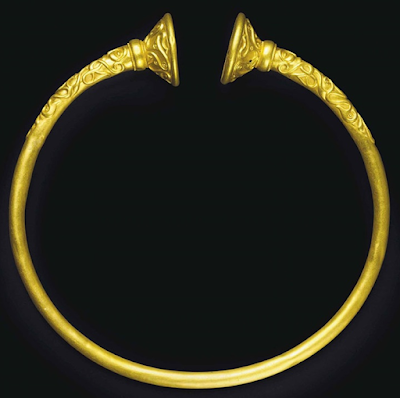
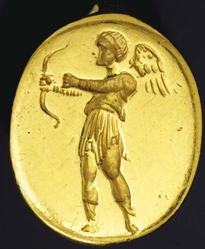
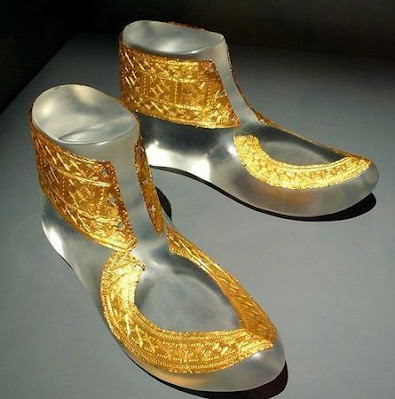
An Iron Age tomb brimming with treasures fashioned out of gold, bronze and amber was uncovered in 2017 after lying undisturbed by the Danube River for nearly 2,600 years.
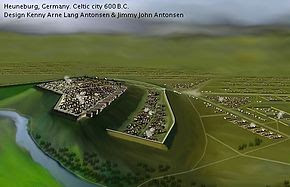
The hoard surrounded the skeleton of a woman who died between the age of 30 and 40. She was an elite member of a Celtic society that buried her in southern Germany at a hill fort called Heuneburg in 583 B.C.
Multiple graves around the woman's burial had been looted over the millenia, with looters digging tunnels from tomb to tomb. The newfound grave was untouched. It is one of the few undisturbed graves from the first half of the sixth century in Heuneburg.
Heuneburg is a prehistoric hill fort near the Danube River. The Celtic city-state was founded around the sixth century B.C.
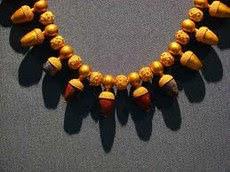
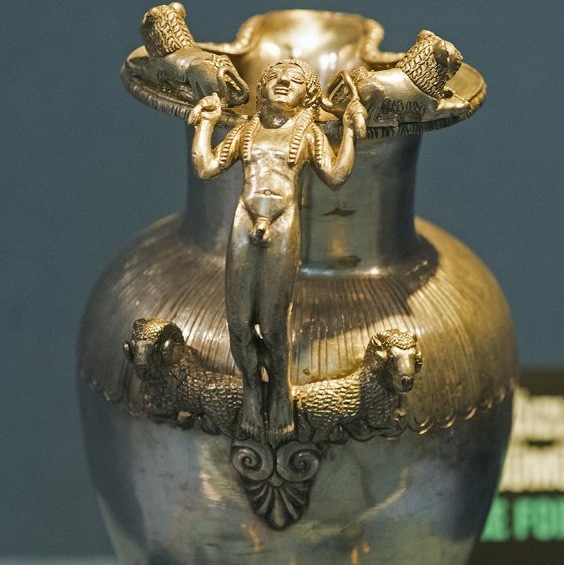
The Karun Treasure is a collection of 363 Lydian artifacts dating from the 7th century BC and originating from Uşak Province in western Turkey. The collection was smuggled outside Turkey and bought by the Metropolitan Museum of Art between 1967-68, at a cost of $1.2m.
The collection is also known as the Lydian Hoard. It is now exhibited in the Uşak Museum of Archaeology.
A long legal battle ensued. The hoard made news again in May 2006 when a golden hippocamp was found to have been switched with a fake.
The rich grave goods came from a high status female burial. Locals in Uşak believe that the treasure is cursed and that it brings misfortune and death. Rumor had all seven men involved in the 1965 illegal digs of the burial mounds dying violent and painful deaths.
Greece marked the 25th century since the Battle of Thermopylae in 2020 with a commemorative €2 coin. 735,000 coins were issued for circulation.
The Battle of Thermopylae was fought between an alliance of Greek city-states, led by King Leonidas of Sparta, and the Persian Empire of Xerxes I over the course of three days, during the second Persian invasion of Greece.
It took place with the naval battle at Artemisium, in August or September 480BC, at the narrow coastal pass of Thermopylae. The Persian invasion was a response to the defeat of the first Persian invasion of Greece, which had been ended by the Athenian victory at the Battle of Marathon in 490BC.
By 480 BC Xerxes amassed a huge army and navy, and set out to conquer Greece.
The vastly outnumbered Greeks held off the Persians for seven days before the rear-guard was annihilated in one of history's most famous last stands. It became a symbol of courage against hopeless odds.
A tiny fragment told a story of Biblical proportions. Archaeologists in Jerusalem unearthed a 2,700-year-old Assyrian inscription in clay that could shine a light on key events detailed in the Old Testament. The 1-inch pottery fragment is part of a seal that was used to authenticate official documents. It was found in a drainage canal at Temple Mount in Jerusalem’s Old City. This is the first time that evidence of relations between the Assyrian Empire and the Kingdom of Judah had been uncovered in the city.
By analyzing the clay, researchers were able to trace the shard’s origin to the Tigris basin region where several Assyrian hubs were located. It was inscribed with Akkadian cuneiform — the world’s oldest written Semitic language. The ancient text is a complaint by the Assyrians over a delayed tax payment by Judah that had been due on the Av, the 11th month of the Hebrew calendar. It was an ancient tax notice from the Assyrian emperor to a Judean king, which rang similar to a Biblical account.
In II Kings 18 and 19, during the reign of Judah’s King Hezekiah, “King Sennacherib of Assyria marched against all the fortified towns of Judah and seized them.” “King Hezekiah sent this message to the king of Assyria at Lachish: ‘I have done wrong; withdraw from me; and I shall bear whatever you impose on me,'” the excerpt read. “So the king of Assyria imposed upon King Hezekiah of Judah a payment of 300 talents of silver and 30 talents of gold.”
Experts were able to date the artifact to between the end of the 8th century and the middle of the 7th century BCE. The tiny shard is evidence of the Hezekiah revolt against Assyrian King Sennacherib. The fragment’s discovery proves how even the tiniest artifacts can provide essential historical evidence.
The grave of a Germanic lord who lived 1,500 years ago was unearthed in Saxony-Anhalt, near Brück in 2020.
Remains of 11 animals were found, including cattle, horses and dogs.
Builders were clearing land for a new chicken farm and stumbled across a royal cemetery. Ashes may be inside a bronze cauldron in the central tomb, which is around 13 feet by 13 feet in size. The cauldron is the focal point of the mounded tomb, and is surrounded by six women buried in a radial alignment from the pot, like the hands of a clock.
A glass bowl was among the objects found.
Vestment clasps.
The site dates from between AD480 and AD530, a period following the fall of the Roman Empire which saw many Germanic tribes, such as the Huns, invade territories which were no longer under Roman protection. A gold coin found at the site features Eastern Roman emperor Zeno. It dates to around 480.
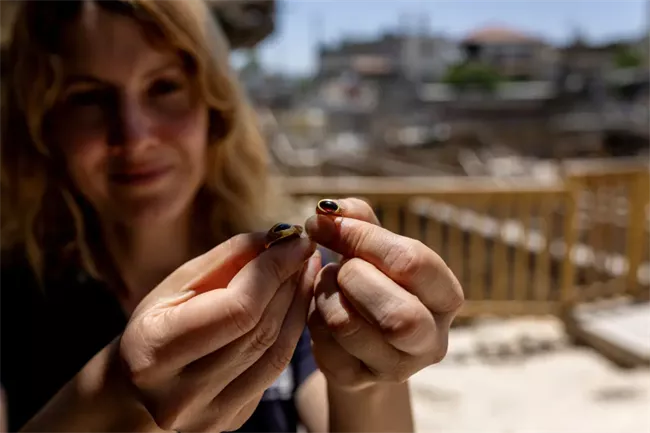
Rings and bronze earrings discovered at the City of David site in the Jerusalem Walls National Park likely come from the early Hellenistic Period in Jerusalem. Reasearchers suggests that two rings may be connected to a coming-of-age ritual for young women before marriage. Found in the building’s foundations, the objects were placed there in the context of executing a well-known Hellenistic period custom in which betrothed women would bury jewellery and other childhood objects in the house foundations as a symbol of the transition from childhood to adulthood.
Jewellery design may have been influenced by trade with the dominant empires at the time. Jewellery that combines gold with bright colour gemstones was a fashion inspired by places such as India and Persia.
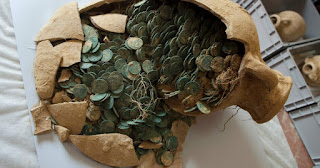
In 2016 workers laying pipe in a southern Spanish park unearthed a 600 kilogram (1,300 pounds) trove of Roman coins.
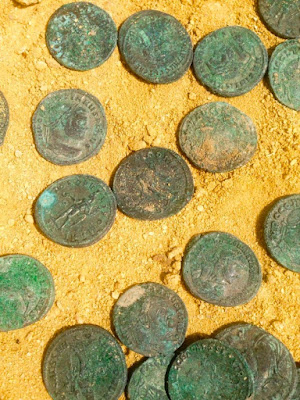
The construction workers came across 19 amphoras containing unused bronze and silver-coated coins dating from the end of the fourth century. The coins are believed to have been recently minted at the time and had probably been stored to pay soldiers or civil servants. The clay pots, 10 of which were said to be intact, were found just over a metre underground. The coins bear images of emperors Constantine and Maximian. The Romans began to conquer Spain in 218 B.C. and ruled until the fifth century.
Hispania was the Roman name for the Iberian Peninsula. Under the Republic, Hispania was divided into two provinces: Hispania Citerior and Hispania Ulterior.
Latin was the official language of Hispania during the Rome's more than 600 years of rule, and by the empire's end in Hispania around 460 AD, all the original Iberian languages, except the ancestor of modern Basque, were extinct. Even after the fall of Rome Latin was spoken by nearly all of the population.
A Minoan woman's skeleton was found in 2018 buried in her tomb along with a gold necklace and bronze mirror, 4,500 years after she died. A large dig in the municipality of Sissi, on the north coast of Crete found remnants of an early Minoan settlement dating as far back as 2,600 B.C.
The Minoan civilization arose on Crete about 2600BC and flourished until around 1400BC when it mysteriously disappeared. The origins of the Minoan and their fate has puzzled archaeologists.
The box-shaped stone tomb held a nearly intact female skeleton, as well as jewelry indicating her great wealth. The jewelry included costumes made of bone and bronze, a bronze mirror with an ivory handle, and a beaded gold necklace. The archaeological site at Sissi is 2 miles from the ancient city of Mallia, in Crete.
The Minoans were the first advanced civilization in Europe, leaving behind massive building complexes, tools, stunning artwork, writing systems, and a huge network of trade.
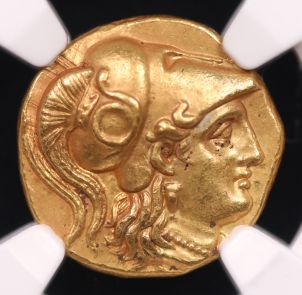
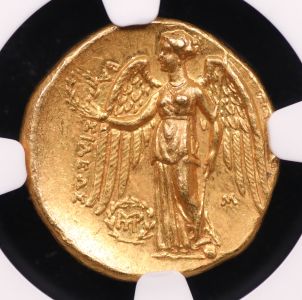
Few ancient coins rival the beauty, power, and enduring legacy of the gold staters issued in the name of Alexander III of Macedon. Alexander the Great. Struck during or shortly after his reign, these coins were a cornerstone of the world’s first truly international currency system. The obverse depicts Athena, goddess of wisdom and war, wearing a crested Corinthian helmet adorned with a coiled serpent—an emblem of divine protection and intellect guiding military might.
On the reverse, Nike, the winged goddess of victory, stands gracefully holding a laurel wreath in her outstretched hand and a stylis (naval staff) in the other, symbolizing triumph both on land and sea. Below her feet appears the mint control monogram, identifying the specific mint—this example attributed to an early Seleucid issue.
Weighing 8.57 grams of nearly pure gold, it earns NGC’s highest surface rating of 5/5. The Fine Style designation underscores exceptional artistry. $33k USD.
In 2016 a gold amulet bearing the face of Odin was discovered on the Danish Island of Lolland.
The time was a dark period in human history. The find is rare with only about 1,000 amulets known.
The amulet may have been offered as a sacrificial gift to the Gods around 536 AD.
The oldest known inscription mentioning the Norse god Odin was found in 2023 on a gold pendant in Denmark from the fifth century A.D. The inscription appears to refer to a Norse king whose face appears in the center of the pendant, and may indicate he claimed descent from Odin.
A metal detectorist has discovered up to 15,000 Roman coins, which could be the biggest hoard ever discovered in Wales. David Moss, 36, from Cheshire, dug up two clay pots in north Wales. The epic find left him fearing they could be stolen, so he slept with them in his car for three days before taking them to experts.
The coins are now in the hands of the National Museum Cardiff. Experts say the haul could have belonged to a member of the Roman army, or multiple members, who buried their coins for safekeeping.
Finding ancient treasure in the UK doesn't mean it automatically belongs to the finder. After being evaluated, an offer is made with half the proceeds going to the discoverer and half to the landowner. Trying to avoid the process can result in severe penalties, including jail. This is what Layton Davies found after he uncovered £3m worth of Viking coins in a field in Hereford. He concealed the finding of the treasure, and then sold it. He was fined and jailed. Davies did not inform the farmer who owned the field and instead contacted dealers.









 Remains of 11 animals were found, including cattle, horses and dogs.
 Vestment clasps.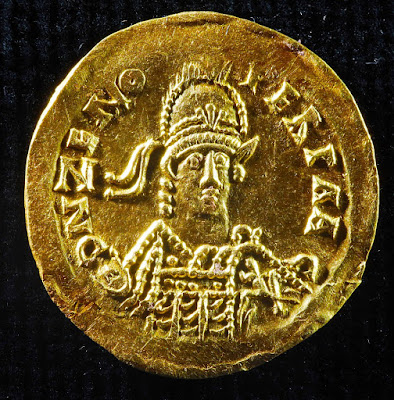




 The time was a dark period in human history. The find is rare with only about 1,000 amulets known.