Sunday, January 11, 2026

Ancient gold coins

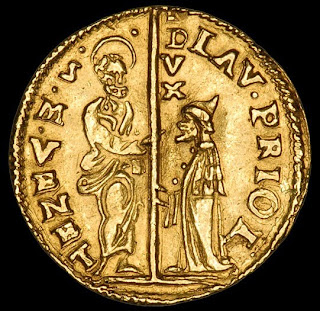
Example of the most successful coin in history; an antique fine gold ducat or Zecchino, minted under the 82nd Doge of Venice, Lorenzo Priuli. Struck 1556 - 1559 in Venice, Italy.

The gold ducats of Venice were first struck in 1284. Their very high gold content (99.40%) made the coins extremely desirable and they are considered to be the earliest examples of a globally accepted currency. Ducats continued to be struck for over 500 years - longer than any other coin issue in history. $1,250.00
An ancient Indian gold Maiores Domus dinar from the Kushan Empire, struck under Emperor Vasudeva II circa 270 - 310 A.D.

The obverse with Vasudeva II, nimbate, standing left, sacrificing over altar and holding filleted scepter; in left field, filleted trident. The reverse with the goddess Ardoxsho, seated facing on throne, holding diadem and cornucopia. $850.00
An ancient Greek hekte from Cyzicus, Mysia, struck circa 500 - 450 B.C. The obverse with naked youth kneeling right, hair bound by taenia with frontal projection, holding knife and tunny fish (emblem of Cyzicus). The reverse with quadripartite incuse square punch. Kyzikos was a wealthy ancient town located between the Aegean and the Black Sea, its advantageous position made it a major center for commerce and trade. $2,250.00
Ancient Celtic gold stater struck by the Chief of the Corieltauvi tribe, Volisios Dumnocoveros. Dating to the Late Iron Age circa 20 - 35 A.D.

The obverse with a vertical wreath made up of square leaves running in opposite directions from the centre of the coin. Across this in two lines is the legend: VOLISIOS. The reverse with disjointed Celtic horse, galloping left. $3,250.00
<
An ancient Byzantine gold solidus of Emperor Basiliscus, (Flavius Basiliscus Augustus.) Struck January 475 - August 476 A.D. at the Constantinople mint. The obverse with a superb portrait of Basiliscus carrying a spear which rests over his shoulder and holding an oval shield, decorated with a horseman spearing a fallen enemy. The legend reading: D[ominvs] N[oster] BASILICVS P[ater] P[atriae] AVG[vstvs]
"Our Lord Basiliscus, Father of the People, Augustus"

The reverse with the goddess, Victory standing left holding a long, jewelled cross and wearing loose drapery. $7,000.00

Friday, January 9, 2026

The Spanish doubloon

In the New World, Spanish gold coins were minted in one, two, four, and eight escudo denominations.
The two-escudo piece was called a 'pistole' with the large eight-escudo coin called a 'quadruple pistole.' English colonists called it the Spanish doubloon. Tens of millions of Spanish cob and milled gold coins circulated throughout Europe. Spanish gold was regularly accepted in the early United Sates and continued to be minted in the New World until 1821. It was the first literally world-wide gold trade coin and circulated for over 300 years until the economic and military decline of Spain forced it's replacement.
The Spanish dollar, also known as the piece of eight is a silver coin of about 38 mm (1.5 in) diameter worth eight Spanish reales. It was minted in the Spanish Empire following a monetary reform in 1497.
A silver Spanish dollar minted in Mexico City c. 1650

Thursday, January 8, 2026

Tomb of Philip II, father of Alexander the Great

A study claims to identify King Philip II, father of Alexander the Great, and determines he was buried in Tomb I, not Tomb II, as previously thought.
The tombs were discovered in 1977 in the village of Vergina in northern Greece. Gold caskets were found housing the remains of several people. Studies were published concerning human remains found in the 24-carat larnax in Tomb II
Philip II was the 18th king of Macedonia (359–336 BC). He gained domination over all Greece, laying the foundation for its expansion under Alexander.
Alexander the Great succeeded his father as king. Philip II is described as a powerful king with a complicated love life. He married between five and seven women, causing confusion over the line of succession. In 336 BC, Philip II was assassinated at a celebration of his daughter's wedding, perhaps at the behest of his former wife, Olympias. Olympias was the fourth wife of Philip II, and mother of Alexander the Great.
An investigation was launched to analyze more than 350 bones and fragments found in the two golden caskets.

The golden larnax and the golden grave crown of Philip
The research team utilized X-ray computed tomography, scanning electron microscopy, and X-ray fluorescence. The skull showed signs of sinusitis, which may have been caused by an old facial trauma, such as the arrow that is known to have hit and blinded Philip II at the siege of Methone in 354 BC. There are signs of chronic pathology on several ribs, which are believed to be linked to Philip’s trauma when he was struck with a lance around 345 BC.
Alexander the Great in Pompeii mosaic.

Sunday, January 4, 2026

Siberia's Valley of the Kings

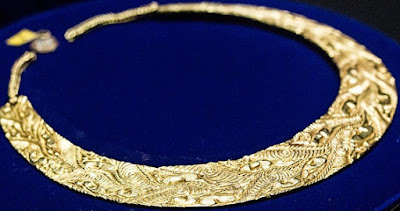
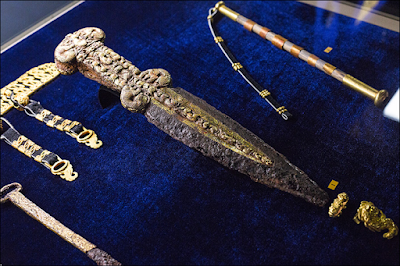
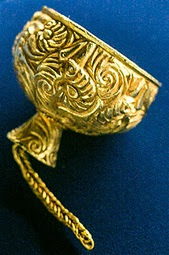
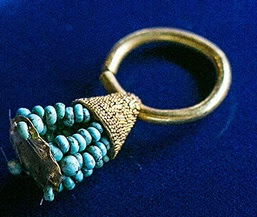
The Arzhan-2 Scythian burial is one the most amazing discoveries ever made. Faces of the buried couple were revealed.
A vale north of Turan, Tuva has become famous for its pancake-shaped Scythian kurgany (burial mounds).
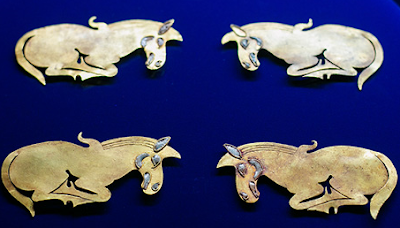
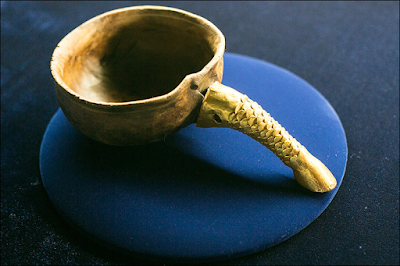
Excavations in 2001 unearthed magnificent artifacts dating from 600 BC. Arzhaan I is the largest kurgan in Tuva. A dig in the early 1970s turned up thousands of gold and silver artifacts.
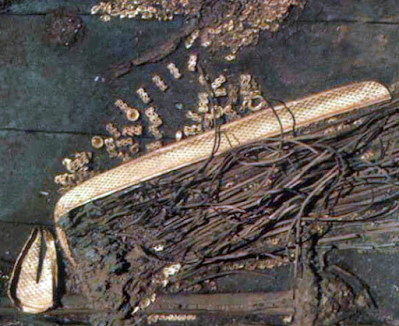
The valley holds an amazing 700 burial sites and eight large kurgany. In addition to 44 pounds of gold, researchers discovered items made of iron, turquoise, amber and wood. The royal tomb Arzhan 2 was excavated in July, 2015 and is about 2,600 years old. The unknown monarch was entombed with 14 horses, a defining symbol of wealth by the Scythian.

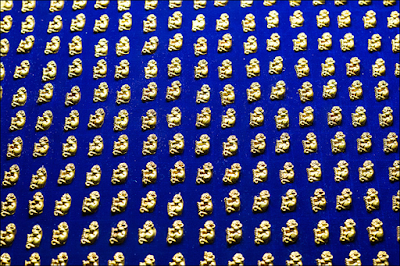
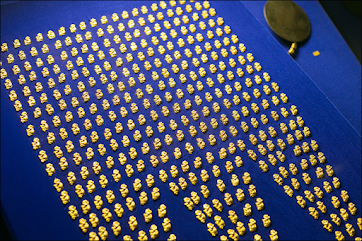
Beside him lay his queen. 33 others lie entombed, including 5 children. They were all likely sacrificed to accompany him on his journey to the afterlife. The burial chamber contained some 9,300 decorative gold pieces ... more than 20 kg of gold. DNA analysis indicated those buried were from the Iranian ethno-linguistic group. Analysis of strontium isotopes in the bones reveal all were locals except for the queen. The king was about 50 years old and analysis of his remains revealed that he died of prostate cancer. It's thought that in his last years he wouldn't have been able to walk.


Friday, January 2, 2026

Ephesus

Ephesus was an ancient Greek city on the coast of Ionia, three kilometres southwest of present-day Selçuk in İzmir Province, Turkey. It was constructed in the 10th century BC by Attic and Ionian Greek colonists. During the Classical Greek era it was one of the twelve cities of the Ionian League.
The city flourished after it came under the control of the Roman Republic in 129 BC. Ephesus was famed for the nearby Temple of Artemis (completed around 550 BC), one of the Seven Wonders of the Ancient World.
Among many monumental buildings are the Library of Celsus, and a theatre capable of holding 25,000 spectators. Ephesus was one of the seven churches of Asia cited in the Book of Revelation. The Gospel of John may have been written there.
The Romans made Ephesus the capital of the Asian State, and the city became one of the biggest settlements in Anatolia. Today Ephesus is one of Turkey’s leading tourist attractions.
A extremely rare ancient Ephesus coin (625-600 B.C.) crossed the block in 2019. The electrum coin could be referring to the god of light, Phanes. There are only two other known examples. It made $300k.
Electrum 'Phanes' staters featured a stag on one side and the inscription "ΦΑΝΕΩΣ" (Phanes) in retrograde (backwards). There are several possible translations. The 'Phanes' named on the coin could have been a treasury official or wealthy individual. The coins represent some of the earliest inscribed coinage.

Thursday, January 1, 2026

Ancient gold found in Judean desert

Israeli archaeologists unearthed gold at a former Christian monastery in the Judean Desert.
The ancient treasure was found at the Hyrcania archaeological site in the northern Judean Desert, located around ten miles east of Jerusalem in the West Bank. Two gold coins and a delicate gold ring were found. The solidi bear the image of Byzantine Emperor Heraclius, who reigned from 610 to 641 AD. The site was founded in the late Hellenistic period, between the second and first centuries BC, when it was used as a fortress. During the Byzantine period a Christian monastery was established at the site, attributed to the activity of Saint Sabbas.
Saint Sabbas was one of the founders of desert monasticism which operated for hundreds of years.