Saturday, March 28, 2026

Brutus aureus brings $2m

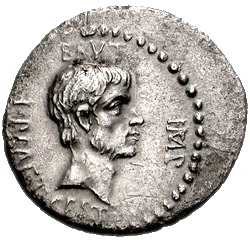
An aureus of Marcus Junius Brutus sold for €1.9 million ($2 million) at a Geneva auction in 2025, far exceeding its €800k estimate. Described as “one of the most iconic and historically significant coins in all of Roman history” it is one of 17 known to exist.
The coin was minted following Brutus’s 44 B.C.E. murder of Julius Caesar, and before his suicide following defeat in the Battle of Philippi in 42 B.C.E.

Brutus on an Ides of March coin, issued shortly before his death.
The Battle of Philippi, involving up to 200,000 men was the largest of the Roman civil wars. It consisted of two battles in the plain west of the ancient city of Philippi. The first occurred in the first week of October. Brutus faced Octavian, and Antony's forces fought those of Cassius. Cassius comitted suicide after losing, but the overall battle was a draw. A second encounter, on 23 October, finished off Brutus's forces after a hard-fought hand to hand battle. Brutus took his own life in turn.

Friday, March 27, 2026

Aegina’s Sea Turtle


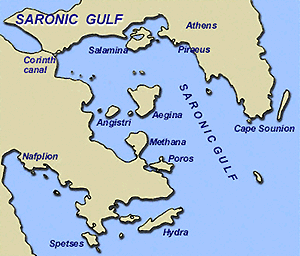
Aegina is a rocky island in the Saronic Gulf located about 25 miles southeast of Athens. It was settled around 900 BCE and was named after the daughter of the Greek river god Asopos. The inhabitants became expert merchants and tradesmen, dominating the shipping industry early in the sixth century BCE. Their success brought the island great wealth and power. The first coins were thought to be made by the king of Argos, Pheidon. Coins with the turtle design were an important early global trade currency.
Aegina became the first of the Greek city-states to issue coined money, starting in the mid-sixth century BCE. Their common didrachm “stater” coinage weighed about 12.6 grams. Their status as the first international trade currency was aided by consistent design. Aegina’s coins spread far throughout the known world.

Thursday, March 26, 2026

Choice Tiberius among Heritage offerings

A rare Tiberius aureus represents a high-grade example of the "Tribute Penny" type, which was the standard gold currency throughout most of his AD 14–37 reign. The coins feature the laureate head of Tiberius (obverse) and the seated figure of Livia as Pax (reverse). The Pontifex Maximus was the highest-ranking chief priest in ancient Rome’s state religion, overseeing the College of Pontiffs

Tiberius (AD 14-37). AV aureus. NGC Choice AU★ 5/5 - 4/5. Lugdunum.
Heritage offers spectacular ancients. A choice Tiberius aureus will make $10k.
Severus Alexander (AD 222-235). AV aureus. NGC Choice MS★ 5/5 - 5/5.
The auction was crowned by a Mint State example of a Lydian ‘Light Series’ Stater, introduced under the rule of Croesus.

Wednesday, March 25, 2026

Meteorite smashed into Earth 12,800 years ago

Scientists in South Africa have discovered new evidence that the Earth was struck by a meteorite or asteroid 12,800 years ago, causing global climate change and mass extinction. Soil samples from an archaeological site called Wonderkrater outside a small town north of Pretoria found a spike in platinum levels, which they say supports the Younger Dryas Impact hypothesis. The theory assumes that a disintegrating asteroid, which is high in platinum, impacted Earth, causing an ice age.

Many large species were wiped out as a result off the Earth’s rapid cooling. The impact from the asteroid or comet sent dust into the air, which might have reduced the amount of sunlight reaching Earth.

Pollen from various plants also reveal a much cooler period, which is called the Younger Dryas. Scientists believe human populations may have also have been negatively affected.

The late Quaternary archaeological site Wonderkrater, located in the Limpopo Province in South Africa, consists of a large spring and peat mound with deposits dated to more than 30,000 years ago. With the rich information this Middle Stone Age site has yielded, it was an ideal place to look for evidence of the “platinum spike” associated with the Younger Dryas, which had not previously been found on the African continent. A team of researchers found such evidence in the form of temperature changes based on pollen analysis.

Tuesday, March 24, 2026

The Trier Gold Hoard

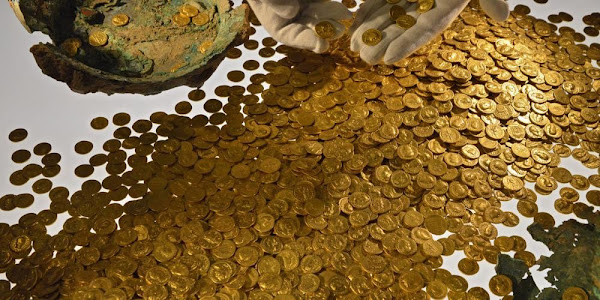
The Trier Gold Hoard consists of over 2500 gold coins with a weight of 18.5 kg found in Trier, Germany, during construction works. On 9 September 1993, an excavator unearthed and ripped apart a bronze cauldron during excavations for an underground parking garage. The Trier Hoard is described as the largest preserved Roman gold hoard worldwide.
A Dutch man faced attempted robbery charges for the failed theft of the Trier Hoard. In 2019, a group of men broke into the Rhineland State Museum with the intention to steal the hoard. The group entered the museum by scaling scaffolding and prying open a window. Inside, they discovered a thick pane of glass reinforced with steel mesh. It proved too difficult to remove. Within three minutes the alarm went off, prompting the thieves to flee.
Part of the cauldron and some coins went to a dump site, initially unnoticed. An amateur archaeologist, Erich Eixner went back to the excavation site at night and found the larger part of the bronze cauldron, containing 560 coins and an additional lump of 1500 coins. He informed authorities and received about 20,000 DM, a fraction of their worth. The oldest coins were struck by Nero in 63/64 AD, the youngest under Septimius Severus between 193 and 196.

Sunday, March 22, 2026

Iron Age Gold Hoard Brings £33,200

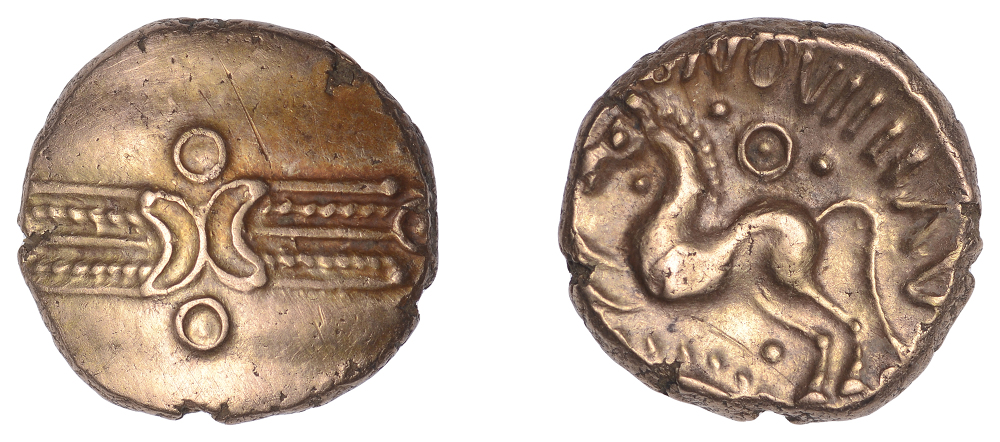
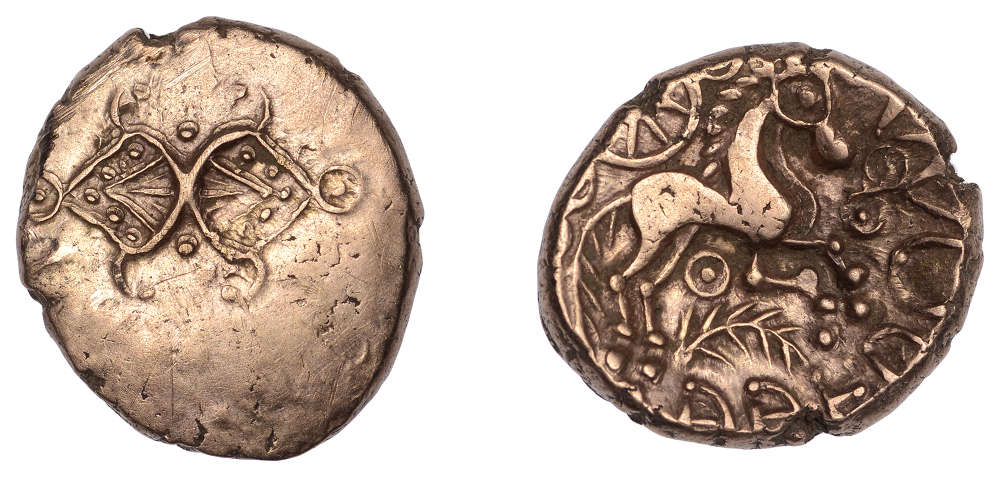
The largest known hoard of Iron Age coins to be deposited during the reign of King Dubnovellaunos, who ruled the Trinovantes between 25 BC and 10 AD, fetched a combined hammer price of £33,200. 16 staters and one quarter-stater were found.
All of the Staters in the hoard are inscribed, and they can be attributed to two figures: Addedomaros and Dubnovellaunos. These are leaders to different tribes: the Catuvellauni and the Trinovantes respectively. Trinovantian staters, minted primarily in the 1st century BC to early 1st century AD in Essex, are typically composed of gold alloyed with silver and copper, showing a gradual debasement over time. Composition of the 5.4gm-5.6gm coin was 46%–48% Gold (Au), 8%–15% Silver (Ag), and 38%–44% Copper.

Researchers stumble over evidence of King Midas

Archaeologists were investigating an ancient mound site in central Turkey called Türkmen-Karahöyük in 2020.
A local farmer told the group that a nearby canal, recently dredged, revealed the existence of a strange stone, marked with an unknown inscription. The script was written in ancient Luwian. Researchers found that the hieroglyphs on this ancient stone block – called a stele – boasted of a military victory. And not just any military victory, but the defeat of Phrygia, a kingdom of Anatolia that existed roughly 3,000 years ago.
The royal house of Phrygia was ruled by a few Midas, but dating of the stele (8th century BC) suggests the block's hieroglyphics are referring to the King Midas.
The mound at Türkmen-Karahöyük.

Friday, March 20, 2026

The Sword of Charlemagne

Joyeuse is the name traditionally attributed to Charlemagne's personal sword. The sword of Joyeuse, which resides in the Louvre Museum, is one of the most famous swords in history.
Historical records link the sword to Charlemagne the Great, King of the Franks. The story begins in 802 AD. Legend says that the sword was forged by the famous blacksmith Galas, and took three years to complete. The sword was described as having magical powers. It was said to have been so bright that it could outshine the sun and blind its wielder's enemies in battle, and any person who wielded it could not be poisoned.
Charlemagne (742-814 AD) did much to define medieval Europe. After the fall of the Roman Empire, he was the first to reunite Western Europe. He ruled a kingdom that encompassed what is now France, Germany, Italy, Austria, and the Low Countries. The sword was moved to the Louvre in 1793 following the French Revolution. It was last used by a French king in 1824 with the crowning of Charles X.

The pommel (top fitting) of the sword dates from the 10th and 11th centuries, the cross to the second half of the 12th century, and the grip to the 13th century. The grip once featured a fleur-de-lis, but was it removed for the coronation of Napoleon I in 1804.

Wednesday, March 18, 2026

The Hoxne Hoard

When Peter Whatling lost his hammer near Hoxne, Suffolk, he asked a friend with a metal detector to help out. They found something.

The 1992 discovery brought the two men a finder’s fee of £1.75m.
The Hoxne Hoard is the largest hoard of late Roman silver and gold discovered in Britain, and the largest collection of gold and silver coins of the fourth and fifth centuries found anywhere within the Roman Empire. 14,780 gold and silver coins, along with 200 jewellery items,ornaments and tableware were found.
The hoard was part of the accumulated wealth of the affluent Roman Aurelius Ursicinus.
A set of silver spoons (cochlearia and cigni) in the hoard are neatly engraved with "AVRVRSICINI" (property of Aurelius Ursicinus). The hoard was buried around AD 408–409, a period of major political instability marking the end of Roman rule in Britain.
The hoard amounts to 3.5 kg (7.7 lb) of gold and 23.75 kg (52.4 lb) of silver.
The holes in the bottom of the model of a Roman noble woman indicate that she was used as a pepper pot. Pepper did not grow in Britain or any other part of the Roman Empire. It was grown in India and was very expensive. Pepper was just one luxury traded across the Indian Ocean in ancient times.

The Phoenix

The Phoenix is found across cultures.
Ancient legend paints a picture of a magical bird which lives for several hundred years before it dies, bursting into flames. It is then reborn from the ashes, to start a new life. It is an image that is still used commonly in popular culture and folklore. The legendary phoenix is associated with the rising sun and fire. It builds its own funeral pyre and ignites it with a clap of its wings. After death it rises from the ashes.
Egyptians seem to have been the first to incorporate a bird into the concepts of immortality, resurrection and rebirth.
They referred to a Bennu in their mythology. Bennu was depicted as a tall bird that resembles a stork. The Book of the Dead describes Bennu as the heart and soul of Ra and the guide of the gods of the underworld.

In Greek and Roman myths the phoenix has been portrayed either as peacock-like or an eagle-like bird bearing crimson and gold feathers. It was recorded as the most beautiful of birds.
The Huma is a mythical bird of Iranian legends and fables. The Huma bird is said to never come to rest, living its entire life flying invisibly high above the earth, and never alighting on the ground. In some Huma myths, the bird is said to be phoenix-like, consuming itself in fire every few hundred years years, only to rise anew from the ashes. The Huma bird is a 'bird of fortune' since its shadow (or touch) is said to be auspicious. Even catching a glimpse of it is sure to make one happy for life.
The Chinese version of the phoenix is Fèng Huáng and is a union of male and female traits. The Fèng Huáng has a head of a swallow with a rooster's beak. Its neck resembles that of a snake's, the back is that of a tortoise's and tail of a fish's. The myth says that it appears only at places which are peaceful and devoid of chaos. The phoenix is Milcham in the Jewish tradition. The legend says that after consuming the 'forbidden fruit' in the garden of Eden, Eve became envious of the other creatures who enjoyed their immortal existence. Therefore, she convinced them to eat the 'forbidden fruit' as well so that they lose their immortality and become lowly mortals. The only creature she could not persuade to do so was the phoenix, who remained immortal.

Tuesday, March 17, 2026

The Donington pendants

Two detectorists found the collection of four gold pendants and one piece of a gold brooch on the slope of a hill in the village of Donington on Bain, about 125 miles (200 kilometers) north of London, in the spring of 2023. Items date to the seventh century. While gold and garnet pendants were common accessories for high-status women in seventh-century England, archaeologists typically find them in graves, not in a group on the side of a hill.
No other artifacts or human bones were found with the Donington pendants, which suggests that they were buried for safekeeping or in a votive act. Lindsey, the region where the hoard was found, shifted between the control of rival kingdoms of Northumbria and Mercia, while the spread of Christianity was reshaping social and political life.

Special ancients bring top dollar

Two dekadrachms from famous engravers minted from the time of Dionysios I were auction stars in 2020.
One was signed by Kimon and graded NGC Ch VF ★ Strike: 5/5 Surface: 5/5, and the other signed by Euainetos and graded NGC Ch EF★ Strike: 5/5 Surface: 4/5. The Kimon coin sold for $360k and the Euainetos for $198k, both well exceeding their estimates.
A phenomenal Elagablus aureus graded NGC Ch MS★, Strike: 5/5 Surface: 4/5 brought $312k, and a Septimius Severus Aureus graded NGC Ch AU, Strike: 5/5 Surface: 3/5 made $192k.