Wednesday, September 9, 2026

Coins of Marcus Antonius

Following the assassination of Caesar in 44 BCE, Rome was plunged into chaos. Many of Caesar’s conspirators, including M. Junius Brutus and C. Cassius Longinus, (Brutus and Cassius) fled Rome in fear of reprisal. Caesar’s ally, M. Antonius (Marc Antony) seized control during the power vacuum, with the conspirators on the run and Caesar’s designated heir, G. Octavius Thurinus, (Octavian) still with an army in Macedonia. He returned to Rome with a new name, G. Julius Caesar Octavianus.
In the spring of 43 BCE, Octavian, along with the consuls Aulus Hirtius and G. Vibius Pansa Caetronianus, conquered Antony and his five legions at the Battle of Mutina in Cisalpine Gaul. Though victorious, Hirtius was killed and Pansa died of possible poisoning. This left Octavian in command of all of their eight legions. Octavian, Antony, and Lepidus established a three-man dictatorship.

Antony, desperate to retain troops, began to strike one of the more iconic series of coinage in Rome’s history, the legionary denarius. The legionary denarii were the largest issue of silver coinage produced in the late Republican period.
Mark Antony’s Legionary Denarii celebrate his many legions – 23 of them, with two extra coins celebrating additional cohorts. They were struck in a lower-purity alloy of silver and copper and remained in circulation for centuries. The legionary issue was Antony's last.
About a dozen gold aurei struck with the same dies as the silver denarii are known. Unlike the debased silver (85 – 90% pure) for the denarius, the gold is very pure and the surviving coins are full weight — about eight grams. A Legion II aureus, pedigreed to the famous Hunt Collection, sold for over $205k. A Legion XIII aureus brought almost $160k in 2015; a Legion XIX made over $67k in 2008.
The coins allude directly to the events of the day, as they feature a praetorian galley. On September 2, 31 BCE, the forces of Octavian and M. Vipsanius Agrippa defeated Mark Antony and Cleopatra at Actium, a promontory between the Ambracian Gulf and the Ionian Sea. Antony and Cleopatra were forced to retreat for Egypt. The final defeat was the Battle of Alexandria on August 1, 30 BCE. It was the official end of the Roman Republic and the start of the Roman Empire.

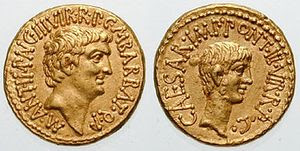
Mark Antony (left) and Octavian (right). Struck in 41 BC, the coin was issued to mark the establishment of the Second Triumvirate.

38 BCE Marcus Antonius aureus minted in Athens during the Second Triumvirate. Mark Antony and Octavia. $220k.

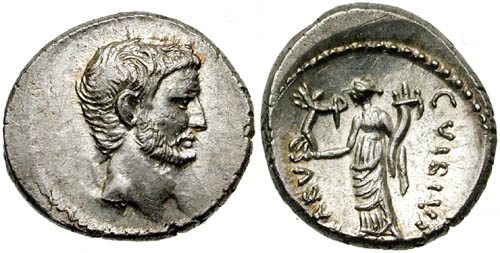
Marcus Antonius portrait. Denarius, 42 B.C.
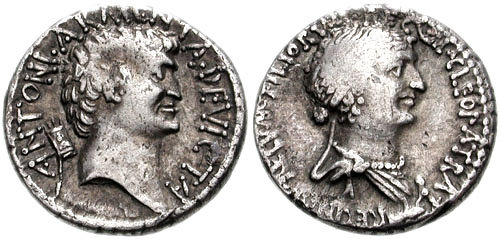
Mark Antony and Cleopatra. 34 BC.

Aureus of Antony and his son Antyllus. 34 BC.

Mark Antony and Cleopatra. Autumn 34 BC. AR Denarius. Est $5k, sold for $13k in 2017.

Tuesday, September 8, 2026

Equestrian statue of Marcus Aurelius

The equestrian statue of Marcus Aurelius is one of the most important surviving bronze sculptures from ancient Rome. It survived primarily because medieval Romans believed it depicted Constantine the Great, the first emperor to embrace Christianity.
It is made of bronze and stands 4.24 m (13.9 ft) tall. Marcus Aurelius extends his hand in a gesture of adlocutio used by emperors when addressing their troops.
The statue was erected around 175 AD. More than 20 other bronze equestrian statues of emperors and generals had been melted down since the end of the Imperial Roman era. Its thought the Equestrian statue of Marcus Aurelius is the only survivor.
The statue appears on the reverse of an aureus of Marcus Aurelius struck in 174 AD. It is also depicted on the reverse of the modern Italian €0.50 coin.
There's a legend behind the so-called owl which sits on the horse’s head. Legend says that the owl will spring to life and sing to herald the end of the world. This will happen on the day the equestrian statue of Marcus Aurelius “discovers in gold”; when the statue is entirely covered in gold. The statue of Marcus Aurelius was gilded bronze. Only traces of gilding remain on the statue.

Monday, September 7, 2026

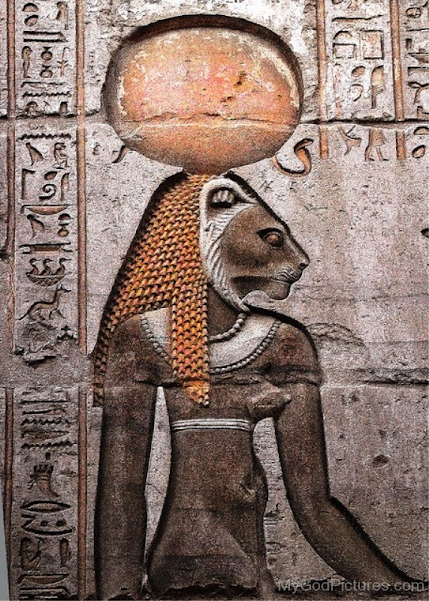
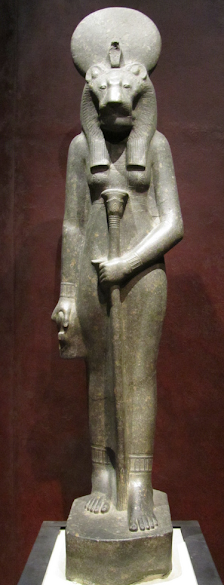
Sekhmet 'The Powerful One'

In 2017 archaeologists discovered 66 fragments and statues of Sekhmet believed to have been warding off evil from Amenhotep III’s temple. Amenhotep III’s reign, between 1386 to 1349 BC, is regarded as the peak of Egypt’s prosperity and power.
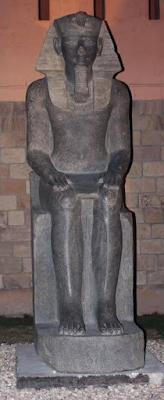
A toppled black granite statue of Amenhotep III was also found at the site.
The statue of Amenhotep shows the king as a young man and is thought to have been commissioned during his reign. Pharoah Amenhotep III became a king at the age of 12, when he inherited an empire spanning from the Euphrates to Sudan. His temple is being preserved and rebuilt as part of a government approved renovation project.
Sekhmet, often called “the powerful one” is the daughter of Egyptian sun god Ra and was believed to ward off evil and ill health. Her influence was powerful on the Egyptians. Some statues depict her standing and holding the symbol of life – a sceptre made of papyrus.

The curse of Pompeii

Most tourists who visit Pompeii every year leave with nothing but memories. Some steal extra – pieces of Pompeii.
Many of those who have stolen a piece of one the world’s most important archaeological sites have come to regret it. Tourists who take relics from the ruined Roman town have been returning them to the site, claiming they are cursed with bad luck.
One man wrote from Latin America saying that he and his entire family had experienced “trauma after trauma” after he took a piece of stone from Pompeii. Massimo Osanna, Pompeii’s archaeological superintendent, said he had received up to a hundred packages from across the world in recent years containing items from the site, often with letters explaining the objects had brought bad luck.
The “curse of Pompeii” says the eruption of Mount Vesuvius in AD 79 was punishment of the gods after legionaries destroyed holy buildings. “At a certain point, people started believing in this story again,” said Osanna. “Even proper thieves have returned things to us.”

Stacks and Bower summer 2026 Global Showcase Auction

Stellar Lifetime-Issue Stater. MACEDON. Kingdom of Macedon. Alexander III (the Great), 336-323 B.C. AV Stater (8.59 gms), Miletos Mint, ca. 325-323 B.C. NGC Ch AU, Strike: 5/5 Surface: 5/5. Est: $8,000-$12,000, Sold $15,250

Est: $1,500-$2,500 Sold $7,930
MACEDON. Kingdom of Macedon. Alexander III (the Great), 336-323 B.C. AR Tetradrachm (17.10 gms), Corinth Mint, ca. 310-290 B.C. NGC AU★, Strike: 5/5 Surface: 5/5. Fine Style.
See ---- Here

Sunday, September 6, 2026

Talent of gold

An ancient talent of gold doesn't have a single fixed weight. It most commonly weighs between 34 to 45 kilograms. (75 to 100 pounds). Originally, a talent was intended to represent the mass of water required to fill an ancient amphora (shipping jar). Because different cultures used different-sized jars and measurement standards, the precise weight varied across the ancient world.

The Roman talent was 32.3 kg, about 71 pounds. This was defined by the Romans as 100 librae (Roman pounds). At a spot price of $142,401 per kg, a Roman talent would be worth around $4.6m today. The Trier Gold Hoard is the largest Roman gold hoard ever discovered. It comprises more than 2,650 aurei with a total weight of about 18.5 kg.

About 6,200 talents of gold looted from Dacia allowed Trajan to completely stabilize the Roman economy, cancel taxes for a year, fund 123 days of celebratory games, and finance the construction of the famous Trajan's Forum.
See ---- Here

Sardis - Ancient City of Gold

Sardis was an ancient city best known as the capital of the Lydian Empire. Rich in placer gold and silver, the city was along important trade routes and grew extremely wealthy from taxing trade. After the fall of the Lydian Empire, it became the capital of the Persian satrapy of Lydia and later a major center of Hellenistic and Byzantine culture.
Croesus, King of Lydia, ruled from 561 to 547 BCE. His wealth was built on gold from the waters of the Pactolus River, which flowed through the capital, Sardis. The Lydians were the first to mint coins of pure gold and silver.
Sardis was conquered by Cyrus the Great around 547 BC. After the Battle of Pteria and Battle of Thymbra, the Persians followed the retreating army back to Sardis and sacked it after a brief siege. After the destruction, Sardis was rebuilt and continued to be an important and prosperous city.
Little of Persian Sardis is in the archaeological record. Sardis was covered over by waves of succeeding generations of invaders, the Greeks, the Romans, and the Byzantines.
Arm of a soldier, killed in the battle between Croesus and Cyrus. He died clutching a slingstone in his hand.

In 334 BC, Sardis was conquered by Alexander the Great. The city was surrendered without a fight.
In 129 BC, Sardis passed to the Romans, under whom it continued its prosperity and political importance as part of the province of Asia.
Sardis began to decline in the 600s AD. It remained part of the Byzantine Empire until 1078 AD. By the 1700s, only two small hamlets existed at the site.

Treasure of Villena

Thieves raided the Spanish museum housing the Treasure of Villena. One of Europe’s most impressive surviving collections of Bronze Age gold and other precious artifacts was stolen. The Treasure of Villena was found in December 1963, 5 kilometres from Villena. It comprises 59 objects made of gold, silver, iron and amber with a total weight of almost 10 kilograms, 9 of them of 23.5 karat gold. It is the most important find of prehistoric gold in the Iberian Peninsula. A pair of corroded objects might be the most precious of all.
A dull bracelet and a rusted hollow hemisphere decorated with gold are forged with iron from a meteorite. They suggest that metalworking technology and techniques in Iberia more than 3,000 years ago were far more advanced than thought. In the Iberian Peninsula, the Iron Age didn't start until around 850 BCE. The problem is that the gold materials have been dated to between 1500 and 1200 BCE. Iron ore from Earth's crust is not the only place source of malleable iron. Pre-Iron Age iron artifacts around the world were forged from meteorites. The most famous is the meteoritic iron dagger of Pharaoh Tutankhamun.
The iron pieces are the oldest found in the Iberian Peninsula and correspond to a stage in which iron was considered to be a precious metal, far more valuable than gold, and so was hoarded. Iron from meteorites has a much higher nickel content than iron found on earth. Mass spectrometry was used to determine their composition. In spite of the high degree of corrosion, which alters the elemental makeup of the artifact, both the hemisphere and the bracelet were made from meteoritic iron.

Saturday, September 5, 2026

The Carambolo Treasure

While archaeologists believe the horde was deliberately buried in the sixth century B.C., most of the jewelry was likely made two centuries earlier.The Carambolo Treasure is a hoard of ancient gold discovered by construction workers near Seville in 1958. It is a collection of 21 pieces of goldwork, including a necklace, several chest decorations shaped like ox skins, and lavish bracelets. Total weight is 2.95 kilograms (6.5 pounds) of 24-karat gold.
Analysis revealed that the gold likely came from the same mines associated with underground tombs at Valencina de la Concepcion, which date to the third millennium B.C.
While the gold was sourced locally, the jewelry was mostly manufactured using Phoenician techniques. A Phoenician temple has been identified in the area where the Carambolo Treasure horde was found.

‘Alien boy’ in Crimean tomb was a child Sarmatian fighter

An 'alien boy' with an elongated skull found in a tomb in Crimea in 2017 was a trainee ancient warrior, say archeologists. Elongated skulls were traditional in the Sarmatian culture. The artificially elongated skull was a sign of a 'true warrior'. The deformation process began early in childhood when the bones were still soft, and no surgery was needed. Wooden planks were tied to the skull, pressing the bones and gradually altering the shape. The boy from the second century AD is believed to have been aged between 18 months and two years old when he died. Discoveries were made at the Kyz-Aul necropolis in Crimea.