Thursday, October 10, 2019

Largest Creatures to ever walk Earth

In 2016 paleontologists in Patagonia, southern Argentina announced they unearthed a 90-million year-old fossil of what they claim is the largest dinosaur found to date.

The dinosaur weighed about 80 tons, the equivalent of 14 grown elephants. The new dinosaur dwarfs even the Argentinosaurus, the previous largest contender.

A complete skeleton was found in a field discovered by a farm worker in 2014, where up to seven such complete skeletons are believed to exist.
The titanosaur lived during the Cretaceous and was a sauropod – a huge plant-eater. Vertebrae and rib bones were among the  finds  from the quarry at La Flecha ranch, Chubut Province in Argentina.

Tuesday, October 8, 2019

Utah Dinosaur 'death trap' reveals tove of predators

A nine-ton block of sandstone that was pulled from a Utah mountain in 2014 holds the biggest fossil trove ever found of the giant predatory dinosaur known as Utahraptor. Utahraptor was covered in feathers, with a huge sickle claw on each second toe.
All the Utahraptor fossils are contained within a large block of sandstone that was once what geologists call a "dewatering feature," or quicksand.

The Utahraptor was the largest of a group of lightly-built carnivores, called the dromaeosaurs ('swift lizards'). It had large eyes, long grasping hands and powerfully clawed feet.
It was carnivorous and relied on a hooked, slashing claw on each foot rather than the jaws and teeth of a typical predator. Its toe joints were specially enlarged so that its massive claw could be raised upward and backward to avoid damage while running.

The dromaeosaur group also included Velociraptor, made famous by Steven Spielberg in 'Jurassic Park'.
By chipping off smaller pieces of the block, researchers uncovered bones from a 16-foot-long adult Utahraptor, four juveniles, and a baby that would have been only about three feet long.
Other bones at the site belong to a beaked, bipedal herbivore called an iguanodont. The dinosaurs may have been what attracted the Utahraptor group to the site.

Monday, October 7, 2019

Nasa admits 'missing' rogue space rock

Known as 2019 TW1, the 52ft wide object is currently powering towards Earth at roughly 26,000 mph. First spotted 2 days ago it's estimated it will careen past this morning. TW1 will pass by at a distance of around 351,000 miles, which is nearly one and a half times the distance from Earth to the Moon. That is alarmingly close in space terms.

Near Earth Objects fly past us regularly. The largest, 2019 RK, is only slightly smaller than the famous Chelyabinsk meteor that detonated over Russia in 2013.

Thursday, October 3, 2019

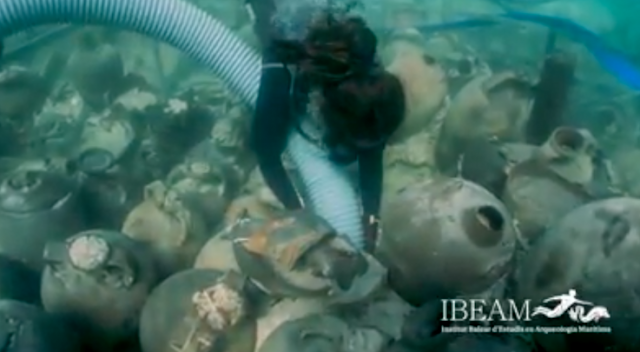
Roman shipwreck yields intact amphorae

An ancient Roman shipwreck has been discovered off the coast of Mallorca in Spain with 93 sealed amphorae inside. Believed to be the wreck of a merchant ship, it was likely carrying a shipment of oil, salt and wine in amphorae from the south of the Iberian Peninsula. The ship was relatively small, measuring just 33 feet long and 5 feet wide, with amphorae stowed in the hold. Many of the vessels remain intact and sealed, meaning their contents may have been preserved.

Experts estimate the ship was dated to the third century A.D

Wednesday, October 2, 2019

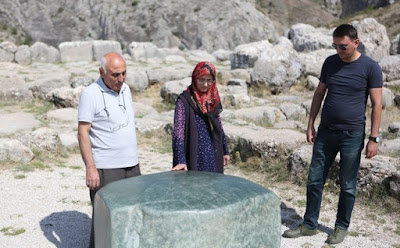
Green rock of Hattusa a mystery

A giant ancient green rock located in the capital of the Hittite Empire in central Turkey is a centuries-old mystery. Visitors to Hattusa, the capital of the empire which lies near modern Boğazkale in Çorum province, admire the beauty of the rock.
Called a "wish stone" by locals, the rock's purpose has yet to be revealed. The rock is different from all others found at the site and is serpentine or nephrite. Researchers believe the stone was used by all civilizations after the Hittites.
The Hittite Empire in the Late Bronze Age was one of the civilizations that played an important role.

Thursday, September 26, 2019

Scientists find microbial remains in ancient Pilbara rocks

Researchers found organic matter in stromatolites -- fossilised microbial structures -- from the ancient Dresser Formation in the Pilbara region of Western Australia. The stromatolites have been thought to be of biogenic origin ever since they were discovered in the 1980s.
Western Australia's 3.5-billion-year-old stromatolites push back the earliest known existence of microbial life on land by 580 million years.

Monday, September 23, 2019

Asteroid collision triggered ancient ice age

Scientists claim a massive asteroid collision may have filled the atmosphere with enough dust to trigger an ice age. They say sunlight-blocking dust remained in the sky for around two million years, effectively causing Earth to freeze. Scientists have long been puzzled by the cause of an ice age that took place 466 million years ago.

Dust is constantly floating down to Earth from space, made from broken parts of asteroids and comets. Scientists believe Earth gains about 40,000 tons of extraterrestrial material every year. Through dating mechanisms, it's possible to verify that a large amount of dust fell around the same time as an ice age began. Not all sunlight would have been blocked – but enough to change Earth's climate. This allowed life to adapt "and even benefit" from the changes, sparking "an explosion of new species".

Sunday, September 22, 2019

Crocodiles revered in ancient Egypt

Several thousand years ago, an Egyptian mummy supplier crept up on a wild crocodile and bashed it with a club, fracturing its skull and killing it. The animal was processed. Its damaged skull was fixed. Its body was treated with salts, oil and resins, and wrapped in multiple layers of linen. Its last meal was still in its stomach. The demand for mummified crocodiles was intense in ancient Egypt.

Thousands were bred and reared in captivity to be expertly mummified for offerings to the gods. In addition to people, millions of dogs, cats, foxes, gazelles, baboons, monkeys, horses, lions, goats, even shrews were expertly preserved. Animal mummies were produced in mass quantities mostly as “votives” to make requests of the gods.

Wednesday, September 18, 2019

Scottish gold ring found by metal detectorist brings £17k

Dating from the 17th century, the ring was discovered by a novice metal detectorist on the shores of Loch Lomond. Before the sale, experts managed to discover the ring’s history.

The crest belonged to the Colman family of Brent Eleigh, Suffolk, who made their fortune in the mid 16th century from the cloth trade. It's thought to have belonged to Edward Colman, who became an ardent convert to Catholicism. The inside of the ring bares an engraved “I” for Jesus, a personal symbol that could indicate that the owner was a member of the Jesuits, an undercover society of Catholics which was illegal in England at that time. In September 1678, Jesuits were accused of involvement in plots to assassinate the king and restore Charles II. Edward was listed as a plotter. He was found guilty of treason and hung, drawn and quartered. Considered to be a Catholic martyr, he was beatified by the Pope in 1929.

Tuesday, September 17, 2019

Ancient Humans interbred with Neanderthals


Neanderthal child
In 1997, scientists found the first scrap of Neanderthal DNA in a fossil. Since then, they have recovered genetic material, even entire genomes, from a number of Neanderthal bones. Their investigations have yielded a surprise: Today, 1 to 2 percent of the DNA in non-African people comes from Neanderthals.

That genetic legacy is the result of interbreeding roughly 50,000 years ago between Neanderthals and the common ancestors of Europeans and Asians. Recent studies suggest that Neanderthal genes even influence human health today.
The DNA extracted in 1997 was from the original specimen of Neanderthals, found in the Neander valley near Dusseldorf, Germany. It suggested that the Neanderthal lineage is four times older than the human lineage, meaning that Neanderthals split off much earlier from the hominid line than did humans.

Humans and Neanderthals split from a common ancestor in Africa some 600,000 years ago. At some point afterward, the ancestors of Neanderthals spread to Europe, the Middle East and Central Asia. Along the way, Neanderthals took on a distinctive anatomy — a stocky, powerful build — and became impressive hunters.
Now scientists have found that the genes flowed both ways. In a study published in Nature, a team of scientists reported that another instance of interbreeding left Neanderthals in Siberia with chunks of human DNA. In 2010 scientists recovered about 60 percent of a Neanderthal genome from fossils found in a Croatian cave.

A toe bone from a male Neanderthal dating back at least 50,000 years.
Neanderthals shared certain mutations with living Europeans and Asians, but not with modern Africans. They concluded that humans must have interbred with Neanderthals after leaving Africa.

Three years later the complete genome of a male Neanderthal was recovered from a toe bone dating back at least 50,000 years, which had been discovered in the Altai Mountains of Siberia. Comparing the Altai genome to modern human DNA confirmed the interbreeding.

Wednesday, September 11, 2019

Burgess Shale yields first spiders/scorpions

Burgess Shale have yielded another ground-breaking fossil find. This time its the oldest known ancestor of today’s spiders and scorpions.
Mollisonia plenovenatrix is over 500 million years old. It had large eyes to spot prey. Long limbs propelled it across the sediments. Its head was like a modern multi-tool with limbs that could sense, grasp, crush and chew.

The tiny pair of structures in front of its mouth are the same pincers on all members of the family Chelicerata. That’s 115,000 different species, and here is the one that started it all.

See ----->Theft from Burgess Shale

Tuesday, September 10, 2019

Poodle from Hell

In 2015 scientists unearthed a spectacularly preserved, nearly complete fossil in northeastern China of a feathered dinosaur with wings like those of a bird, although they doubt the strange creature could fly.

The researchers said the fast-running meat-eater was about 6 feet (1.8 meters) long and covered with simple hair-like feathers over much of its body, with large, quill-like feathers on its wings and long tail.

Finding the dinosaur raises questions about why wings evolved in the first place.
The largest-known dinosaur with wings, it lived about 125 million years ago during the Cretaceous Period. Paleontologists dubbed the dinosaur, named Zhenyuanlong suni, a "fluffy feathered poodle from hell."

Birds evolved from small feathered dinosaurs. The oldest-known bird, crow-sized Archaeopteryx, lived about 150 million years ago.