Monday, September 21, 2026

Gladiators - Heroes of the Colosseum


Under Augustus (63 BC - 14 AD), games were allowed only during a few specific days of the year.
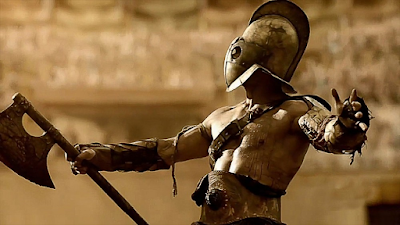
An exhibition called "Gladiators - Heroes of the Colosseum" examined the lives of gladiators. The first documented gladiator fights took place in Rome in 264 BC. Descendants of a deceased citizen had three pairs of slaves compete against each other in the honor of the departed. Typically, the fight would happen in a marketplace. These private battles of nobility became increasingly popular among citizens of ancient Rome.

Gladiators were not always prisoners or slaves. Gladiator schools (ludi - singular: ludus) ensured a supply of highly trained fighters. Many free Roman citizens also joined for fame, money, and glory. The games offered a chance for the most successful warriors to earn redemption, wealth and freedom.

The typical schedule of a fight day started around noon, with executions of criminals sentenced to death. Afterward, circus acts would sometimes take the stage. After a few additional fights, the gladiators were presented as the main act. Women also fought against each other. This was officially banned in the year 200.
A gladiator was most often a slave, socially marginalized, and segregated even in death. The average age of those killed in the arena was around 28. Few gladiators survived more than ten matches. Gladiatorial combat rapidly became an essential feature of social life in the Roman world.

Its popularity led to ever more lavish and costly games. The games lasted for nearly a thousand years, peaking between the 1st century BC and the 2nd century AD. The games declined during the early 5th century after the adoption of Christianity.
The person who presided over the games was called the editor. He could be the emperor, a senator, or other political figure and made the final decision about the fate of the gladiators in the arena.

To make sure the loser wasn’t pretending to be dead, an attendant dressed as Mercury would touch him with a hot iron wand. If still alive, another attendant, dressed as Charon, would kill him with a mallet.
If a gladiator repeatedly survived the arena and lived long enough to retire, they were given a symbolic wooden training sword, or rudis, as a token of their freedom.

Even after winning freedom, the lucrative life of a gladiator appealed: rudiarii were gladiators who had earned their freedom but chose to remain fighting in the arena.

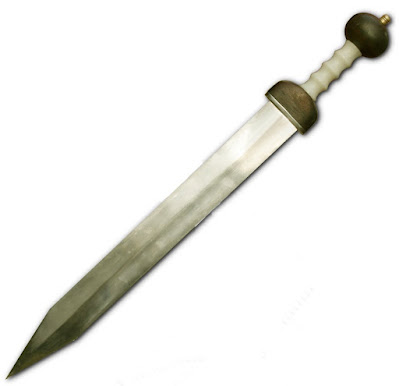
Gladius, an early ancient Roman sword
There were many types of gladiators and each had different weapons. It was usual to pair off combatants with widely different, but more or less equivalent, equipment. Studies have shown that gladiators fought to strict rules and barefooted. During combat musicians performed and altered tempo to match that of the combat.
From left, a disarmed and surrendering retiarius and his secutor opponent, a thraex and murmillo, a hoplhus and murmillo (who is signalling his surrender), and the referee.

Roman Gladiator Dagger

The quadrens was a specialized close-quarter weapon used by the Roman net-fighter, or retiarius.

Roman soldiers were taught to deploy the gladius horizontally, piercing the enemy's ribs and penetrating vital organs.

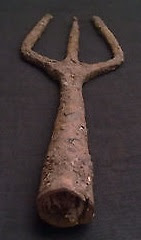
Roman iron gladiator trident.

Gladiator Arm Guard

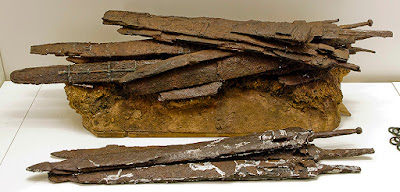
Greaves and dagger discovered at Pompeii's gladiator barracks.

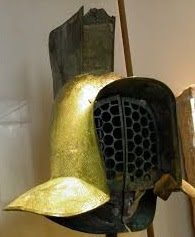
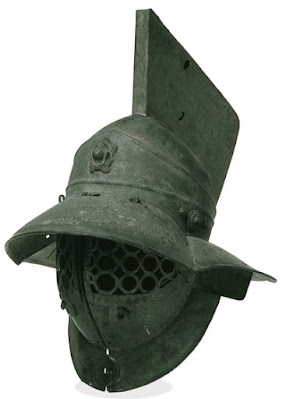
Helmet of a murmillo.

Vivid fresco depicting gladiators from Pompeii

A vivid fresco depicting a gladiator standing victorious as his wounded opponent gushes blood was discovered in Pompeii in 2019.

This formal gesture of submission was known as 'ad digitum'.
A 'murmillo' holds up his shield in his left hand, as he grips his short sword in the right. A murmillo was a slow, heavily armored Roman gladiator who fought with a large rectangular shield and a short sword, named after the Greek word for a type of fish due to his distinctive helmet. On the ground next to him lies the shield of the defeated 'thraex', who was wounded and is bleeding. The thraex is gesturing with his hand, probably asking for mercy.
When a gladiator asked for mercy they raised a single finger, usually the index finger of their left hand.
A Thraex, or Thracian, was equipped with a distinctive Thracian-style weapon and armor, including a small rectangular shield called a parmula and a curved short sword known as a sica. They also wore leg greaves. Gladiators fought to strict rules and barefoot.

Vercingetorix

On September 21, 46 BC Julius Caesar celebrated a triumphal procession in Rome over Gaul, with leader of the Gauls Vercingetorix paraded in chains.
Vercingetorix (c. 82 BC – 46 BC) was a king and chieftain of the Arverni tribe; he united the Gauls in a revolt against Roman forces during the last phase of Julius Caesar's Gallic Wars. Vercingetorix came to power in 52 BC. He established an alliance with other Gallic tribes, took command of combined forces, and led them in the Celts' revolt against the Romans. He won the Battle of Gergovia against Julius Caesar in which several thousand Romans and allies died and Caesar's Roman legions withdrew. Vercingetorix is considered the first national hero of France and was greatly admired in his time, even by his enemies.
Vercingetorix waged the world's first guerilla war. Vercingetorix made swift strikes on the Romans and their supply lines, and then disappeared into the surrounding landscape. There could be no victory for the Romans because there was no enemy for them to engage. The Gauls struck and vanished.
All hope was lost behind the walls in Alesia. Vercingetorix surrendered himself, taking the Romans by surprise. Caesar had him taken away in chains and sent to Rome. The defenders of Alesia were massacred, sold as slaves, or given as slaves to soldiers as spoils. Vercingetorix was exhibited in Caesar's triumph; then he was executed.
Two coins are a fitting set of the two most important generals of the Gallic Wars. They are both Roman Republican silver denarii minted in the 40s BC. Julius Caesar bears his portrait and the title Dictator for Life. The coin was struck February-March 44 BC, the last before his famous demise. The coin depicting Gallic chieftain Vercingetorix was struck by Caesar’s political ally L. Hostilius Saserna in 48 BC, while the Roman general was still vying for control of the Republic with Pompey Magnus.

Sunday, September 20, 2026

Unique ancients


Sicily, Aitna (Catania) Silver tetradrachm c. 465 BCE obverse: bearded Silenus right AITNA ION, “of the people of Aitna.”, beetle below, reverse Zeus enthroned.
The value of ancient coins is determined by three factors other than condition: historical interest, eye appeal, and rarity. Any unique coin of Alexander the Great or other famous figure would be important no matter how battered and worn. But a unique provincial copper of an obscure ruler would likely carry a modest price.
Alexander III of Macedon, double daric, Mobile mint with Alexander’s Army in India, after 326 BCE 16.75 grams.
In 1922 workmen in France unearthed a hoard of gold and silver buried c. 315 CE. Buried was a unique 10-aureus (52.88 gram) gold medallion of Constantius I, father of Constantine the Great. It commemorates his defeat of the British usurper Allectus in 296 CE.
A gold stater of Abydos, issued around 330 BCE. Abydos was located at the narrow crossing point of the Hellespont. Alexander the Great established a mint at Abydos that struck a very few gold staters c. 330 BCE.

Gold aureus of Antoninus Pius

Born on September 20 86 AD, Antoninus Pius was the 15th Emperor of Rome. He was the fourth of the “five good emperors”
Antoninus Pius, also known as Antoninus, was Roman emperor from 138 to 161. He was one of the Five Good Emperors. About A.D. 141 Antoninus Pius ordered the Roman frontier be pushed northward. A gold aureus alludes to his victory in Britain. The coin was struck circa 143 to 144 A.D., at the Rome Mint. The campaign was successful, establishing the 39-mile-long Antonine Wall some 99 miles north of Hadrian’s wall. The Senate acclaimed Antoninus as Imperator in A.D. 143 for the second time.

This coin marks that event, with its depiction of winged Victory holding a trophy symbolizing military success. The aureus made $7,000.

Marcus Antonius and Marcus Antonius Antyllus

The Triumvirs. Marcus Antonius and Marcus Antonius Antyllus. Antyllus was Anthony's oldest son from Fulvia. He was heir apparent to Antony’s interests. It became his death sentence after the downfall of his father. Antyllus was the only child of Marcus Antonius to be executed immediately, while his siblings joined the household of Octavia. Greek tutor Theodorus betrayed the boy’s hiding place to Octavian's soldiers, who dragged Antyllus away and beheaded him. Theodorus stole a precious jewel that Antyllus wore around his neck and sewed it into his belt. Although he initially denied the theft, the crime was discovered, and Octavian ordered Theodorus to be crucified.

Saturday, September 19, 2026

The Colosseum’s inaugural games

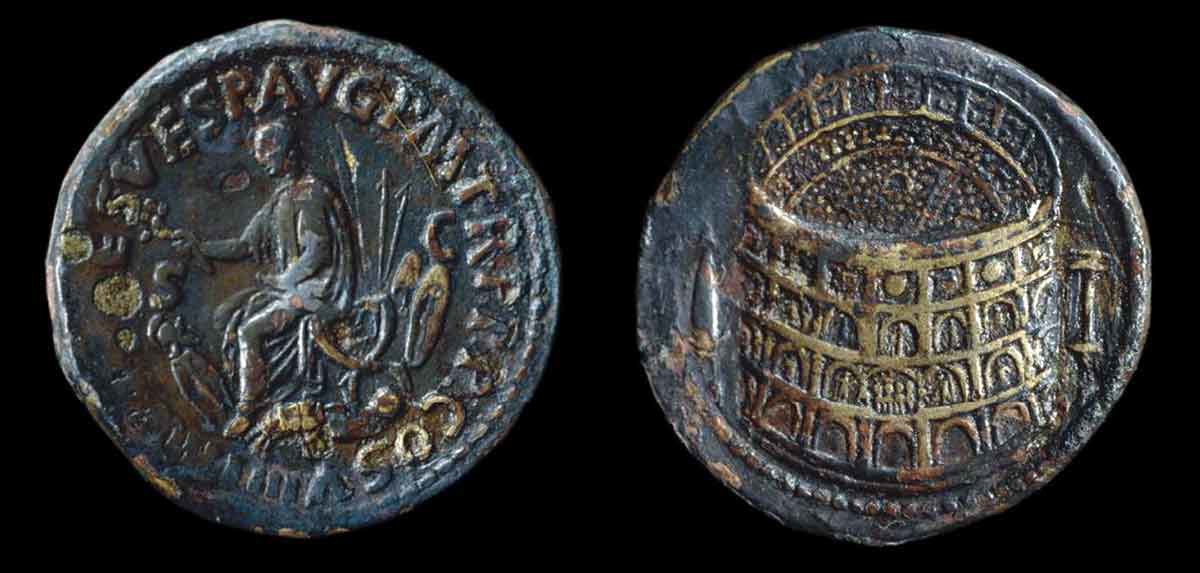
The Colosseum, (Flavian Amphitheater) was completed during the reign of Titus in AD 80 or 81 and inaugurated with 100 days of games and spectacles. The amphitheater was only constructed to the third level when Vespasian died in 79 AD. It was completed by his son and successor Titus. He also built the Baths of Titus beside the Flavian Amphitheater. When it was dedicated, the structure was known as the Amphitheatrum Caesarum. Inaugural games lasted 100 consecutive days. A day at the games would have been an all day affair. The program usually started with animal spectacles in the morning, executions around lunchtime, and either gladiatorial fights or historical re-enactments in the afternoon. The show went on sun or rain, with canopies operated by sailors over the open arena to protect spectators.
Seating was based on class. While seats would have been reserved for senators, others would probably have obtained their tickets by lot. Tickets were made of wood, terracotta, or bronze, and directed the holder to the right entrance for their seat. Rome's population was estimated at up to 1 million at the time.
Tickets weren’t just for seeing the games; they also gave people the opportunity to receive prizes. Bread was handed out freely at the games, and monetary donatives were sometimes made to all spectators. Cassius Dio wrote that during inaugeral games, Titus threw wooden balls inscribed with specific gifts from his seat into the crowd. They could then exchange the ball for the corresponding gift. Prizes included food, clothing, slaves, horses, cattle, gold, and silver.
Writers celebrated a famous bestiarius named Carpophorus. A bestiarius was a specific type of gladiator who trained to perform with animals in the arena. He specialized in fighting ferocious and exotic animals like lions, leopards, bears, boars, and rhinos during venationes (arena animal hunts). Some 9,000 animals were used in the inaugural games.

Executions were at noon when the sun was at its hottest. This spectacle the emperor wasn't involved in. Senators and upper class left for lunch during the executions and returned afterward. Titus was likely not present during executions.
Executions were usually carried out as crucifixions or maulings by wild animals. (Damnatio ad bestias) Murderers and enemies of the state from the lower classes were most often sent to the public games. They were also sometimes killed as elaborate re-enactments of stories from myth. Roman citizens convicted of major crimes were usually beheaded instead of crucified.
Naumachia were re-enactments of famous naval battles. Most afternoons were reserved for popular gladiatorial combat.

The Holzthum Hoard

Archaeologists in northern Luxembourg unearthed a stash of Roman gold coins in 2019 near the ruins of a burgus. (small Roman fortress or tower) The coins were minted during a collapsing Western Roman Empire, just before Roman troops abandoned the region around 406 C.E. The coins span Roman emperors who reigned during the fourth and fifth centuries—including Eugenius, an illegitimate usurper who ruled the Western Roman Empire for two years. Coins were excavated at an archaeological site in the northern village of Holzthum. The Holzthum Hoard consists of a total of 141 solidii, encompassing nine Roman emperors, who reigned between 364 and 408 AD.
The burial site was a Late Roman military fort, based on the foundations of the building that the cache was deposited in. The Roman emperors were Valentinian I, Valens, Gratian, Valentinian II, Theodosius I, Magnus Maximus and the ursurper Eugenius, of which three solidii were attributed to him, minted in Lugdunum, modern day Lyon. Eugenius, whose brief reign resulted in clashes with Theodosius I, and subsequent demise at the Battle of the Frigidus in September 394, meant few of his coins were minted.

The gold solidi are in excellent condition and because they include very rare examples, experts evaluated the coins at 308,600 euros. The Ministry of Culture paid the valuation as a finder’s fee to the landowner and acquired the coins for the nation. They will go on public display after they are conserved and studied.
Flavius Eugenius (ruled 392–394 AD) was a rhetoric teacher turned Western Roman usurper. Because his reign was brief his gold solidi are among the rarest and most sought-after coins of the late Roman Empire.

Eugenius solidus, Treveri 392–394. Very rare. A superb portrait of fine style and a lovely light reddish tone. Almost invisible marks, otherwise extremely fine. 40,000 CHF in May 2026.
141 solidii around the time of Theodosius I was a huge sum. Roman Cavalryman earned about 180 base copper coins (nummi) per day. At an exchange rate of  7,200 nummi to 1 solidus, one solidus represented about 1.5 months of military service. A standard foot soldier earned less, meaning 1 solidus could represent up to 2 full months of pay at the time.

The stele of Titus Flavius Bassus (eques of the ala Noricum) a Roman cavalryman from 1st century AD.

Roman calceus

The intricately punched, 2,000-year-old Roman leather shoe excavated at the Saalburg fort in Germany in 1907 belonged to a wealthy, high status woman. The shoe dates to the first half of the 2nd century. (100–150 AD). The stylish calceus (a type of enclosed shoe), survived for two millennia because the oxygen-poor, waterlogged environment it was found in drastically slowed decomposition. In ancient Rome, women’s shoes were decorated with embroidery, motifs and often with lace, displaying the wealth and social status of the Roman woman who wore them. Saalburg was a Roman fort on the summit of Mount Tanus and part of Roman border fortifications. With the surrounding village, the fort was home to about 2,000 Romans in its heyday.
The Saalburg fort was constructed in 90 A.D. and remained in operation until 260 A.D.
See ----- The Roman shoe hoard of Vindolanda

Friday, September 18, 2026

Trajan - optimus princeps

Trajan was born on this date, September 18, 53 AD.
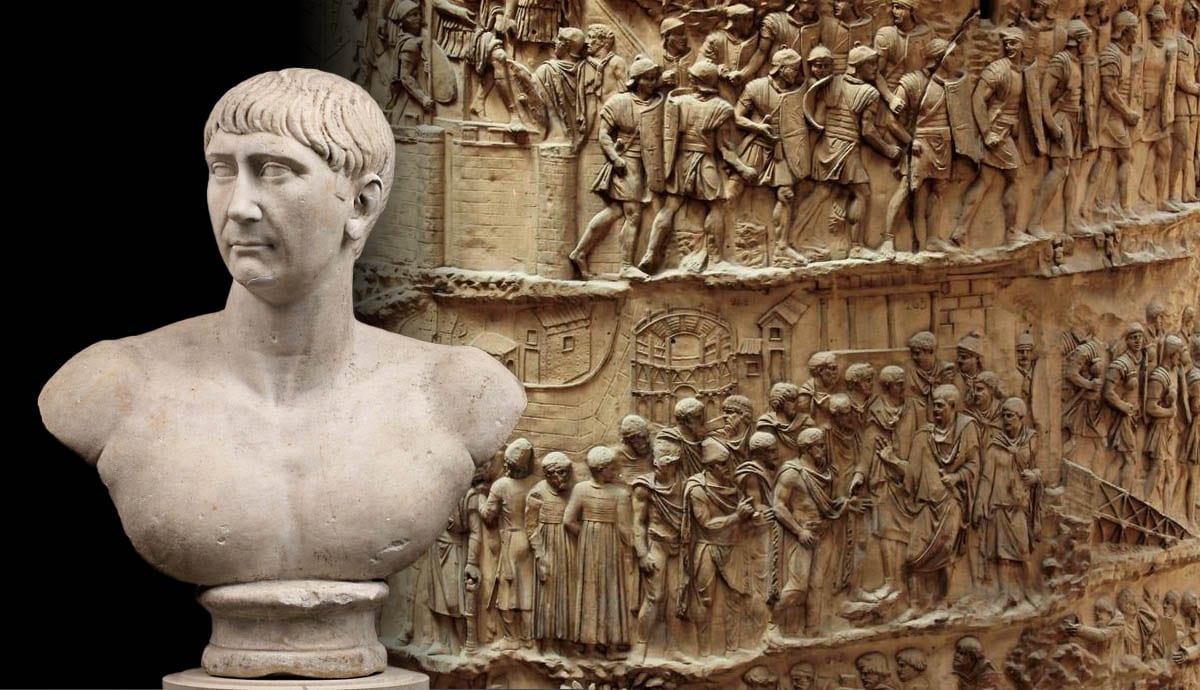
Trajan (Marcus Ulpius Traianus) was Roman emperor from 98 to 117 AD. He was officially declared by the Senate optimus princeps. ("the best ruler") Trajan is remembered as a successful soldier-emperor who presided over the greatest military expansion in Roman history, leading the empire to attain its maximum territorial extent by the time of his death. Trajan was the first emperor born outside Italy. Trajan is best known for his public building program, which reshaped Rome and left many landmarks such as Trajan's Forum, Trajan's Market and Trajan's Column.
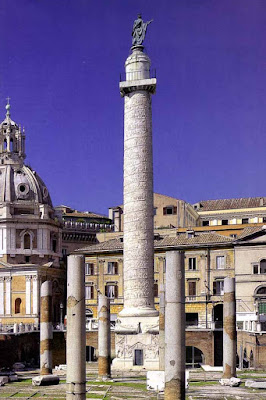
Early in his reign, he annexed the Nabataean Kingdom, creating the province of Arabia Petraea. His conquest of Dacia enriched the empire greatly, and paid for many of Rome's monuments. Trajan's Column was the crowning glory of the Forum Traiani. Covered by a continuous frieze of the war's events, the column was capped with a gilded heroic statue of the emperor.
In 107 Trajan devalued Roman coinage. He decreased the silver purity of the denarius from 93.5% to 89% – the actual silver weight dropping from 3.04 grams to 2.88 grams. This devaluation, coupled with the massive amount of gold and silver carried off after the Dacian Wars, allowed the emperor to mint a far larger quantity of denarii than his predecessors.

Trajan was succeeded by his adopted son Hadrian.
In late 117, while sailing back to Rome, Trajan fell ill and died of a stroke in the city of Selinus. He was deified by the Senate and his ashes were laid to rest under Trajan's Column.
Aureus struck circa late 113-114 showing Trajan's column.
The Roman Empire reached it's maximum territorial extent under Trajan.
In April 2025 a Trajan aureus dating from 114-117 CE, was unearthed at Newstead in the Scottish Borders. The obverse features a portrait of the Emperor, while the reverse shows the Parthian king surrendering.