Monday, October 5, 2026

Saffron


Saffron, the world’s most expensive spice, is extracted from the flowers of the saffron crocus, Crocus sativus. It has been used for over 50,000 years. Saffron was a precious commodity treasured across ancient civilizations for medicine, dye, perfume, and rituals. It was cultivated and traded extensively. Saffron was a prized luxury item in ancient Rome, symbolizing high status and extreme wealth.
Romans sprinkled saffron essences and scattered saffron threads in public spaces, royal halls, theaters, and banquet rooms to deodorize and perfume the air. When Emperor Nero entered Rome for a triump in 67 AD, citizens famously spread saffron along the streets for him. It wasn't a bloody military victory, Nero was celebrating his 1,808 first-place prizes in music, poetry, and chariot racing. According to Suetonius Nero rode in the historical triumphal chariot used by Augustus.
He wore a purple robe covered in gold stars and held his musical crowns proudly in his hands. The procession traveled through the Circus Maximus, the Velabrum, and the Forum up to the Temple of Apollo on the Palatine. As he passed, citizens and attendants showered him with birds, ribbons, sweets, and the very expensive saffron. The spectacle alienated the Roman aristocracy and military commanders and accelerated unrest that forced Nero's death months later in June 68 AD.
The first known use by humans of wild crocuses was as pigment for cave paintings, about 50,000 years ago in today’s Iraq. Ancient texts from Sumer, Assyria, and Babylonia also describe the use of wild crocuses in medicine and dye. Ancient artworks and genetics point to Bronze Age Greece, in 1700 BCE or earlier, as the origin of saffron’s domestication. Domesticated saffron can only be propagated asexually with human help. The process was first described by the Greek philosopher Theophrastus in the fourth century BCE. Today, domesticated saffron is grown for use in cooking and perfumes and as a yellow dye. 16000 flowers, requiring up to 470 person-hours to collect, yield a single kilo, worth between $1,300 and $10,000.
Dense patches of crocus flowers on the fresco ‘The Saffron Gatherers’ from the island of Santorini (1600 BCE) suggest cultivation.
Around the globe today, all saffron crocuses are effectively clones dating back to saffron’s emergence in ancient times.

The Zliten mosaic

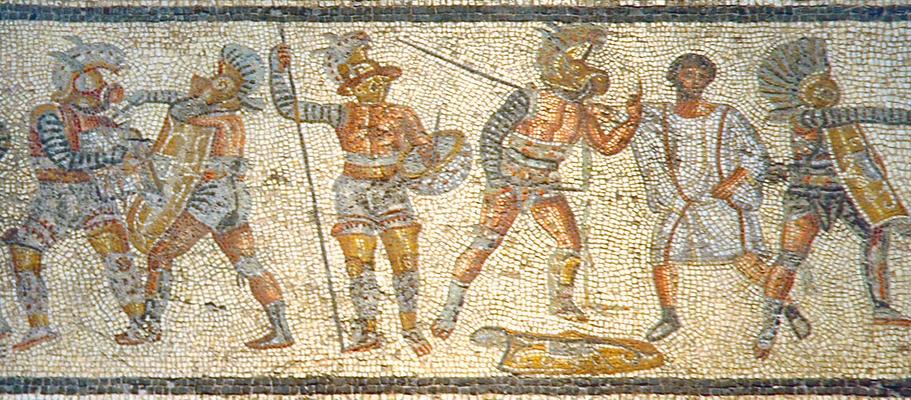
The Zliten mosaic is a Roman floor mosaic from about the 2nd century AD, found in the town of Zliten in Libya, on the east coast of Leptis Magna. It was the birthplace of Septimius Severus.
Gladitorial combat between equites, a retiarius and secutor, a thraex and murmillo, a hoplomachus and a bleeding murmillo who is appealing to the referee.

It depicts gladiatorial contests, animal hunts, and scenes from everyday life.
The mosaic was discovered in 1913 and is now on display at The Archaeological Museum of Tripoli.
Gladiatorial contests alternate with animal hunts. Across the top border musicians and combat scenes appear. Music was played during contests, accompanying the tempo of the action. Gladiators followed many rules and always fought barefoot. Across the right-hand border there are scenes of damnatio ad bestias (execution by beasts) and venationes (staged animal hunts). The opposing borders are damaged but show more gladiatorial combat across the bottom and venationes on the left.

Sunday, October 4, 2026

Roman trade with India

The Roman Empire funded up to half its empire from tax on trade with India. At the height of Rome’s power, the richest city in the western world ran a huge, unbalanced trade account with a land its armies never reached.
Pliny the Elder, who had governed provinces, put the annual outflow at 50 million sesterces in bullion. The emperor Tiberius complained Roman wealth was passing to foreigners. Domitian built dedicated warehouses for pepper in the heart of the city attempting to control prices. A single shipload, recorded in a surviving papyrus, was valued at close to 9 million sesterces, a massive sum. Based on those numbers, customs duties on Indian cargoes produced close to half of the revenue needed to finance the empire. Two legions in Egypt held the customs house that made the scheme work.
India sent pepper, ivory, gems, perfumes and medicines.
Romans prized Indian black pepper, precious gemstones like beryl, pearls, sapphires, and fine cotton and silk textiles along with ivory. Rome paid in gold and silver. Taxes on imports and exports produced the revenues for the state.
The Red Sea corridor required a trip by ship of 4,500 km, (2800 mi) followed by a caravan route of 380 km (236 mi) across the Egyptian Desert, and then another 760 km (472 mi) by ship on the Nile, for a total distance of 5,640 km (3500 mi). The Persian Gulf corridor required a trip by ship of 2,350 km (1460 mi) from India and then by caravan across the Syrian desert for 1,400 km (870 mi), for a total of 3,750 km (2330 mi). To get to India, Chinese silk had traveled another 5,000 km (3100 mi) across the mountainous terrain of Central China.
Great braziers of incense were burned at the Colosseum in Rome to cover the stench of the blood and gore left in the hot sun. During mass spectacles like gladiatorial games and wild beast hunts (venationes), the volume of organic waste created a severe odor problem. Romans honored their dead by burning prodigious quantities of incense at their funerals. The wealthier the dead, the more elaborate the ceremony. Pliny reported that at the funeral of a guilty Nero’s consort Poppaea, a full year’s supply of Rome’s incense was consumed.

Facing severe financial problems, Vespasian tried in vain to restrict the import of Indian luxury goods to Rome. Vespasian even taxed the collection and trade of urine around AD 70. Romans traded human urine as a valuable industrial commodity because stale urine breaks down into ammonia, a powerful natural cleaning and bleaching agent.

Poppaea

Saturday, October 3, 2026

Cool ancient - Alyattes of Lydia

Alyattes is the name inscribed in the Lydian language on early electrum coins. That is King Alyattes (reigned c. 619–560 BC). He was the father of Croesus, who succeeded him around 560 BC. This is among the first coins ever minted for general circulation.
LYDIAN KINGDOM. Alyattes or Walwet (ca. 630-mid-6th century BC). EL 1/24 stater or myshemihecte (6mm, 0.57 gm). NGC AU★ 5/5 - 4/5. Lydo-Milesian standard. Sardes mint. Head of boar right / Incuse square punch with geometric design. Spier p. 332, 6. Rosen 282 (A5/P5). Weidauer Series XIII (unlisted denomination). Kurth G13 (same rev. punch). cf. SNG Kayhan 1011 (hemihecte). Possibly the finest certified of its type. Radiating, honey dies.
The coin is bid to $4,600 USD with 8 days to go. Here

Vercingetorix

On August 3, 52 BC the battle of Alesia ended with the utter defeat of the Gauls. The Roman victory established Roman hegemony over Gaul which continued for more than 500 years. On September 21, 46 BC Julius Caesar celebrated a triumphal procession in Rome over Gaul, with leader of the Gauls Vercingetorix paraded in chains.
Vercingetorix (c. 82 BC – 46 BC) was a king and chieftain of the Arverni tribe; he united the Gauls in a revolt against Roman forces during the last phase of Julius Caesar's Gallic Wars. Vercingetorix came to power in 52 BC. He established an alliance with other Gallic tribes, took command of combined forces, and led them in the Celts' revolt against the Romans. He won the Battle of Gergovia against Julius Caesar in which several thousand Romans and allies died and Caesar's Roman legions withdrew. Vercingetorix is considered the first national hero of France and was greatly admired in his time, even by his enemies.
Vercingetorix waged the world's first guerilla war. Vercingetorix made swift strikes on the Romans and their supply lines, and then disappeared into the surrounding landscape. There could be no victory for the Romans because there was no enemy for them to engage. The Gauls struck and vanished.
All hope was lost behind the walls in Alesia. Vercingetorix surrendered himself, taking the Romans by surprise. Caesar had him taken away in chains and sent to Rome. The defenders of Alesia were massacred, sold as slaves, or given as slaves to soldiers as spoils. Vercingetorix was exhibited in Caesar's triumph; then he was executed.
Two coins are a fitting set of the two most important generals of the Gallic Wars. They are both Roman Republican silver denarii minted in the 40s BC. Julius Caesar bears his portrait and the title Dictator for Life. The coin was struck February-March 44 BC, the last before his famous demise. The coin depicting Gallic chieftain Vercingetorix was struck by Caesar’s political ally L. Hostilius Saserna in 48 BC, while the Roman general was still vying for control of the Republic with Pompey Magnus.

Friday, October 2, 2026

The secutor

The secutor was a heavily armoured Roman gladiator. The name means chaser or persuer. The character emerged from a murmillo around 50 AD.
Most often his opponent was the lightly armed retiarius: no helmet, little armour. Just a net, a trident and a dagger. The helmet was built against all three. Small round eye holes, too narrow for a trident's prongs to enter. A smooth, rounded shell, nothing for a net to snag. He was dressed as a fish and his opponent was the fisherman.
Found at Pompeii, the helmet survived in a theatre courtyard turned into gladiators' barracks.
Flamma, a Syrian, was a famous Roman secutor. He died at the age of 30, after having fought 34 times. He won 21 times, drew 9, and needed missio (to be spared) 4 times. Flamma's gravestone was discovered in Rome. It was erected by a fellow gladiator named Secundus. The inscription translates to: "Flamma, secutor, lived 30 years, fought 34 times, won 21 times, drew 9 times, reprieved 4 times, a Syrian by nationality. Secundus made this for his well-deserving comrade-in-arms."

Thursday, October 1, 2026

Pyrrhic Victory

Taras or Tarentum, in Calabria, is modern Taranto in southern Italy. When the Romans broke a treaty with Taras in 282 B.C. to subdue an adjacent Greek city, Taras expelled the Roman garrison from the captured township. The Romans sought revenge.

Bust of Pyrrhos
Taras appealed for help to King Pyrrhos of Epirus in northwestern Greece. Pyrrhos embarked upon the Pyrrhic War of 280-275 B.C.E. A skilled commander, with a strong army fortified by war elephants, Pyrrhus had initial success against the Roman legions, but suffered heavy losses even in victory. 3 battles represent the origin of the phrase “Pyrrhic victory” The battle of Heraclea was a decisive victory for Pyrrhus, who employed a tight phalanx formation with elephant charges. Though the win was complete, it caused high casualties of Pyrrhus’ best troops.
The next battle of Asculum was a similar result; the Romans attempted to repulse the elephants with war wagons but failed. The Romans withdrew to higher ground. The Romans were worse off, but Pyrrhus lost thousands of men and his best officers. The battle of Beneventum was either inconclusive, a Roman victory or a victory for Pyrrhus. The Romans repulsed the elephants and send them rampaging through Pyrrhus’ lines. The result drove him from Italy and in 278 B.C.E. Pyrrhos abandoned Taras to its fate.
He returned in 275 B.C.E., but was soundly defeated and returned to Epirus. Three years later Taras was besieged and the city finally fell to the Romans.
A superbly struck example of a rare gold stater from the ancient Greek city state of Taras (Tarentum) in southern Italy, a.k.a. Calabria. The 8.55 g coin dates from 276-272 BC. The obverse shows the head of Zeus. On the reverse an eagle with wings displayed perches on a thunderbolt.
$ 18,000 in VF.

EPIRUS. Pyrrhus (297–272 BC). Silver tetradrachm (16.56 gm). $60K in 2012.
After the particularly bloody Battle of Asculum in 279 BCE, Pyrrhus famously remarked: “If we are victorious in one more battle with the Romans, we shall be utterly ruined.” This would live forever in the phrase “Pyrrhic victory”.

The silver tetradrachms were a high-value coin and were struck with dies engraved by the most skilled artisans.

Pyrrhos, King of Epiros, (297-272 BC.), AV Stater, 8.55g, Struck in Syracuse, 278 BC. $180k.

To pay mercenaries needed to fight the Carthaginians, Pyrrhus produced a huge issue of gold staters and half staters at Syracuse. The finest engravers were hired to produce stunning designs.

Wednesday, September 30, 2026

Hadrian - Hercules Gaditanus

An aureus of Hadrian depicting Hercules Gaditanus, the principal deity of Gades (modern Cádiz), on the reverse. Issued early in Hadrian’s reign, in AD 119, the coin celebrates Hadrian’s connection to his mother’s native city and associates him with the city’s cult of Hercules. Hercules stands with his club and the apples of the Hesperides, beside a prow and the personification of Gades, with the legend HERC GADIT (Hercules Gaditanus).

The mines of Ancient Greece

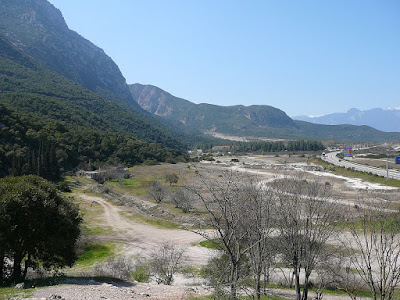
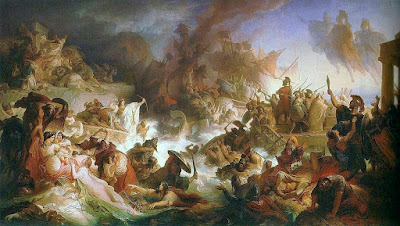
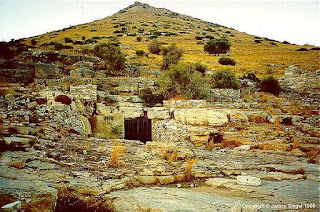
In 480 BCE, the Persian army defeated the Greeks at the Battle of Thermopylae and invaded parts of Greece. When all seemed lost, Themistocles proposed an unusual plan: the Greeks should not face the superior Persian soldiers on the battlefield, but instead invest in a fleet. In the naval battle of Salamis, the newly-built ships destroyed the Persian fleet.
Without a navy to support their army, the Persians were forced to retreat. The battle of Salamis was a critical turning point. The ships that won the battle of Salamis were paid for with silver from the mines of Laurion. 20,000 slaves worked to provide the silver for the fleet. Without it victory would have been impossible.
Discovery of major veins of ore meant that at the beginning of the second Persian invasion of Greece in 480–479 BC, the Athenian state had at its disposal a hundred talents of silver. (about 2.6 tonnes)
After the defeat of Persia, Sparta and Athens waged a long and taxing war. As the silver mines became exhausted, a backwater territory, Macedonia, thrived and became the new power. The gold mines of Macedonia played a critical role. The largest gold mines in antiquity were operating in Macedonia and Thrace and they supported the rise of Philip II and his son, Alexander the Great.

Evolution of gold coins

Gold has been used as a medium of exchange and a store of wealth for millennia due to its rarity, desirability, and high value. Ancient gold coins were first introduced for commerce in the kingdom of Lydia (modern Turkey) during the reign of King Croesus in the 6th century BC. The earliest coins were made from electrum, a naturally occurring alloy of gold and silver. Electrum wasn't always desirable. When coinage gained popularity a way to standardize the purity of gold and silver was needed.
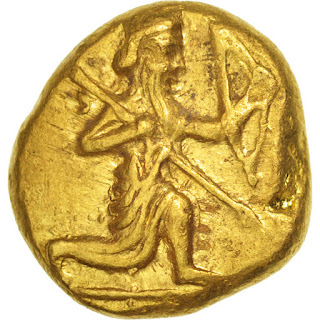
The first technique of gold parting was invented by Croesus: salt cementation. King Cyrus and the Persians defeated the Lydians in 546 B.C., and the region became part of the Achaemenid Persian Empire. Through trade and conquest the Persians spread the use of gold coinage throughout the Mediterranean. The most popular gold coin of the empire was the Persian daric, introduced by Darius the Great sometime around 500 B.C. Production of darics continued for nearly two hundred years, until the Persians were defeated by Alexander the Great.
Alexander and his armies looted some 700,000 troy ounces of gold coins from the Persians. These ‘spoils of war’ were subsequently melted and used to mint coins in his name.

In Britain and elsewhere, a number of Celtic tribes issues coins in gold. The early Roman Republic issued few coins in gold, their main coinage being in silver, with bronze or copper for smaller denominations. From the death of Julius Caesar, gold coinage became an important part of the Roman financial system.

See ----->Gold of Croesus