Showing posts with label Expensive Ancient Coins. Show all posts

Thursday, July 2, 2026

Expensive ancient coins

A gold aureus of Diadumenianus (or Diadumenian). He was son and co-emperor of Macrinus who ruled from April 217 to June 218. Macrinus came to power by murdering his predecessor, the demented Caracalla. He then made Diadumenianus, his 9 year-old son, co-emperor. Defeated in battle, both were hunted down and executed by rebel troops. In 1973 an aureus sold for $65,825 USD. In 2018 a comparable example made $336k.
Julius Saturninus was the Roman governor of Syria. He was forced by his troops and an unruly mob to proclaim himself as emperor in the year 280. After a few months, he was killed by his own troops. Only two coins are known. One resides in the French national collection, the other sold by Sotheby’s in 1972 for $61,500. It appeared again at auction in 1991 and brought $180k. 
Jewish War Year 5 Silver Shekel. Judea rose in revolt in the year 66. The war dragged on for five bloody and bitter years. Around 25 genuine examples of the Year 5 shekel are known. One appeared at auction in 2020 and brought $300k.
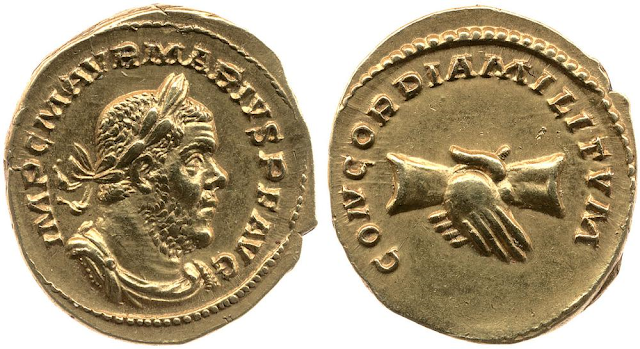
Marius aureus. In 269 CE, a blacksmith who had risen through the ranks of the Roman army on the Rhine was proclaimed emperor by his troops under the name “Marcus Aurelius Marius”. He reigned for a few months before he was executed, according to legend with a sword that he had forged. Only 9 gold aurei of Marius exist. The sole undamaged coin in private hands sold for $59,305 in 1972. When it came to market again in 2003, it made $138,598.

Wednesday, April 23, 2025

Expensive ancient coins

The record holder for an ancient Greek coin is the facing portrait gold stater of Pantikapaion, which brought $3.2m in a 2012 New York auction. Pantikapaion on the Black Sea coast of Crimea grew wealthy shipping grain from Ukraine’s fields to feed Greek cities. Weighing 9.12 grams, the coin was struck between 350 and 300 BCE. On the reverse a griffin stands over an ear of wheat, surrounded by the first three letters of the town’s name. The obverse shows the bearded head of a satyr.
Syracuse Tetradrachm of Kimon. Greek cities of Sicily during the fifth century BCE brought the art of coin die engraving to levels that would not be seen again for 1300 years. Cities like Syracuse, Akragas, Leontinoi and Naxos competed to celebrate their deities on large silver ancient coins. $3m a record for a Greek silver coin.
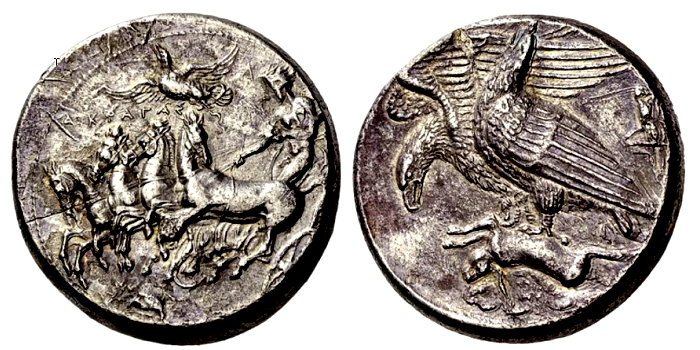
Akragas Dekadrachm. Until it was sacked by the Carthaginians in 406 BCE, Akragas (now Agrigento) was one of the largest and wealthiest cities in the Greek world. $2.4m
Dekadrachm of Athens. With only around 40 genuine examples known (and many convincing fakes), the silver dekadrachm of Athens struck c. 467-465 BCE is one of the most desired ancient coins. The obverse depicts the helmeted head of the goddess Athena. The reverse shows an owl, wings outspread. At 42.5 grams, the coin is so large that it pushed the limits of hand-hammered minting. $ 850,000
Gold Stater of Athens. A handful of gold staters and fractions were struck as an emergency wartime issue in 406-407 BCE. Four examples of the 8.6 gram gold stater are known, three of them in museums. The fourth brought $783k in 2008.