
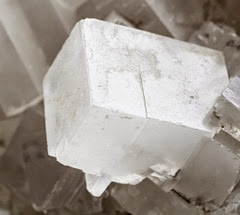
 Halite rock salt (NaCl) | Salt is a mineral made up of cube-shaped crystals composed of two elements, sodium and chlorine. It is translucent, colourless, and odourless. Salt has always had a permanent place in the life of human beings. Salt was considered sacred, a gift from the Gods; it was used to confirm oaths and sacrifices. Salt served as money at various times and places, and the quest for salt has been the cause of warfare. Offering bread and salt to visitors is a sign of hospitality from ancient times. |  |
 | Prior to industrialization, it was expensive and labor intensive to harvest the mass quantities of salt necessary for food preservation and seasoning. This made salt a very valuable commodity throughout history. Mining salt causes rapid dehydration. Accidental excessive sodium intake was often fatal. (hypernatremia) | 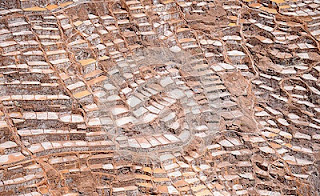 Entire economies were based solely on salt production and trade. |
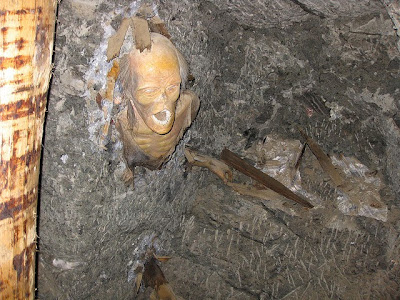 | The 'Man in Salt' greets visitors at the Salzwelten Hallstatt Mine, Austria. In 1734 a corpse preserved in salt was discovered in the deposit. Salzwelten Hallstatt is the world's oldest salt mine, with a history of salt extraction spanning over 7,000 years. |  |
 | At the Chehrabad Salt Mine, Iranian miners recently uncovered the 6th salt man to be found in the last 15 years. Salt men are ancient corpses killed or crushed in the cave and mummified by the extreme conditions. Hair, flesh and bone are all preserved by the dry salinity of the cave, and even internal organs have been found intact. The first salt man, dated to 300 A.D., was discovered in 1993, sporting a long white beard, iron knives and a single gold earring. In 2004 another mummy was discovered 50 feet away, followed by another in 2005 and a "teenage" boy later that year. The oldest of the salt men has been carbon dated to 9550 B.C. |  |
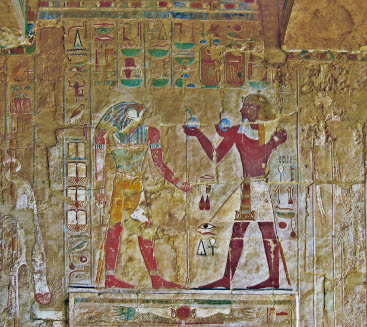 | Egyptians may have been the first civilization to preserve fish and meat with salt. Food that could be preserved was extremely valuable. Recognizing the worth of preserving food, Egyptians turned to trade. The Egyptians did not export salt by itself, it was bulky and difficult to transport. Food that was salted was transported easily over long distances without spoiling. | 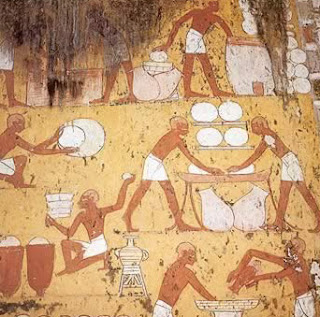 |
 Boiling brine into salt in China. | In the Iron Age evaporated salt was obtained by boiling seawater or brine in clay pots over a fire. Roman salt making entailed boiling seawater in large lead-lined pans. In ancient Rome, salt on the table was a mark of a rich patron; those who sat nearer the host were "above the salt," and those less favored were "below the salt". Roman salt mining was often done by slaves and prisoners, and life expectancy was short. |  Malta Roman salt flats |
 Ancient Roman glass salt dishes | Roman salt extraction relied on coastal solar evaporation ponds (salinae), inland brine springs, and underground rock salt deposits. The most famous marine salt works of Rome were the salinae located at the mouth of the Tiber, where extensive lagoons existed in antiquity. Salt was a strategic necessity for the Roman army. A salarium was a standard monetary allowance or stipend given to soldiers to buy their own salt and daily necessities. |  Roman salt pans in Hortales. |

No comments:
Post a Comment