The Boscoreale Treasure is a large collection of exquisite silver and gold Roman objects discovered in the ruins of the Villa della Pisanella at Boscoreale, near Pompeii.
 | It consists of 109 pieces of silverware, as well as gold jewellery (necklaces, bracelets and earrings) and over 1,000 gold coins. Items from the hoard date from the 4th century BC to the 1st century AD. Many of the silver items from the treasure are considered masterpieces of Roman art. A Julius Caesar aureus,8.17gm, 46 BC, with Boscoreale Toning Ch XF. Strike: 5/5 Surface: 3/5 €32.500.
|  |
Boscoreale was buried by volcanic ash following the eruption of Mount Vesuvius in 79 AD.
  Skeleton cups of the Boscoreale Treasure Skeleton cups of the Boscoreale Treasure | Among those who escaped Mt. Vesuvius was the owner of Villa Pisanella, a popular wine producing villa. It's believed that the owner was Lucius Caecilius Iucundus, a wealthy merchant and banker who was the son of a freed slave.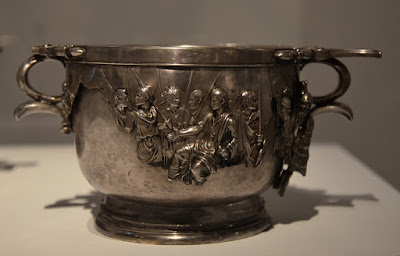 |  The priceless hoard was found in 1895. The priceless hoard was found in 1895. |
The coins were stored in an empty cistern in the wine cellar. With a general exchange rate of one aureus as pay for one month of work, it is a significant sum.
 | The coins are known as “Boscoreale” aurei because of the distinctive toning found on many of them. Gold itself is inert, but when made into coins, it is alloyed with small amounts of silver and copper which are susceptible to toning.
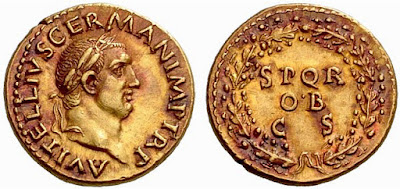 |  |

Over the 1,800 years that the coins spent buried beneath the ash and pumice from Vesuvius, some examples developed significant toning. |  | |


No comments:
Post a Comment