Showing posts with label Octavian and the Battle of Actium. Show all posts

Tuesday, July 7, 2026

Octavian and the Battle of Actium

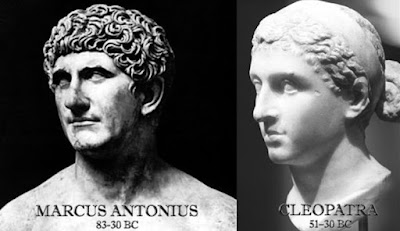
In 43 BCE, Octavian formed the Second Triumvirate with Marc Antony and Lepidus. They defeated Brutus and Cassius and divided the empire with Octavian holding most of the West and Antony the East. In 33 BC, the Second Triumvirate ended, leaving Antony without legal authority. Octavian then began a campaign against him, declaring war against Cleopatra.
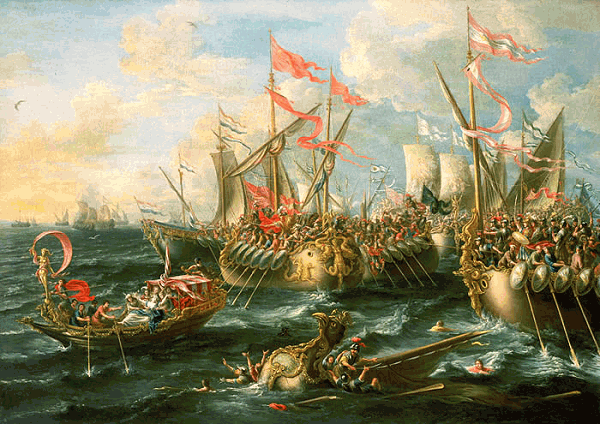
The Battle of Actium was a naval battle fought between Octavian's fleet, led by Marcus Agrippa, and the combined fleets of Mark Antony and Cleopatra on 2 September 31 BC in the Ionian Sea. In early 31 BC, Antony and Cleopatra were temporarily stationed in Greece. Mark Antony possessed 500 ships and 70,000 infantry and made his camp at Actium. He was soon trapped on both land and sea. Antony's fleet sailed out through the straits of Actium in a desperate attempt to break free of Marcus Agrippa's naval blockade. While fleets were about equal, Antony was eventually routed by Octavian's smaller, more maneuverable ships. On September 2, Antony and Cleopatra managed to escape with a small force, leaving the rest of his army to surrender to Octavian. The end came in Alexandria on 1 August 30 BC. Antony and Cleopatra committed suicide.
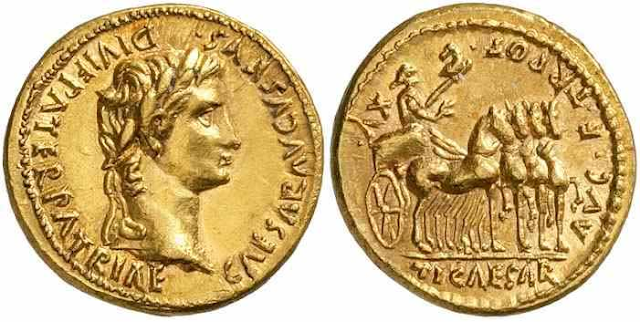
Octavian's victory enabled him to consolidate power. He adopted the title of Princeps (first citizen), and in 27 BC was awarded the title of Augustus (revered) by the senate. The reign of Augustus gave Rome a golden era known as the 'Pax Romana' during which he served for 41 years. It was Augustus’ coinage reform in 23 BCE that saw the aureus come into consistent use.


The lifetime aureus shown was minted while Octavian retained his name, around 32-31 BC and the time of the Battle of Actium. It features the inscription "CAESAR DIVI F" on the reverse, which translates to "Caesar, son of a god".

Saturday, May 9, 2026

Octavian and the Battle of Actium

Emperor Augustus died on August 20 in 14 AD of natural causes while visiting Nola. He was 75. He was the founder of the Roman Empire, and reigned as the first Roman emperor from 27 BC until his death. August is named in his honour.
This aureus was made between 27 B.C. and 18 B.C. The early lifetime coin depicts the new portrait of Augustus transformed into an ageless Apollo-like figure on one side and an image of a heifer based on a long-lost masterpiece by a Greek sculptor on its reverse. 22 examples of the heifer-reverse aureus minted during the reign of Augustus are known, of which 15 are in museums. £400k
Octavian was the son of Julius Caesar's niece, Atia. Octavian was 20 years old when he learned of Caesar's assassination. Caesar had no living legitimate children under Roman law and so had adopted Octavian, his grand-nephew, in his will, making him his primary heir. Octavian returned to Italy to avenge Caesar's murder. In 43 BCE, he formed the Second Triumvirate with Marc Antony and Lepidus. They defeated Brutus and Cassius and divided the empire, with Octavian holding most of the West and Antony the East.
Antony and Cleopatra grew closer as Octavian worked to restore Italy. In 33 BC, the Second Triumvirate ended, leaving Antony with no legal authority. Octavian began a campaign against him, declaring war against Cleopatra.
Octavian’s admiral Marcus Agrippa held Antony’s fleet back in the bay of Actium in Greece. Antony and Cleopatra escaped, leaving the rest of his men to surrender. Antony fled to Alexandria where he and Cleopatra eventually took their own lives in August, 30 BCE; this marked the end of the Roman civil wars.


This coin was minted in Rome, 13-14 AD.
Rome was officially transformed from a Republic to a Principate in January, 27 BCE. Octavian was crowned 'Augustus'. Over the next 40 years, Augustus shared his authority with the Senate. It would not be until Augustus’ coinage reform in 23 BCE that the gold aureus would come into standard use. In addition to his reorganization of the state and institutions of Rome, Augustus introduced a formal system of fixed ratios between denominations of coins.