Saturday, July 5, 2025

The aureus

The aureus was a gold coin of ancient Rome originally valued at 25 pure silver denarii. The aureus was regularly issued from the 1st century BC to the beginning of the 4th century AD, when it was replaced by the solidus.

The aureus was about the same size as the denarius, but heavier due to the higher density of gold. Caesar began striking the coin more often, and standardized the weight at 1/40th of a Roman pound (about 8 grams).

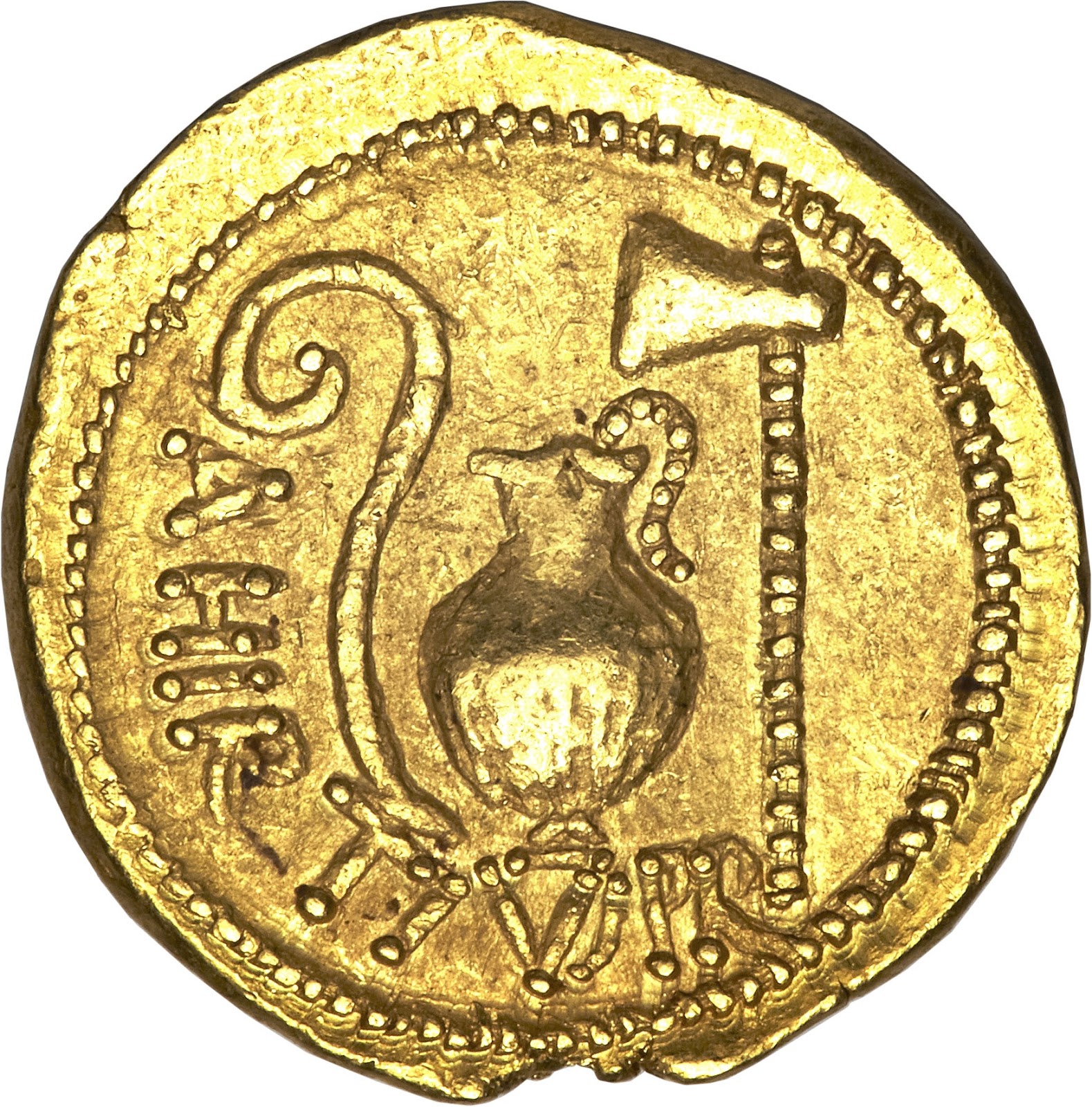
This unique gold aureus of Augustus Caesar realized $781,675 U.S.
Augustus (29 BC – 14 AD) decreed the value of the sestertius as 1/100th of an aureus. The aureus was decreased to 1/45th of a pound (7.3 g) during the reign of Nero (54–68).
This aureus celebrates Trajan’s war against the Parthians between 114 and 117 CE. The Romans temporarily conquered important cities such as Ctesiphon and Seleucia, but these were subsequently retaken after his death. After the reign of Marcus Aurelius (161–180) the weight of the aureus fell to 1/50th of a pound (6.5 g).
The solidus was introduced by Diocletian (284–305) around 301 AD, struck at 60 to the Roman pound (5.5 g) and with an initial value equal to 1,000 denarii. The solidus was reintroduced by Constantine I (306–337) in 312 AD, permanently replacing the aureus as the gold coin of the Roman Empire. The solidus was struck at a rate of 72 to a Roman pound of pure gold, 4.5 grams of gold. Inflation was affected by the debasement of the silver denarius, which by the mid-3rd century had practically no silver left in it.
In 301, one gold aureus was worth 833 denarii; by 324, the same aureus was worth 4,350 denarii. In 337, after Constantine converted to the solidus, one solidus was worth 275,000 denarii and finally, by 356, one solidus was worth 4,600,000 denarii.

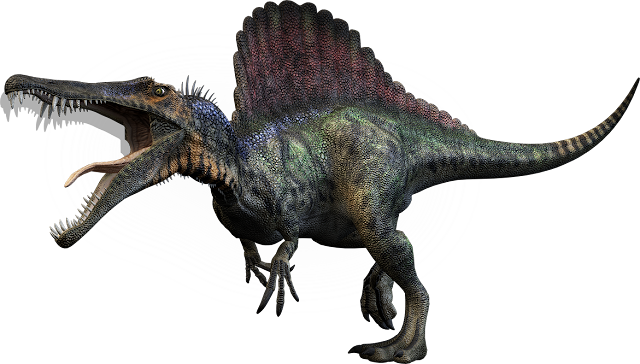
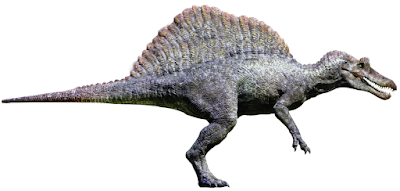
Spinosaurus, largest of all the carnivorous dinosaurs

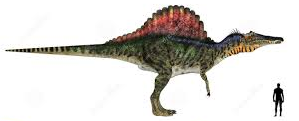
The largest dinosaur predator that ever stalked Earth was also the strangest. Spinosaurus aegyptiacus was the largest carnivore dinosaur of all time. It measured 18 meters (50 feet) long, 4.9 to 7.7 meters (16 to 25 feet) tall and 12 tons. Spinosaurus lived in Cretaceous North Africa from 102 to 93 mya
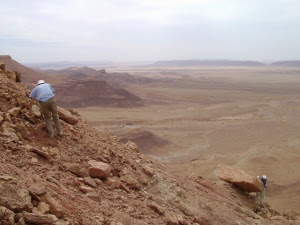
In 2014 scientists discovered in Moroccan desert cliffs new fossil remains of Spinosaurus aegyptiacus, a monster that breaks the mold for how a dinosaur predator looked and behaved.
It was roughly 2.5 metres longer than T-rex and equally massive.
The distinctive spines of Spinosaurus, which were long extensions of the vertebrae, grew to at least 1.65 meters (5.4 ft) long and likely had skin connecting them.

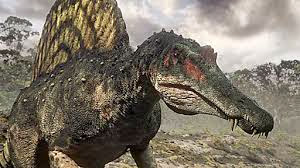
Spinosaurus is the only known carnivorous dinosaur adapted for a semi-aquatic lifestyle. Spinosaurus roamed the swamps of what is now North Africa. Spinosaurus terrorized a vast North African river system from Morocco to Egypt. Spinosaurus's environment was "the most dangerous place in the history of our planet."
Spinosaurus was the undisputed king of waterways teeming with sharks and 11-metre crocodilians. Flying reptiles with wingspans of seven meters soared overhead. It may not have been very agile on land but would have taken down anything unfortunate enough to be in it's path.

Friday, July 4, 2025

Gold of Tutankhamun

In 1922, the tomb of Tutankhamun was discovered by British archaeologist Howard Carter.

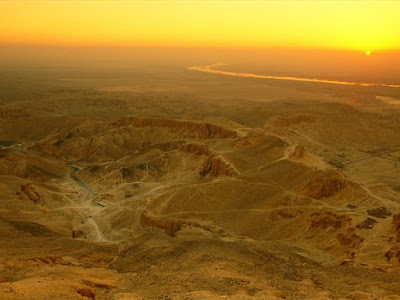
It was in the fall of 1917 when Carter and his sponsor, Lord Carnarvon, began excavating in earnest in the Valley of the Kings.

Carter stated there were items bearing the name Tutankhamun - a faience cup, a piece of gold foil, and a cache of funerary items, that convinced him that the tomb had not yet been found. Carter was determined to search down to the bedrock. By late 1922, Carter began his fifth and final season in the Valley of the Kings by having his workers expose the workmen's huts at the base of the tomb of Rameses VI. After exposing the huts, Carter and his workmen began to excavate the ground beneath them. By the fourth day of work, they had found something - a step that had been cut into the rock.


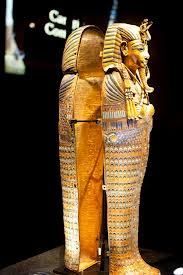
Work feverishly continued and 12 stairs leading downwards were revealed; and in front of them, stood the upper portion of a blocked entrance. Carter had discovered an ancient royal Egyptian tomb, one that had lain nearly undisturbed for over 3,300 years. When the boy king was found he rested inside three golden coffins. The first two were carved in wood. The coffin was first overlaid with sheet gold on a thin layer of plaster. Narrow strips of gold, placed on edge, were then soldered to the base to form cells in which small pieces of colored glass, fixed with cement, were laid.The third coffin is 296 pounds (135Kg) of gold.

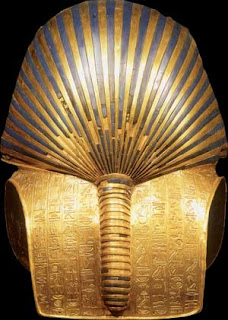
The death mask is solid gold, beaten and burnished, and was placed over the head and shoulders of Tutankhamun's mummy, outside the linen bandages in which the whole body was wrapped. It weighs about 24 pounds. (10.9kg)

The stripes of the headdress are made of blue glass. The vulture's head upon the brow, symbolizing sovereignty over Upper Egypt, is also solid gold, apart from the beak, which is made of horn-colored glass, and the inlay of the eyes, which is missing. By its side is the cobra, symbolizing sovereignty over Lower Egypt, its body made of solid gold, its head of dark blue faience, its eyes of gold cloisonne inlaid with translucent quartz backed with a red pigment, and its hood inlaid with carnelian, lapis lazuli, turquoise-colored glass, and quartz.


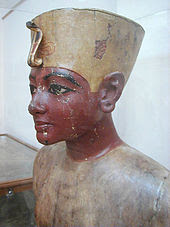
Wooden bust of the boy king.

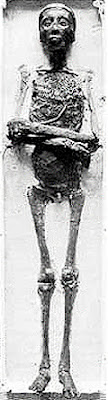
There is speculation about the fate of the boy king who inherited the throne at 11, and who died around 1324 BC at age 19. Tests performed on 16 royal mummies found four, including Tut, had contracted a severe form of malaria that likely cut short Tut's reign -- ruling out murder or some other sickness. Research showed that Tutankhamun also had "a slightly cleft palate" and possibly a mild case of scoliosis, a medical condition in which the spine is curved from side to side. Examination of Tutankhamun's body has also revealed deformations in his left foot, caused by necrosis of bone tissue. The affliction may have forced Tutankhamun to walk with the use of a cane, many of which were found in his tomb.

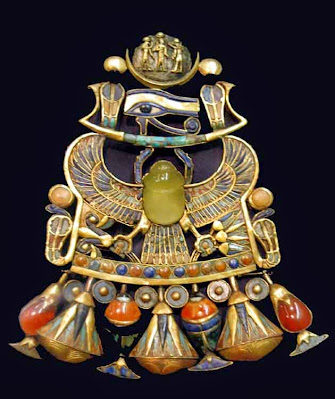
A rebus pectoral scarab worn by King Tut-ankh-amun from Thebes. It symbolizes the birth of the moon and the sun and was part of the king's coronation regalia.


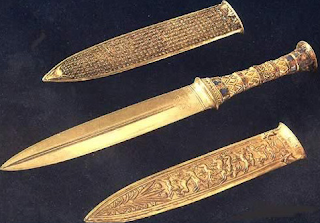
Gold Dagger and Sheath


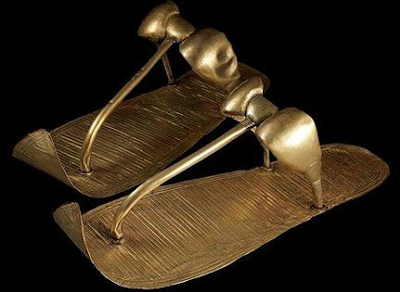
King Tut's golden sandals
In 2014 new evidence suggested pharaoh King Tutankhamen was killed by a chariot that smashed his rib cage, shattered his pelvis, and crushed his internal organs, including his heart.

After being sealed in his tomb in 1323 B.C. His mummified body caught fire and burned from flammable chemicals that built up in his decomposing body.

Sunday, June 29, 2025

Lampsakos

Lampsakos (Lampsacus) was an ancient Greek city located in modern day Turkey, strategically situated on the eastern side of the Hellespont.
Lampsakos was founded by Greek colonists in the 6th century B.C. It became main competitor of Miletus, controlling the trade routes in the Dardanelles. During the 6th and 5th centuries B.C., Lampsacus was successively dominated by Lydia, Persia, Athens, and Sparta.

LAMPSAKOS, Stater c. 360–340, Persic standard, AV 8.47 g. Obv. Laureate and head of Zeus left, lotus-tipped sceptre on right shoulder. Rev. Pegasus flying right
Lampsakos was the first ancient Greek city state to see its gold coinage reach broad acceptance for international trade, a testament to its prosperity and influence. The stater of Lampsakos became very popular, circulating from Sicily to the Black Sea.
In 196 BC, the Romans defended the town against Antiochus the Great, and it became an ally of Rome. Lampsacus was notable for its worship of Dionysus/Priapus, who was said to have been born there.

Saturday, June 28, 2025

The 'Dolphin Rider' coinage of Tarentum

Tarentum, the city upon which modern Taranto, Italy was built, was founded in the eighth century BCE. Some attributed the civic beginnings to Taras, the legendary son of Poseidon and Satyria, a local nymph. In his myth, Taras falls from his ship during a storm, and is miraculously rescued and brought to shore by a dolphin. Starting in the very late sixth century BCE, Tarentum began issuing coinage paying tribute to the dolphin.
Though many denominations were struck over the ensuing three centuries, the most iconic was that of the nomos, a silver coin equivalent to two drachmai. Corresponding in size to U.S. nickel, these coins were a staple in regional trade.
A vast quantity were struck owing to the fact that Tarentum was one of the most populous cities in the world around 500 BCE.