Saturday, July 19, 2025

Returned Stolen Treasure

Two Roman ballista balls from Gamla were returned. The 2,000-year-old stones were left in a bag at the courtyard of the Museum of Islamic and Near Eastern Cultures.
In 1993, a retired Red Army officer dropped off 101 drawings by masters like Goya, Manet, and Delacroix at the German embassy in Moscow. They had been looted from the Bremen museum in 1945 by Soviet soldiers.
The looting of the Baghdad Museum as Saddam Hussein’s government crumbled was devastating for antiquities lovers. In 2003, three men anonymously returned one of Iraq’s most precious treasures in the back of a car. The Sacred Vase of Warka, a massive limestone bowl, dates to around 3200 B.C.
In 2001 a London dealer received an anonymous phone call that led him to his doorstep to six fragments of Roman frescoes taken from Pompeii.

They had been stolen 16 years earlier.

In 2006, just a year after a 1,500-year-old stone box from the Mayan civilization was found in Guatemala, it mysteriously vanished. After a national investigation, it returned through an anonymous delivery at the country’s Ministry of Culture.
In 1950 a group of 11 small ancient clay figurines were found in a Utah canyon. They belonged to a long-vanished people called the Fremont Culture, who had lived in the region from 700 to 1300 A.D. For two decades, these pieces, which came to be known as the Pilling Collection, toured around Utah museums. In the early 1970s, one of the figures mysteriously failed to show up. In 2011, an anthropologist at Utah State University received a box with the missing piece.
In 2007 the J Paul Getty Museum returned disputed antiquities, including a prized statue of the goddess Aphrodite. Italian authorities believe the 7ft statue, bought by the Getty for $18m in 1988, was looted from an ancient Greek settlement in Sicily.
In April 2015 some 123 artefacts were seized by US customs as part of a five year investigation into international smuggling networks dubbed Operation Mummy's Curse. One item, a 2,300 year-old sarcophagus was found in a garage in Brooklyn.

Castellón Alto

Between 2200 BC and 1550 BC, the Argaric roamed the southeast of the Iberian peninsula, from Granada to Alicante and from Almeria to Ciudad Real. About 1900 BC the Argaric built a fortified settlement near the village of Galera in Granada’s Altiplano region. It became known as Castellón Alto.
Each inhabitant’s position in the social structure was determined by which terrace they lived on.
Crowning the settlement is where the leaders had their homes. A total of nine graves, all cyst burials beneath the dwellings, have been found compared to a total of 130 tombs.
One of the high status tombs contained a bowl, a jar, a halberd (a two-handed pole weapon) and a short copper sword. The Argaric people of Castellón Alto denuded the valley sides of trees for fuel and building. This is likely the reason for it being abandoned after only 300 years.

Friday, July 18, 2025

Mosaic returned to Pompeii

An ancient mosaic, stolen by a Nazi officer during World War II, has been returned to Pompeii. The piece was stolen from the Roman ruins by a German Wehrmacht captain stationed in Italy. It later resurfaced in Germany as part of a private estate. Relatives, aware of its origins, contacted Italy’s Carabinieri art protection unit to return it. Experts at the Pompeii archaeological park believe the artifact likely came from a private home, though its exact original location remains unclear.

Thursday, July 17, 2025

The Crondall Hoard

The Crondall Hoard was found in 1828 in a field in Crondall, England.
Anglo-Saxons began striking coins in what was to become England around 600 CE. Early coins consisted almost entirely of the small gold coins known as 'thrymsas', which were struck in imitation of the Merovingian tremissis. Fewer than 400 thrymsas are known, and 73 of these came from the Crondall Hoard. The Hoard dates to no earlier than about 620 and no later than about 650.
The 73 thrymsas show little sign of circulation, indicating that coin production was limited.

Circa 620-635. AV Thrymsa. Kent and Essex, Eadbald (616-640). Obverse: Diademed, draped bust right; trident cross. Reverse: Latin cross on a globe within a pelleted inner circle.
The most important Crondall coin is the Eadbald thrymsa. It is the earliest known coin to name an English king; 50 years would pass before another coin naming an English king would appear. The Crondall Hoard contained one example.
Twenty-one of the 73 thrymsas in the Hoard are of the “Witmen Monita” type.
The extreme rarity of Crondall Type coins makes them very pricey for collectors. Most reside in museums.

Monday, July 14, 2025

Ancient gold coins found in Jerusalem's Old City

In late 2020 Israeli archeologists discovered four gold coins in Jerusalem's Old City that were minted from the 940s to the 970s, a period of radical political change. During that period, the ruling Sunni Abbasid caliphate, headquartered in Baghdad, lost control of Jerusalem to its rival, the Shiite Fatimid dynasty of North Africa. The Israel Antiquities Authority said the coins were unearthed during excavation work near the Western Wall, which is the holiest site where Jews can pray.

The find marks the first time in over fifty years that a gold cache from the Fatimid period has been discovered in Jerusalem's Old City.

Thursday, July 10, 2025

Crusader-era gold found off coast in Northern Israel


The coins are gold florins, minted in Florence, Italy, starting in 1252. The ship must have sailed in the last half of the 13th century.
In 2017 30 gold coins were found amid the remains of a Crusader-era shipwreck discovered off the coast of Acre in northern Israel. The city of Acre is on Israel’s Mediterranean coast, north of Haifa. In the 13th century it was one of the most important strongholds left to European Crusaders in the Holy Land. Archaeologists dated the shipwreck's wood to 1250 A.D. But the gold coins showed that the ship likely sailed later than that.

Crusader Fortress : Old City of Acre – Northern Israel
At the siege of Acre, as Christian citizens made a desperate attempt to flee the city, the knights made their doomed last stand. The Mamluks of Egyptian sultan Al-Ashraf Khalil dug tunnels and the castle’s foundation collapsed, burying the doomed Templars. The sultan’s flag soon flew over Acre, and the Egyptian forces systematically dismantled the Crusader city, leaving its seaport in ruin.

Monday, July 7, 2025

Ancient gold of royal Haihunhou cemetery

Archaeologists digging in the royal Haihunhou cemetery in Nanchang City in eastern China in 2016 unearthed gold coins, gold sheets, gold ingots, and other relics from the Han Dynasty. It is believed to be the tomb of Liu He, grandson of Emperor Wu and the Marquis of Haihun. He was installed as emperor in 74 BC but was deposed after only 27 days as emperor.
The Western Han Dynasty (202 B.C.-25 A.D.) tomb is one of the few imperial tombs not to be looted. In addition to the gold coins, hoof-shaped gold ingots, jade pendants and 2,000-year-old goose-shaped bronze lamps were also found. Finds include 20 thin gold sheets.
The site covers more than 43,000 sq ft. Liu He was the first Haihunhou, or marquis of Haihun State, a small kingdom in the north Jiangxi Province. The cemetery has been explored since 2011. More than 10,000 items have been discovered, with 110 of the items put on exhibition at the Jiangxi Provincial Museum in Nanchang.
When Prince He's uncle Emperor Zhao died in 74 BC without a son, the regent Huo Guang rejected Liu Xu, the Prince of Guangling and the only surviving son of Emperor Wu, from the succession. He turned to Prince He, who was Emperor Wu's grandson. The remains of Liu were found in a coffin in the interior chamber of the main tomb and removed in January 2016 for further research.

Turtle-shaped jade stamp

The Athenian Owl Tetradrachm

The Athenian Owl tetradrachm was minted for over 400 years, beginning around 512 B.C.
Following the city’s defeat of the Persians at the Battle of Marathon in 490 B.C., Athens entered a period where it was the principal city of the Greek world. Athens controlled the nearby Laurium silver mines and was able to produce high-quality silver coinage in vast quantities.
The Athenian Owl gained widespread use due to it's high silver content and high production. The Athenian government minted coins at a profit, building state coffers. The Athenian Owl tetradrachm would remain the dominant currency in the ancient world until Roman coinage replaced it in the 1st century B.C.
Despite many revisions, the general design remained the same. The obverse depicts the Greek goddess Athena, who represents wisdom and warfare. The ideals are portrayed in Athena’s large eyes, representing wisdom, and her crested war helmet, representing war.
The Owl appears with two-leaf olive sprig, representing olives and olive oil, the primary exports of Athens.

Sunday, July 6, 2025

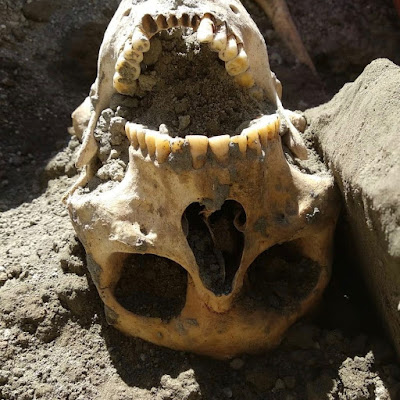
Crippled Pompeii man suffocated

With his skull in hand, experts believe that the man died from being suffocated by the volcanic ash that rained down on Pompeii, rather than being squashed by the rock.
The skeleton was found in an area of new excavations in 2019, close to a newly-discovered alleyway of houses with balconies.
Archaeologists discovered silver and bronze coins that he had been carrying in a leather pouch. It contained 22 coins, worth 80 sestertii, enough to sustain a family for a month.
Excavations of the ancient Roman city of Pompeii have revealed the skeleton of a man who may have been decapitated by a large stone block as he fled from the catastrophic 79 C.E. eruption of Mount Vesuvius. Possibly hampered by a bone infection, he fled through an alleyway after surviving the first ejections that rained down on the city. He was thought to met his demise when struck by a stone. His body was found at roughly the same height as the second floor of a nearby building, suggesting he ventured outside after the first phase of raining ash had settled. Lesions at the tibia suggest he was suffering from a chronic bone infection. This could have hindered his movements and stopped him leaving Pompeii when the volcano first erupted.
The crippled man was found in an alleyway above a thick layer of lapilli—debris thrown from the erupting Vesuvius. Archaeologists were excavating areas of the city which have not yet been fully explored. This is another remarkable archaeological discovery in Pompeii.