Saturday, August 23, 2025

Treasures of Thrace

Thrace is a historical and geographic area in southeast Europe, centered on the modern borders of Bulgaria, Greece, and Turkey. In antiquity, it was also referred to as Europe, prior to the term to describe the whole continent.
Thrace designates a region bounded by the Balkan Mountains on the north, Rhodope Mountains and the Aegean Sea on the south, and by the Black Sea and the Sea of Marmara on the east. The areas it comprises are southeastern Bulgaria (Northern Thrace), northeastern Greece (Western Thrace), and the European part of Turkey (Eastern Thrace). The biggest part of Thrace is part of present-day Bulgaria. The population of Thrace was a people called the Thracians, divided into numerous tribal groups. The region was controlled by the Persian Empire at its greatest extent, and Thracian soldiers were known to be used in the Persian armies. Later, Thracian troops were known to accompany Alexander the Great when he crossed the Hellespont.
Some of Bulgaria’s famous Thracian treasures were part of a major exhibition at the Louvre Museum in Paris in 2015. The exhibition brought together more than 1,600 objects from 17 Bulgarian museums and several international museums including the Louvre and the Prado Museum, giving visitors an opportunity to see in one place some of the most significant Thracian artifacts that have ever been discovered.
The Odrysian kingdom was mostly on the territory of present-day Bulgaria but also included parts of modern Greece and Turkey. It was a regional power which was involved in the struggle with the Macedonian kingdom and with Athens and Sparta. One of the exhibition highlights is the bronze head of Seuthes III.

Hilt with gold inlay of Seuthes III's sword. ca. 331 BC.
Another highlight was the Panagyuriste gold treasure, which was excavated in 1949 and consists of gold drinking vessels that are elaborately decorated with mythological scenes and images, showcasing the artistic skills of the Thracians.


Rare gold hemidrachm from Thasos, Thracian islands.
Gold and silver greave (knee-piece)

Friday, August 22, 2025

Vetranio - Temporary Emperor

Vetranio entered the army and served with distinction under the mighty Constantine I (AD 306-337), the first Christian ruler of Rome, who even during his lifetime came to be called "Magnus" -- The Great.
Upon Constantine's death, the Roman Empire was split between his three surviving sons: Constantine II, Constantius II, and Constans. In 340 CE, sibling bloodletting eliminated Constantine II and the survivors divvied up the spoils, with the West going to Constans.
A coup toppled Constans early in 350, replacing him with Magnentius, who had no blood connection to the Constantinian dynasty. For 10 months, Vetranio played the man in the middle, alternately professing loyalty to Constantius and telling Magnentius he might be open to an alliance.
Magnentius quickly consolidated his power base. Commanding a large army at a critical crossroads between two rivals, Vetranio was in a delicate position. In December 350, Constantius marched west and met Vetranio at Naissus in modern Serbia.

Constantius
On Christmas day Vetranio formally abdicated the throne. Constantius pensioned him off to an opulent estate in Bithynia. Unwilling to accept Magnentius as co-ruler, Constantius waged a civil war against the usurper, defeating him at the battles of Mursa Major in 351 and Mons Seleucus in 353. Magnentius died by suicide after the latter battle, leaving Constantius as sole ruler of the empire.
Vetranio had played his difficult hand well, and enjoyed a far better fate than most others who claimed the top chair. Having two mints under his control, Siscia and Thessalonica, Vetranio struck coins both in his own name and that of Constantius II. His bronze coinage is scarce, the silver rare, and the gold extremely rare.

Tuesday, August 19, 2025

'Fake' gold coin sells for $2.16m

Mistakenly believed by its owner to be fake, a historic gold coin was authenticated as 'the discovery of a lifetime' by Numismatic Guaranty Corporation in 2019.
It is only the fourth known surviving example of a $5 denomination coin struck at the San Francisco Mint in 1854. The 1854-S Liberty Head $5 gold half eagle was one of the first coins struck at the San Francisco Mint. It made $ 2.16m. Mint records indicate 268 of the coins were made in 1854. The other known coins have a history. One is located at the National Numismatic Collection at the Smithsonian, and another was stolen from the DuPont family in 1967 and hasn't been seen since.

Sunday, August 17, 2025

Famous mythological creatures

The Kraken.
In Scandinavian mythology, the Kraken is a giant sea creature that attacks ships and is so huge that its body could be mistaken for an island. Accounts of the Kraken are believed to have originated from sightings of the giant squid, which can reach 18 meters in length.
The Griffin is a legendary creature with the head and wings of an eagle, and the body, tail, and hind legs of a lion.
While griffins are common in the art and mythology of Ancient Greece, representations of griffins in ancient Persia and ancient Egypt date to as early as the 4th millennium BC. On Crete, archaeologists have uncovered depictions of griffins in the Bronze Age Palace of Knossos dating to the 15th century BC.
Medusa was a famous Greek monster.
She had the face of an ugly woman with snakes instead of hair; anyone who looked into her eyes was immediately turned to stone. She was a priestess of Athena, devoted to a life of celibacy; however as punishment for marrying Poseidon she was cursed. Medusa was beheaded by the hero Perseus, who used her head as a weapon until he gave it to the goddess Athena to place on her shield. In classical antiquity the image of the head of Medusa appeared in the evil-averting device known as the Gorgoneion.
The Banshee is a spirit creature originating in Irish folklore.
She is said to scream when someone is about to die. The foretelling of death was seen as both a blessing and a curse. The Bean Sidhe or Banshee haunts only the families of authentic noble stock and it is with great dread when her piercing "caoine" or keening is heard. The Banshee scream is always a death omen.
Mermaids. In ancient Syrian folklore there was a goddess named Atargatis. She was a fertility goddess whose cult eventually spread to Greece and Rome and was associated with water. Often depicted in mermaid form, Atargatis is perhaps the “original” mermaid.
A Melusine, or siren, has two tails. This creature is from medieval legend. A Melusine was a beautiful woman that transformed into a serpent from the waist down while bathing. This always resulted in calamity.

Saturday, August 16, 2025

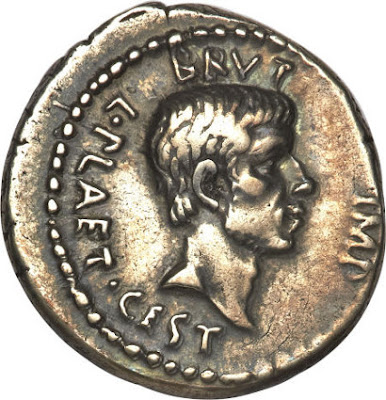
Ides of March - Pawn Stars

An 'Ides of March' coin appeared on PawnStars in 2017.
The Ides of March was a day in the Roman calendar that corresponds to 15 March. It was marked by several religious observances and was notable for the Romans as a deadline for settling debts. The Ides is the 13th for most months, but the 15th in March, May, July, and October. In 44 BC, it became notorious as the date of the assassination of Julius Caesar which made the Ides of March a turning point in Roman history.
The Ides of March marked the transition from the Roman Republic to the Roman Empire. According to Plutarch, a seer had warned that harm would come to Caesar no later than the Ides of March. On his way to the Theatre of Pompey, where he would be assassinated, Caesar passed the seer and joked, "The Ides of March are come", implying that the prophecy had not been fulfilled, to which the seer replied "Aye, Caesar; but not gone."
Caesar's death was a closing event in the crisis of the Roman Republic, and triggered the civil war that would result in the rise to sole power of his adopted heir Octavian.
One of the most famous coins of all time is the EID MAR denarius issued by Brutus in 43/42 BC. Marcus Antonius took advantage and loudly condemned Brutus' actions. Brutus was forced to flee Rome with his soldiers. After several military encounters, Brutus's forces fell to Mark Antony and Octavian. Brutus committed suicide before he could be taken prisoner.
About 60 examples of Brutus's coin are estimated to exist in silver, with only 3 genuine examples in gold. Silver specimens in fine condition have sold at auction for $120k to $150k. Lower grade silver coins occasionally come on the market for around $50k.

In 2011 a exceptional example fetched a record $546,250.

Thursday, August 14, 2025

Detectorists in U.K. land 14th century hoard

In 2019 a 14th century hoard of 557 gold and silver coins was discovered in Buckinghamshire. The haul included a dozen gold coins from the time of the Black Death.
It was one of the biggest coin hoards found in the UK in the last decade. The finders were four amateur detectorists taking part in a local metal detector rally. The finders were initially overjoyed to find a dozen silver Edward I and II coins. At the end of the day they had found 276 silver coins and nine gold nobles. The silver coins are believed to be from the reign of Edward I and II - 1272 to 1327.
The full gold nobles might be worth up to £10,000 each although condition may be an issue. The silver coins might be worth between £20 and £50.

Wednesday, August 13, 2025

King Offa of Mercia

King Offa of Mercia, who reigned between 757AD and 796AD, minted hundreds of Gold dinars featuring his name and the Islamic declaration of faith. The Anglo-Saxon moneyer who made the coins clearly did not understand Arabic. The Arabic inscription is upside down in relation to Offa’s name, and there is abundant evidence Offa was Christian, not Muslim.

King Offa's coins featured the Islamic declaration 'No God but Allah.' This example is only known to exist.
This gold coin might have been one of 365 gold coins Offa reportedly sent to the pope in Rome. Offa may have chosen to mint the gold dinar because it was the dominant coinage in the Mediterranean in this period.
Many surviving coins from Offa's reign carry elegant depictions of him. Some of his coins carry images of his wife, Cynethryth—the only Anglo-Saxon queen ever depicted on a coin. Only three gold coins of Offa's have survived: one is a copy of an Abbasid dinar of 774.

Tuesday, August 12, 2025

Silver in Ancient Egypt

Gold was considered to be the skin of the ancient Egyptian gods and their bones and were thought to be made of silver. At the beginning of recorded history, silver may have been unknown to the ancient Egyptians. Early Egyptian language lacks a word for silver. They described it only as the "white metal".
They could obtain gold and electrum, which was a natural alloy of silver and gold, from the mountains of the Eastern Desert and Nubia. When they did run across silver, they seem to have regarded it as a variety of gold. When silver was introduced into Egypt, it probably was more valuable than gold. It was rare, and on lists of valuables, items of silver were listed above those of gold during the Old Kingdom.
Silver diadem. The double uraei – two sacred cobras, protectors of royal power.

Solid silver casket of Psusennes I. 21st Dynasty who ruled from Tanis between 1047 – 1001 BC.
Jewelry made of silver was almost always thinner than gold pieces, as indicated by the bracelets of the 4th Dynasty queen Hetephere I, in contrast to the extravagance of her gold jewelry.

Gold bracelets of Queen Hetepheres I.
The rulers of the 21st and 22nd Dynasty, who were buried at Tanis used silver in their burials. Sheshonq II had a solid silver coffin with gilded details in the form of the hawk-god, Sokar.

Silver could be stained black using sulphur. This was applied as decoration. Beaten into sheets, silver was used to plate copper and other materials, especially to obtain mirror surfaces. There is no evidence that the Egyptians themselves mined silver. From ancient records it is thought that silver was imported from Mesopotamia, Crete and Cyprus.
A silver treasure found at the site of Tod comprised vessels likely made in Crete. The hoard dates to the reign of Amenemhat II who ruled during the 12th Dynasty. (1962 BC)


Silver mummy mask of Queen Malakaye (Egyptian Late Period)
By the Middle Kingdom, silver was less valuable than gold. By this time a much better supply of the metal had developed. During the 12th Dynasty, silver acquired a value about half that of gold. By the 18th dynasty silver and copper had been established as a means of exchange. Copper was valued at about one-hundredth the value of silver.
Ptolemy II, 285-246 BC, silver dekadrachm

Silver Tetradrachm, Alexandria mint, dated 55/54 BC. Diademed head of Ptolemy I.