Friday, February 6, 2026

The Pereshchepina Treasure


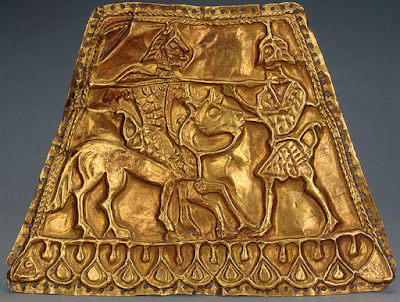
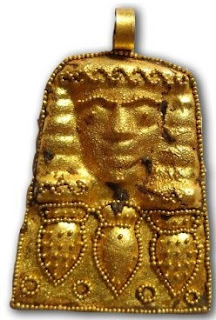
Belt Plaque Gold. Late 7th century BC
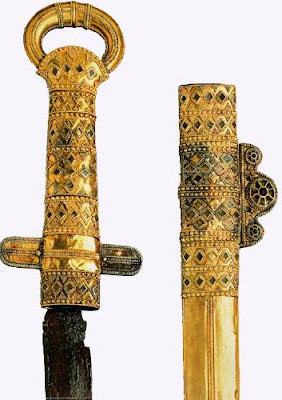
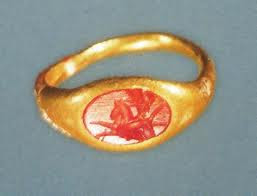
The Pereshchepina Treasure is a major deposit of Bulgarian, Sassanian, Sogdian, Turkic and Avarian objects. The hoard was discovered in 1912 in the village of Mala Pereshchepina (20 km from Poltava, Ukraine) by a boy shepherd who literally stumbled over a golden vessel and fell into what is thought to be the grave of Kuvrat, the founder of Great Bulgaria and father of Asparuh, the founder of the First Bulgarian Empire. The most priceless items are the sword of Kubrat, a gift from Emperor Heraclius and the ring with the monogram of the ruler, as a "patrician", that is, as the savior of the New (Christian) Rome.

Comb with Scythians in Battle. Gold; cast and chased. Late 5th - early 4th century BC

Plaque in the Form of the Head Gold; stamped.Scythian. 4th century BC

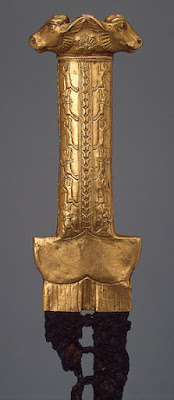
Sword Hilt. Gold and iron; chased. Scythian. 5th century BC
The 800 piece trove contains finely crafted gold artifacts that exceeds 21 kg and 50 kg of silver. (42 pounds, 110 pounds) Items ranged from 500 BC to 670 AD and are objects of Byzantine, Persian and Barbarian origin. Three gold rings are engraved with the monogram of Kubrat, and his 400gm gold patrician buckle and sword were found.
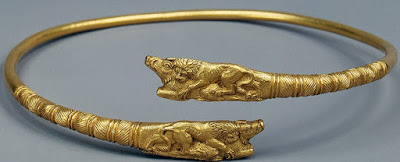
Torque (Grivna) Gold; cast, forged, chased. Meotian Culture. Late 4th century BC

Necklace. Gold; stamped, soldered, filigreed, repousse. Meotian Culture. Late 4th century BC

Plaque with Scythian Warriors. Gold; repousse. Scythian. 4th century BC

Facing for a Horse's Frontlet Gold; stamped. Scythian. 4th century BC

Overlay for a Goryt (Case for a Bow and Arrows) Gold; stamped. Scythian. 4th century BC

Hand-Washing Vessel: Pitcher and Ladle Poltava Region, Ukraine. Silver gilt

Overlay for a Wooden Vessel Gold; stamped. Scythian. First half of the 5th century BC

Pair of Boat-Shaped Earrings Gold; forged, stamped, soldered, filigreed. Scythian. 4th century BC

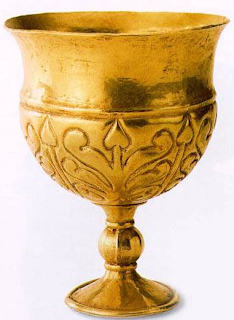
Goblet Poltava Region, Ukraine 7th century

Wednesday, February 4, 2026

Gold bracteate hoard found in Norway

Seven gold pendants were buried in the Norway clay, the precious jewellry most likely a sacrifice meant for the gods. Those same pendants, called bracteates, have now been recovered near the municipality of Råde in Østfold County. A metal detector enthusiast first uncovered four pieces in a plowed field, and archaeologists from the University of Oslo later found three more during a follow up excavation. Researchers date the hoard to the sixth century.
Researchers classify the Råde hoard as a mix of C type and D type bracteates, which helps date the burial to the sixth century. Items were connected to aristocratic communities within a Germanic elite in Scandinavia. The pendants likely acted as visible symbols of status and alliances. Only people with considerable wealth could afford to bury so much high purity gold in the ground and walk away from it.
Tree ring records and glacial data point to a sharp cooling after a series of volcanic eruptions in the years 536 and 540. A study links those eruptions to a veil of volcanic dust that dimmed sunlight, reduced plant growth and brought food insecurity and hungar. Norse stories tell of a legendary Fimbul winter, a long season of darkness and hunger.

Tuesday, February 3, 2026

Treasures of Pompeii

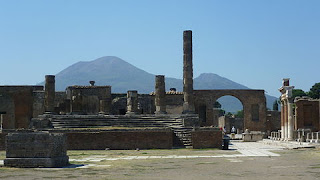
The city of Pompeii is a partially buried Roman town near modern Naples.

When Mt. Vesuvius erupted in 79 AD, Pompeii was burned and buried in ash, while nearby Herculaneum was destroyed by the pyroclastic flow. The area was buried under 4 to 6m (13 to 20 ft) of ash and pumice from the eruption. Pompeii was lost for 1500 years until its rediscovery in 1599 and broader rediscovery almost 150 years later in 1748. Discoveries continue to this day.
The objects that lay beneath the city have been well preserved for thousands of years.
Marble statue with traces of gold-plating from the Temple of Isis, Pompeii.

Helmet of a ‘Thracian’ (Thrax) gladiator. Bronze, from Pompeii.

Mosaic (detail) from Pompeii.

Apollo as an Archer


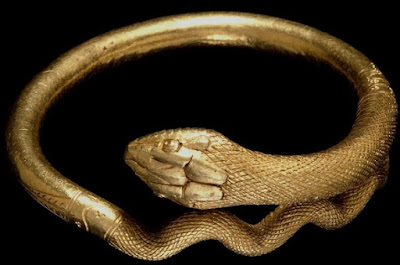
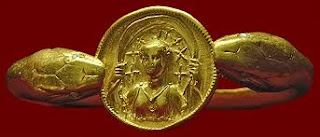
A gold bracelet bears an inscription. On its inside face are the words 'dominus ancillae suae'– from the master (dominus) to his slave-girl (ancilla).

Monday, February 2, 2026

20 ancient wooden coffins uncovered in Egypt

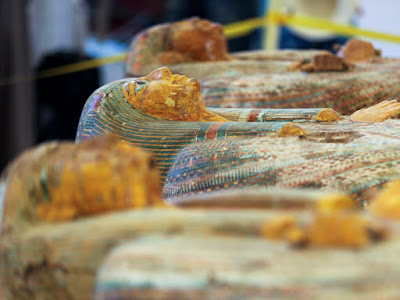
Archaeologists uncovered at least 20 ancient wooden coffins in the southern city of Luxor in 2019.
Archaeologists found the coffins in the Asasif Necropolis. The necropolis is located in the ancient town of West Thebes and includes tombs dating back to the Middle, New Kingdom and Late Periods (1994 B.C. to 332 B.C.)
Researchers cracked open the spectacular wooden coffins and found perfectly preserved mummies. The find is being described as the most important in a century. The coffins are estimated to be 3,000 years old.
The coffins were found sealed and intact, featuring vibrant color inscriptions and well-preserved engravings, both inside and out. Inscriptions suggest the coffins were for children and priests.

Sunday, February 1, 2026

Ancient Byzantine Gold Coin in Norway

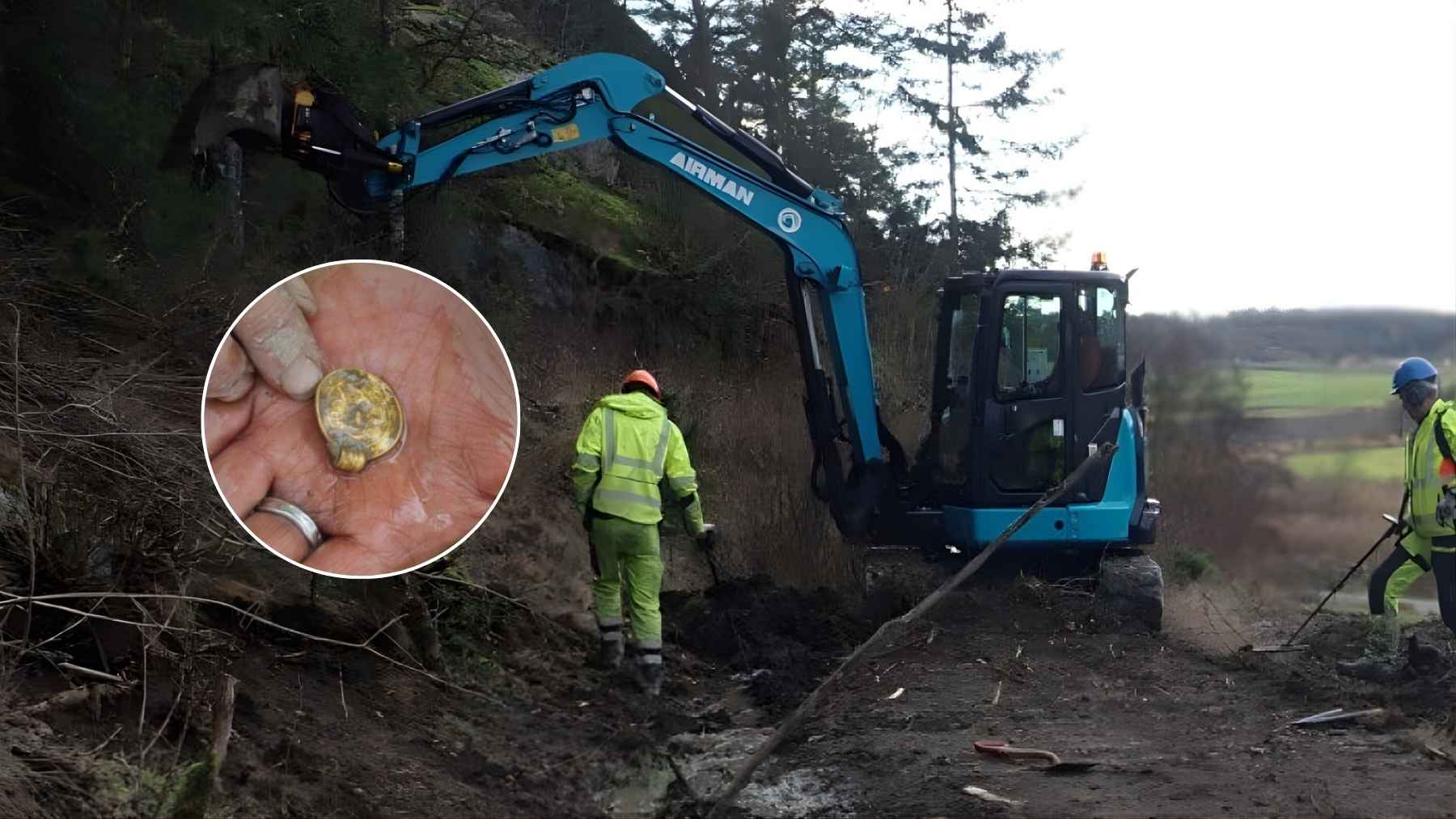
A Byzantium-era gold coin that was discovered in the mountains of southern Norway is a mystery. The coin is a Byzantine histamenon nomisma. These were introduced in Byzantium around 960 AD in what was then the eastern part of the Roman Empire. One side of the coin is stamped with an image of Christ holding the Bible. On the other side, the two emperors Basil II and Constantine VIII.
The two brothers jointly ruled in Byzantium for almost fifty years from 976 to 1025. The coin bears two inscriptions. In Latin, it says Jesus Christ, King of those who rule, and in Greek, it reads Basil and Constantine, emperors of the Byzantine Empire. Struck in gold, standard weight is around 4.4g, though quality and fineness decreased in the 11th century, transitioning to electrum.
It was possibly part of the treasures that Harald Hardrada amassed after serving in the Varangian Guard for the Byzantine emperor in 1034. The Varangian Guard consisted of Scandinavian mercenaries, who served as bodyguards and were known as being fearless. Hardrada was King of Norway from 1046 to 1066. He unsuccessfully claimed both the Danish throne until 1064 and the English throne in 1066. It was customary at that time for the guards to loot the palace when an emperor died, and during Harald’s time in Byzantium, three emperors had died.
Some historians believe that Harald’s demise at Stamford Bridge in 1066 is the end of The Viking Age and deem him the Last Viking. Harald Hardrada, the King of Norway, was killed on September 25, 1066, at the Battle of Stamford Bridge, ending his invasion of England. Caught off-guard by King Harold Godwinson’s forces, Harald was struck in the throat by an arrow while fighting without his chainmail.

Basil II, the 'Bulgar-Slayer,' solidified the empire through military victories.
Basil II (r. 976–1025) and Constantine VIII (r. 1025–1028) were brothers of the Macedonian dynasty who reigned for a combined 66 years, bringing the Byzantine Empire to its zenith. Constantine VIII acted as a nominal co-emperor, largely ignoring statecraft for a life of luxury.

Eleutherna Treasures

Eleutherna, also called Apollonia, was an ancient city-state in Crete, Greece. It is located on a narrow northern spur of Mount Ida, the highest mountain in Crete.

It flourished from the Dark Ages of Greece’s history until Byzantine times.
The Eleutherna museum is in an area where excavations were conducted and is enclosed within the Eleutherna archaeological park's boundaries.
Located in the heart of Crete, near the island's geographical center, the archaeological site is nestled in a slope of Mount Ida overlooking the sea. Time has erased most traces of the ancient city-state from the surface – with a human presence dating back to 3000 BC. But the ground itself has yielded many treasures.
The site of Eleutherna includes an acropolis, a polis, and a necropolis. Excavations over the years have shown that the people who lived here were of the Bronze Age civilizations of both the Minoans and the Mycenaeans, as well as the Dorians, warriors from the Greek mainland.

Plaques with the Life of Achilles, about A.D. 300–350, made in Thessaloniki; found in Eleutherna

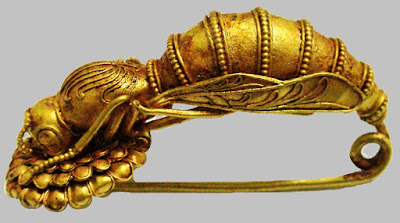
Greek Bee Fibula, 4th century BC

Bee Goddess - From Eleutherna on Crete, c. 700 BC.