Saturday, February 14, 2026

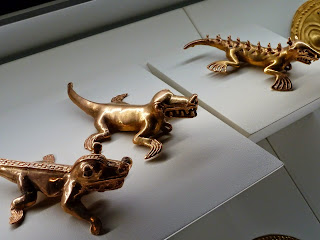
The Pre-Columbian Gold Museum

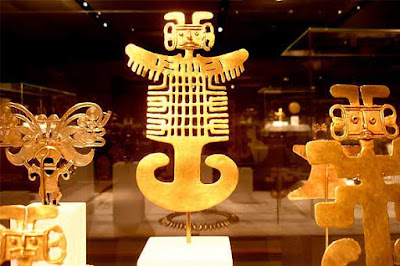
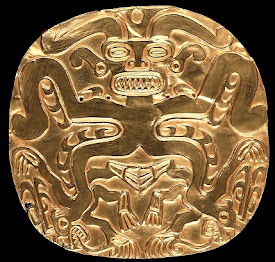
The Pre-Columbian Gold Museum is a museum in San José, Costa Rica. It is located in a subterranean building underneath the Plaza de la cultura and is managed by the Banco Central de Costa Rica.
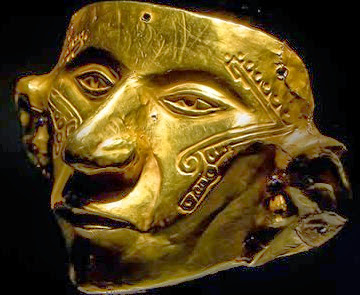
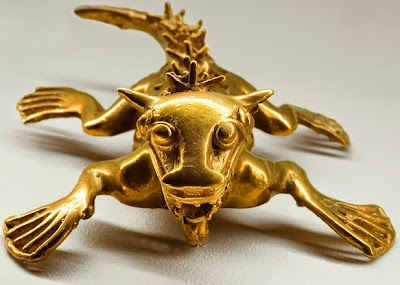
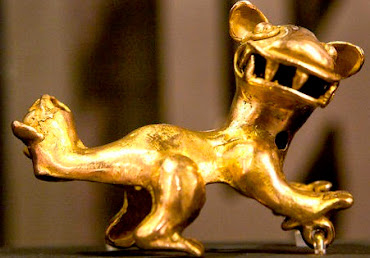
The museum has a collection of over 1600 artifacts of Pre-Columbian gold. The Central Bank began collecting the country's gold patrimony in 1950.
The Costa Rican metallurgical tradition was imported from Colombia, and its hallmarks include a casting method involving wax and the use of gold-copper alloys to make the metal more malleable. The earliest pieces are small and realistic; some are trade goods from Colombia.

In southern Costa Rica, the discovery of gold deposits meant that artisans could afford to be more profligate, and the artifacts became bigger and bolder.

In Peru and other countries, gold was used to fashion armor and musical instruments. But in Costa Rica gold objects were less utilitarian and more often symbols of prestige and rank.
Warriors projected fierceness and social standing with pectorals, headdresses, armbands and nose pins. Shamans, considered conduits between the natural and supernatural worlds, were represented by finely worked pendants that combined human and animal features, often in the form of masks. In Costa Rica the first metal objects appeared around 400-500 AD.
The manufacture of metal objects reached its maximum development after the year 700 AD and lasted until contact with the Spanish. The majority of the metal objects that have been recovered in Costa Rica come from the southern Pacific area. This is due to the existence of natural gold and copper deposits in the region.
Friday, February 13, 2026

Shimao - China's Pompeii

Villagers in the hills of China’s Loess Plateau believed that the crumbling rock walls near their homes were part of the Great Wall.
Locals, and then looters, began finding pieces of jade in the rubble. Jade is not indigenous to this part of Shaanxi Province, the nearest source is almost a thousand miles away.

The rubble was not part of the Great Wall but the ruins of a magnificent fortress city. Carbon-dating determined that parts of Shimao date back 4,300 years, nearly 2,000 years before the oldest section of the Great Wall was built. The ongoing dig has revealed more than six miles of walls surrounding a 230-foot-high pyramid.
80 human skulls with no bodies were found, suggesting human sacrifice.Shimao flourished for nearly half a millennium, from around 2300 B.C. to 1800 B.C. It is the largest known Neolithic settlement in China with its 1,000-acre expanse. Fortified walls eight feet thick and six miles long ringed the city. Suddenly and for unknown reasons, it was abandoned.

Only a small fraction of Shimao has been excavated so far.

Vivid fresco depicting gladiators from Pompeii

A vivid fresco depicting a gladiator standing victorious as his wounded opponent gushes blood was discovered in Pompeii in 2019.
A 'murmillo' holds aloft his shield in his left hand, as he grips his short sword in the right. On the ground next to him lies the shield of the defeated 'thraex', who has suffered wounds and is bleeding. The thraex is gesturing with his hand, possibly asking for mercy.
A murmillo was a heavily armored Roman gladiator who fought with a large rectangular shield and a short sword, named after the Greek word for a type of fish due to his distinctive helmet. A Thraex, or Thracian, was equipped with a distinctive Thracian-style weapon and armor, including a small rectangular shield called a parmula and a curved short sword known as a sica. They also wore leg greaves.

Thursday, February 12, 2026

Iron Age and the Bones of the Dead

A macabre discovery rewrites what we knew about the rituals and beliefs of Iron Age man.
In 2012 ancient remains were discovered in a bog in Denmark. Archaeologists are piecing together what happened to the dozens of dead warriors found at Alken Enge. Researchers were startled by what appeared to be desecration of the skeletal remains.
At least six months after the warriors died, their bones were collected, scraped of remaining flesh, sorted and dumped in a lake.

Protohistoric cultures had many traditions of ensuring the respect of their ancestors, and protection from dead enemies.
Some were handled in a bizarre manner; four pelvises were found strung on a stick. Researchers guess that the desecration of the body parts was an ancient ritual. Was the barbaric ritual a triumph over defeated enemies, as Roman records suggest? There have been Iron Age rites of warding, ensuring the ghosts of a fallen enemy wouldn’t return from the grave to wreak revenge.
Norse folktales included the mythology of the draugr, an undead creature, literally meaning “again-walker”. The draugr was a corpse risen from the grave, a decomposed body. It would seek out and attack those who had wronged it in life.
So horrifying was the prospect of creating a draugr that special care was taken to ensure a proper burial of the dead.

Wednesday, February 11, 2026

Roman gold discovered in plowed UK field

In 2022 detectorists discovered 11 gold coins on a remote stretch of cultivated field located in Norfolk, near England's eastern coast.
The hoard is dated to between the first century B.C. and the first century A.D. All the coins were minted before the Roman conquest, when Britain became occupied by Roman forces in A.D. 43 after an invasion by Claudius. Two types of gold coins were found: one type was marked with the portrait of Augustus Caesar, the first emperor of Rome, with Gaius and Lucius, his grandsons and heirs to the throne. (Both grandsons died before they could become emperor.) The other featured Augustus in profile on one side, but with Gaius on horseback on the reverse.
The farmland where the coins were found sits on land once occupied by the Iceni, a tribe of British Celts. During the Roman invasion, the tribe's leader, Queen Boudica, led a revolt against Roman forces, attempting to drive them off their land in A.D. 60. The queen's army was no match for the Romans. The coins have a small indentation at the top, likely indicating that someone tested the coins for their purity. Cutting "knicks" into the faces of gold coins was a common practice in the Roman Empire, where forgeries were abundant.

Tuesday, February 10, 2026

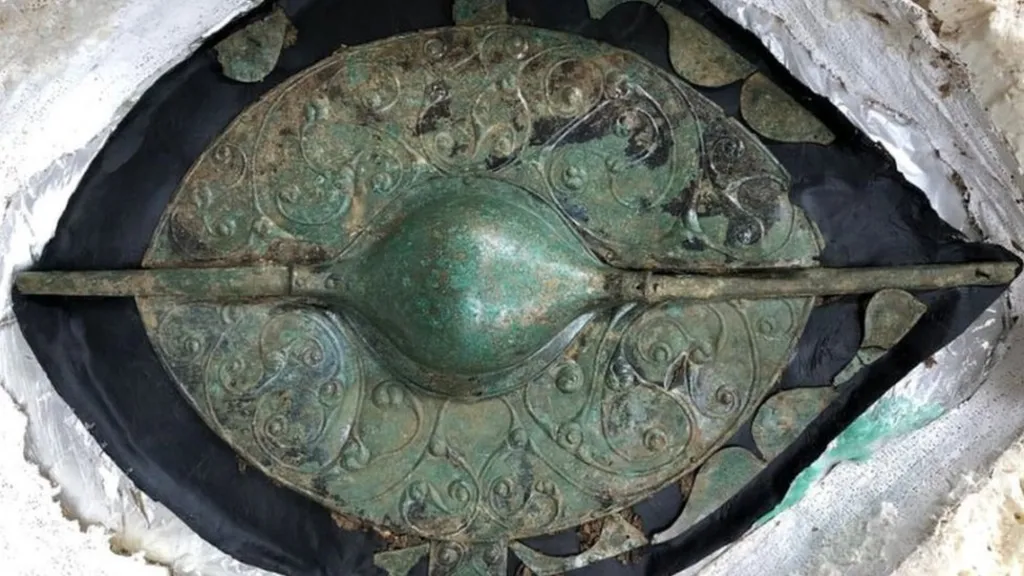
Iron Age shield of Pocklington

An exceptionally rare Iron Age bronze shield, described as one of the most significant British Celtic art objects of the millennium, was discovered in 2018 in Pocklington, East Yorkshire. Dated between 320 and 174 B.C., the 30-inch-diameter shield features a scalloped border, swirling La Tène style decorations, and a central boss. The bronze shield was found in a huge grave which contained the skeleton of a "very revered" man who probably lived between between 220 - 300 BC.
The bronze shield formed part of a chariot burial, which also contained the upright skeletons of two ponies.
Its owner was a high status male, in his late 40s or older when he died, between 320BC to 174BC. The shield was well used and a slash made by a sword is clearly visible in the upper right hand side. The only other shield like it, the Wandsworth shield boss, found in the Thames river in 1849, is now in the British Museum.
Found in a Celtic grave alongside a chariot and two upright horse skeletons, the shield was discovered face down on the chariot with the body of a man placed on top in a crouched position.

Russian farmer unearths unusual 2,000-year-old skeleton

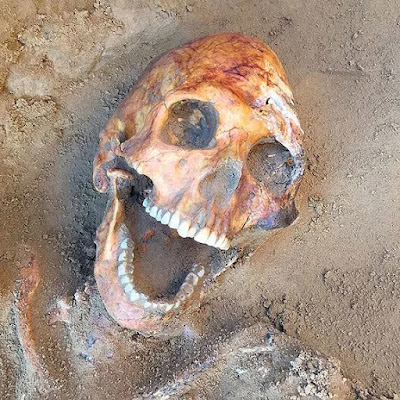
The rich grave yielded gold and silver jewellery, weaponry, valuables and artistic household items in 2019. They were found next to a chieftain’s skeleton in a grave close to the Caspian Sea in southern Russia. Among the bodies is a “laughing” young man with an artificially deformed egg-shaped skull and excellent teeth.
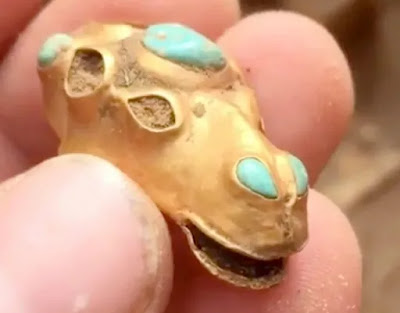
A gold and turquoise horse head
The most “significant” finds came from a male skeleton buried inside a wooden coffin. The burial is thought to belong to a leader of a Sarmatian tribe that dominated this part of Russia until the 5th century AD. Multiple gold jewellery decorated with turquoise and inserts of lapis lazuli and glass were found. The chieftain’s head was raised as if it rested on a pillow and he wore a cape decorated with gold plagues.
A Sarmatian diadem was found near the grave. Archaeologists found a collection of knives, items of gold, a small mirror and different pots signalling his elite status.
They found a gold and turquoise belt buckle, and the chief's dagger along with a gold horse’s head which was buried between his legs.
Part of the chief's belt was found.

The chief's dagger.

Monday, February 9, 2026

Emperor Volusianus - binio

In 2022 researchers in Hungary discovered a rare gold Roman coin of Roman emperor Volusianus.
A binio (or double aureus) of the Roman Emperor Volusianus (251–253 AD) is an extremely rare gold coin from the mid-3rd century. These coins are heavy, high-value gold pieces (5.4–5.6 grams) minted during the short reign of Volusianus and his father, Trebonianus Gallus. The denomination of the coin is not an ordinary aureus, but a rare binio, i.e. a double aureus.
The large sum was lost at the Roman site in the Roman province of Pannonia Superior. The coin was minted during his rule, between A.D. 251 and 253. One side of the coin features a portrait of the emperor, while the other side depicts Libertas, freedom.
The third-century coin depicts Emperor Volusianus, who co-ruled the Roman Empire for about two years with his father, until he was assassinated at age 22 by his own soldiers. Volusianus and his father were killed in August 253 by their own soldiers, who were terrified of the forces of the usurper Aemilian which were marching towards Rome. Estimate: 15 000 CHF. Price realized: 17 000 CHF

Sunday, February 8, 2026

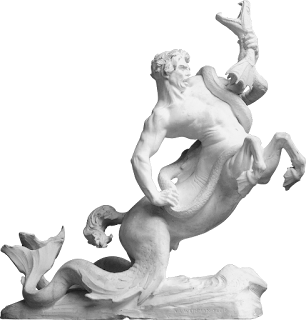
Ichthyocentaurs

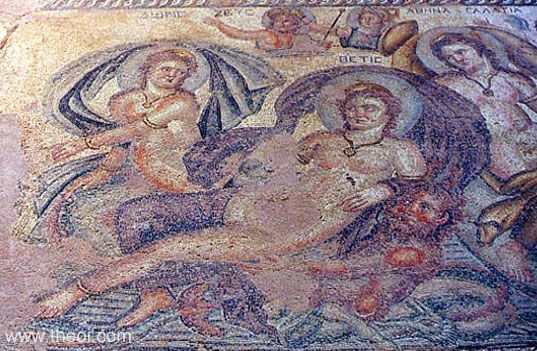
In late Greek mythology ichthyocentaurs were a race of centaurine sea-gods with the upper body of a human, the lower front of a horse, the tail of a fish, and lobster-claw horns on their heads. The sea-centaurs were probably derived from the divine fish of Syrian mythology.
Ichthyocentaurs upper bodies took the form of a human torso down to the hips, and the lower that of a fish, with two horse legs protruding from this intersection. They were sometimes depicted with lobster claw horns. The two named ichthyocentaurs were Aphros 'Sea Foam' and Bythos. 'Sea Depths'
They were half-brothers of Chiron and the sons of the Titan Cronus and Nymph Philyra.

Bythos and Aphros
Some ichthyocentaurs wore crowns while others were depicted with horns. The best-known members of this race were Aphros and Bythos. These two sea-gods, though little remembered, were set in the sky as the astronomical constellation Pisces.

Friday, February 6, 2026

1937 Edward VIII sovereign - $1.3m

A gold coin bearing the image of King Edward VIII before his abdication sold for 1m pounds (US$1.3m) in 2020, setting a new record for a British coin. The coin shows Edward, the uncle of Queen Elizabeth II, before he relinquished the throne in 1936 to marry American divorcee Wallis Simpson.
The 22-carat gold coins were never released to the public. The Edward VIII sovereign is thought to be one of just two examples in private ownership, with the remaining four examples in museums.