Saturday, October 18, 2025

Akan Gold


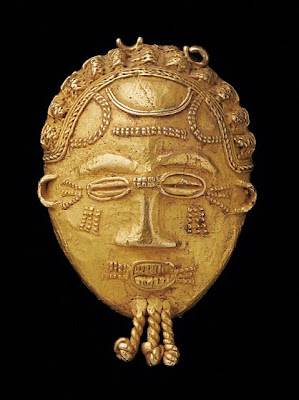
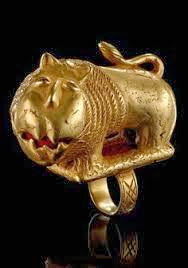
The Akan became one of the most powerful groups in West Africa.
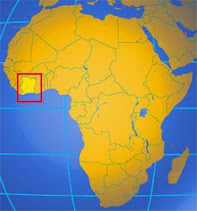
The Akan are an ethnic group native to Ghana and the Ivory Coast. Ethnic Akans are the largest ethnic group in both countries with a population of 20m. From the 1500s the Akan dominated gold mining and trading in the region.
This wealth attracted European traders. Initially the Europeans were Portuguese but eventually the Dutch and British joined in the quest for Akan gold. Akan people fought against the European colonists to maintain autonomy including many Anglo-Ashanti wars: the war of the Golden Stool, and other similar battles.
By the early 1900s all of Ghana was a colony or protectorate of the British while the lands in the Ivory Coast was under the French. On 6 March 1957, following the decolonization from the British, the Gold Coast was joined to British Togoland, and the Northern region, Upper East region and Upper West region of the Gold Coast to form Ghana. Ivory Coast gained independence on 7 August 1960.

Thursday, October 16, 2025

Julius Caesar on coins

Gaius Julius Caesar was born on July 13, 100 BCE. Caesar was the first Roman politician to strike coins with his own portrait at the Rome mint during his lifetime.
The aureus was produced between the first century BCE and the fourth century CE. It was originally worth 25 silver denarii. Caesar's aureus depicts an uncertain goddess.
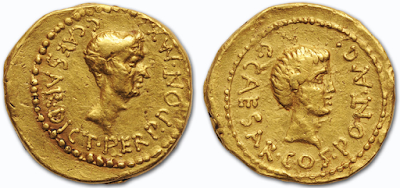
Aureus struck at a military mint, c.43 B.C. It bears the portraits of Julius Caesar and Octavian (Augustus). Extremely rare. At least $50k. In 44 B.C. Caesar became dictator for a term of 10 years and then ultimately dictator perpetuo (dictator for life).

A denarius of February or March, 44 B.C., on which Caesar displays his title “dictator for life.”
Julius Caesar was assassinated on the Ides of March (15 March) 44 BC. The story says Caesar received 23 stab wounds and was left to die at the foot of a statue of Pompey, his former adversary.
Among the last denarii struck before Caesar’s assassination, it portrays him wearing priest’s veil.

Wednesday, October 15, 2025

OMG.v - Omai Gold Mines Corp.

Omai Gold Mines Corp. is a Canadian gold exploration and development company focused on its 100%-owned Omai Gold Project in Guyana, South America. The project hosts two adjacent orogenic gold deposits. An updated NI43-101 Mineral Resource Estimate of 4.4 million oz (Inferred) at 1.95 g/t Au (in 69.6Mt) plus 2.1 million oz (Indicated) at 2.07 g/t Au (in 31.9Mt) was announced August 25, 2025.

https://www.stockwatch.com/Quote/Detail?C:OMG

Tuesday, October 14, 2025

Ptolemy, son of Lagos

Of all the successors of Alexander the Great, the family of Ptolemy, son of Lagos, was the most successful, ruling Egypt for nearly three centuries (305 – 30 BCE).
Bust of Ptolemy. The story of that success begins with a hijacking. When Alexander died in Babylon on 10 June 323 BCE, his corpse, embalmed by a team of Egyptian morticians, was placed in an elaborate cart for travel back to Macedon in northern Greece for burial. Ptolemy was one of Alexander’s boyhood companions and trusted bodyguards. He seized the body and diverted it to Memphis, capital of Egypt, where he had been appointed satrap (governor). Alexander’s body became a trophy and symbol of legitimacy for Ptolemy’s dynasty.
The dynasty shared just three names – at least seven Cleopatras, four Berenikes and four Arsinoës.
He founded the city of Alexandria and built the famous Lighthouse of Alexandria.
The earliest coins of Ptolemy I followed the pattern of Alexander’s coinage. At an uncertain date (c. 316 – 312), Ptolemy issued a new type of silver tetradrachm bearing a portrait of the deified Alexander wearing an elephant head-dress (symbolizing his conquest of India). On the reverse, the goddess Athena. Ptolemy had three official wives and numerous liaisons, fathering at least 11 children. In 289 BCE he appointed his son, Ptolemy II as co-ruler. He died in 283 or 282, aged 84, the only one of Alexander’s successors to die peacefully in his own bed.

Monday, October 13, 2025

Scythians: Warriors and Master Goldsmiths


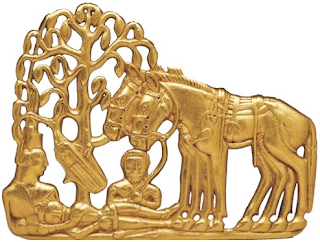
Plaque unearthed from the Kul-Oba kurgan in eastern Crimea.
For most of the first millennium BC, the steppe between the Black Sea and China was the domain of Scythians – fierce nomadic warriors who were advanced metalworkers, wood-carvers and painters.

Heavily decorated shoe of a woman interred in a burial mound at Pazyryk. It’s made from red leather embellished with gold and tin, and the sole is ornamented with tiny beads and pyrite crystals stitched into the leather.

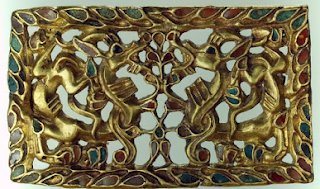
Half of a belt buckle; the other half was often but not always a mirror image.

Gold lion-griffin ornament, fourth century BC

Scythian button

Belt Plaque

Gold torque.
The Golden Pectoral from Tovsta Mohyla is an ancient Scythian treasure discovered in a burial kurgan in 1971. The pectoral is 24 karat gold and weighs just over 2.5 pounds.
The crescent is stylistically broken down into three sections. The top section reflects Scythian daily life.
The middle section is believed to represent Scythian connection to nature. The third section is thought to represent Scythian belief in the cosmos and their mythology.

The Princess of Ukok


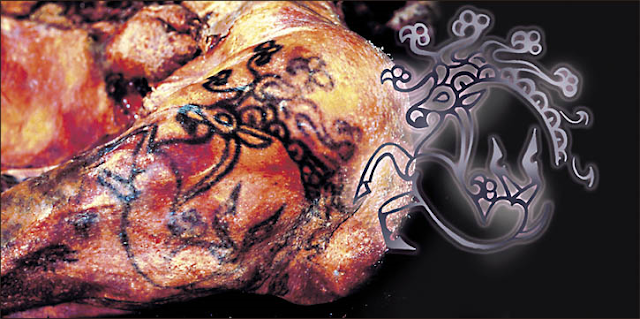
The Princess of Ukok is a mummy of a woman from the 5th century BC, found undisturbed and in spectacular condition in 1993 in a kurgan in Republic of Altai, Russia. She is among the most significant Russian archaeological finds of the late 20th century. Buried around her were six horses, saddled and bridled, her spiritual escorts to the next world, and a symbol of her status.

Her tattoos are said to be best-preserved, and most elaborate, ancient art ever found.
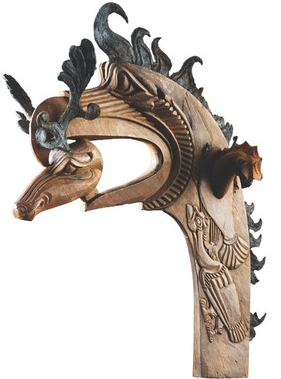
The Ice Maiden was buried in balm and bandages in a chamber built of larch logs. Her organs were removed and her body stuffed with grass and wool, and placed in a wooden coffin. Water flooded her tomb helping to freeze her and preserve her remains. Her head had been shaved and her hair replaced with a wig that was draped with a tall wooden head-dress, decorated with carved cats and swans. It is extremely rare to find a woman buried alone in such a tomb.
When she was around 20 years old, she became ill with breast cancer. It eventually killed her. She was very high status and was buried in a separate mound, rather than a line of family tombs. Locals claim that her presence in the burial chamber was ‘to bar the entrance to the kingdom of the dead’. By removing this mummy, the elders contend that ‘the entrance remains open’. Today she rests in a specially-built museum in the city of Gorno-Altaisk, capital of the Altai Republic.

She belonged to a tribe called the Pzyryks, close relatives of the Scythians.

Saturday, October 11, 2025

1600-year-old gold bead from the ancient City of David


A tiny gold bead turned up in soil from the City of David. It is dated to the end of the Roman era and it survived whole, which is unusual for something so small. The bead was recovered during wet sifting at excavations in the Jerusalem Walls National Park.

The soil came from a large Roman structure, and the bead’s fine work points to a skilled maker and a wealthy owner. A grand Roman building once stood along the Pilgrimage Road. It was at least about 82 feet long, with imported ceramics and a mosaic floor that signal high status. The gold bead likely belonged to a necklace or bracelet and was lost. The bead was fashioned with granulation, a technique that joins tiny gold spheres to create patterns or whole objects.
Highly skilled artisans controlled heat and solder to bond granules without collapsing the form, a complex production method. It demands steady temperature control so the small balls fuse to a ring without melting the whole piece, a balancing act few could master. The craft sits at the boundary of chemistry and art.
It leaves no room for error because one extra degree can erase hours of work. Specialists read such work as a mark of wealth and access to high level makers. Likely lost in a street, layers here build up quickly when streets are rebuilt, washed by winter runoff, or covered by repair fills. A stray bead can lodge in debris and stay hidden for centuries. Gold jewelry tends to be recycled, so it rarely survives outside hoards and graves. That makes tiny, intact gold items in excavations rare finds.

Friday, October 10, 2025

'Commodus Passage' to Colosseum unveiled

For the first time in nearly 2,000 years, visitors to Rome’s Colosseum can walk through a hidden imperial passage that once allowed Roman emperors to reach the ancient amphitheater unseen. It gave exclusive access to the arena without them having to walk through crowds. The once-secret corridor — known as the 'Commodus Passage' opens to the public on October 27.
The passage was initially constructed between the reigns of Domitian and Trajan and included luxurious stucco and marble coverings. Over centuries, natural wear nearly erased these decorations. Meticulous restoration was required.
Roman emperors would use the passage to enter the arena unseen and protected, leading them directly to their reserved honor box overlooking the games. The passage was named after Commodus, who lived between 180 and 192 A.D., when it was discovered in the 1810s. Commodus was passionate about combat in the arena. When passing through the tunnel, he was attacked by an assassin, but survived that attempt on his life.

Commodus was assassinated on December 31, 192 AD by his wrestler, Narcissus.
See ----->Commodus

Thursday, October 9, 2025

Ancient gold and silver coins found in Czech Republic

Archaeologists in the Czech Republic have revealed a trove of coins, gold jewelry and other artifacts that date to about 2,500 years ago, during the region's Celtic period. Objects were discovered during excavations at a site in the Pilsen region in the west of the Czech Republic.
Other metal objects — including fragments of gold and silver ingots, as well as bronze buckles, pins, bracelets, pendants and a horse figurine — were also found at the site. There were no signs of a permanent Celtic settlement, which implied the site might have been a seasonal market or fair.
The Celts are often thought of as occupying only the Western fringe of ancient Europe, such as Ireland; but excavations and historical records show that they spread at times across much of the continent, from the Iberian Peninsula to Anatolia and what is now the Czech Republic. The first phase of Celtic culture is known as the Hallstatt culture (between about 1200 and 450 B.C.), while its peak is recognized as the La Tène culture (between about 450 and 50 B.C.) across France, Germany and other regions.

Wednesday, October 8, 2025

Gold coin hoard in Israel

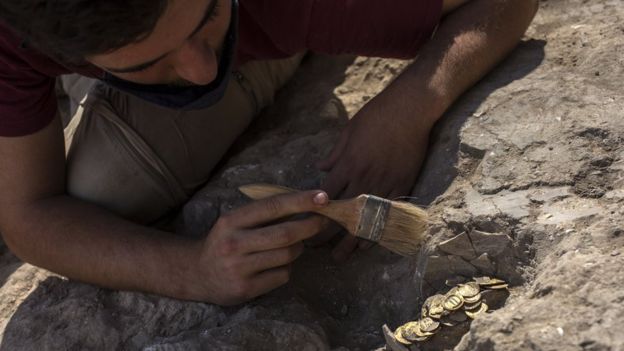
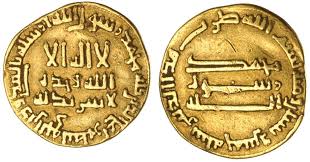
In 2020 students volunteering at an archaeological dig in central Israel landed 425 gold coins that had lain buried in a clay jar for 1,100 years. The coins date to the early Islamic period, when the region was part of the Abbasid caliphate.
The coins weigh 845g and would have been a huge sum when they were buried - enough to buy a luxurious home. The cache consisted of full gold dinars and 270 small gold cuttings - pieces of dinars cut to serve as 'change'. Some of the cuttings were from a gold solidus of the Byzantine Emperor Theophilos minted in Constantinople. This provides evidence of the continuous trade connections between the two rival empires during the period.
The Abbasid Caliphate was the third of the Islamic caliphates to succeed the Islamic prophet Muhammad. The Abbasid dynasty descended from Muhammad’s youngest uncle, Al-Abbas ibn Abd al-Muttalib (566–653 CE), from whom the dynasty takes its name.