Roman iron slave collar. The inscription on the collar reads – “I have run away; hold me. When you have returned me to my master, Zoninus, you will receive a solidus" (gold coin)
Blood Stained Cloak of Archduke Franz Ferdinand – Austrian Military Museum, Vienna. The murder of Archduke Franz Ferdinand plunged the world into the first World War.
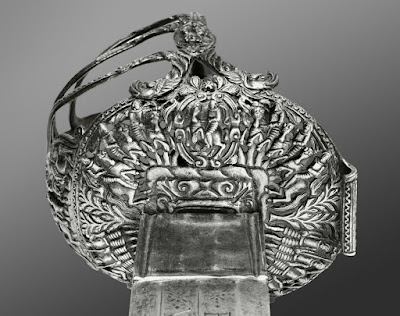
Broadsword of Oliver Cromwell c. 1650. This is one of the finest surviving swords of it's type, favored during the English Civil War (1642-51). The association of this sword with Oliver Cromwell (1599-1658) is confirmed with the inscription and heraldic arms of England and Ireland on the blade.
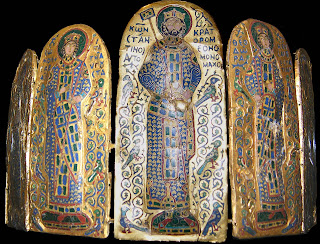
Monomachus Crown – Hungarian National Museum, Budapest.
The crown is engraved Byzantine goldwork, decorated with cloisonné enamel. King Constantine Monomachus ruled the Byzantine kingdom from 1042 to 1055 with his wife Zoe and her sister Theodora. It was probably made in Constantinople in 1042. It was found in 1860 by a farmer while plowing. The objects passed to the local landowning nobility, who sold it in four transactions to the Hungarian National Museum between 1861 and 1870.
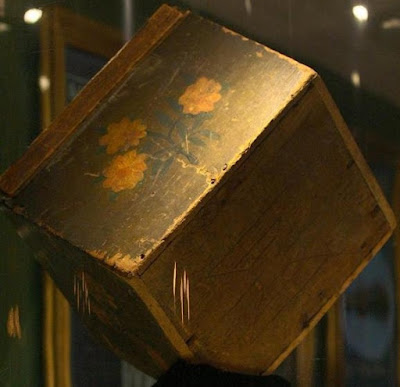
A Surviving Crate from the Boston Tea Party. The Boston Tea Party was the spark in the powder keg for the American War of Independence. The rebelling colonials climbed aboard a ship carrying England’s most valuable commodity – tea, and threw it overboard in an act of open defiance. Two crates survived.
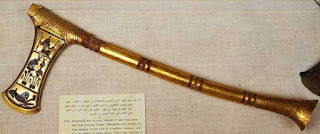
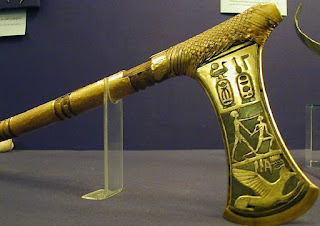
The Axe of Pharoah Ahmes
A gold ceremonial axe was found among the treasures in the Tomb of Ahmes. It is funerary object that was not used in the life of the pharaoh. One of the sides of the blade is adorned with Nekhbet, vulture goddess and the guardian of Upper and Lower Egypt, and other deities who protect the pharaoh . The other side of the blade depicts the pharaoh tormenting one of his enemies as a symbol for sovereign power.
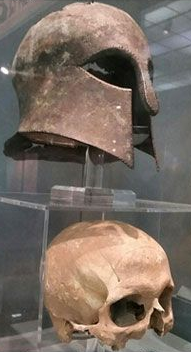
Corinthian helmet and skull from the Battle of Marathon 490 BCE. A pivotal moment in history, the battle of Marathon saw a smaller Greek force, mainly made up of Athenian troops, defeat an invading Persian army. A fierce and bloody battle, with numerous casualties this helmet (with skull inside) belonged to a Greek hoplite (soldier) who died during the fighting. The story of the man who ran back to Athens with the news of the victory became synonymous with the long distance running event in the Olympics.
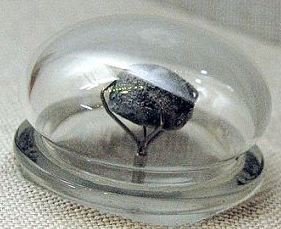
Bullet that killed Lincoln. On April 14, 1865, five days after Confederate General Robert E. Lee surrendered to Union General Ulysses S. Grant in Appomattox, Virginia, actor John Wilkes Booth achieved historical immortality by firing the shot that claimed the life of Abraham Lincoln.
Roman emperor Macrinus reigned for about a year, from 217 to 218, before falling victim to assassination, a fate he shared with many of his peers. Veteran soldiers revolted. One of three known gold aureus coins of the type for Macrinus was a highlight of a Heritage auction in 2019. At the same sale a Diadumenian aureus made $336k
AV aureus. NGC Choice AU ★ 5/5 - 5/5, Fine Style. Rome, AD 218. $288k
Macrinus served under Emperor Caracalla as a praetorian prefect and dealt with Rome's civil affairs. He later conspired against Caracalla and had him murdered. Macrinus proclaimed himself emperor without confirmation from the Senate in Rome. This and reigning in soldiers’ pay made him deeply unpopular.
Diadumenian, as Caesar (AD 217-218). AV aureus. NGC Choice AU ★ 5/5 - 4/5, Fine Style. Rome, AD 218. $ 336k
Macrinus was overthrown at the Battle of Antioch on 8 June 218 and Elagabalus proclaimed himself emperor with support from the rebelling Roman legions. Macrinus fled the battlefield and tried to reach Rome, but was captured in Chalcedon and later executed.
Marcus Opellius Diadumenian, ten-year-old son of emperor Macrinus (AD 217-218), was granted the rank of Caesar soon after his father had succeeded the murdered Caracalla. Coinage in his name was struck in all denominations, though his gold is extremely rare. Diadumenian was captured and executed in late June 218.
Commodus (161 – 192), born Lucius Aurelius Commodus, was Roman Emperor from AD 180 to 192. He ruled as co-emperor with his father Marcus Aurelius from 177 until his father's death in 180.
Commodus as Hercules
Holding a huge club to beat his enemies, Commodus wears a lion skin in a marble portrait bust made in the second century AD, which is one of the treasures of Rome’s Capitoline Museum. The portrait equates the strength of Hercules with the power of the emperor. The son of the respected Marcus Aurelius took control of the Roman empire and embarked on a career of bizarre, erratic behavior and monstrous cruelty. He enjoyed executing his enemies and perceived enemies personally.
Commodus fought in the arena, killing gladiators with his own hands, a spectacle Romans found shameful.
His misrule precipitated civil strife that ended 84 years of stability and prosperity. His accession marked the descent "from a kingdom of gold to one of iron and rust" – a famous comment which has led historians to take Commodus' reign as the beginning of the decline and end of the Roman Empire. Commodus would go on to claim to be the son of Jupiter, the supreme god of the Roman pantheon.
He viewed himself in megalomaniacal proportions.
In November 192, Commodus held Plebeian Games, in which he shot animals with arrows and javelins every morning, and fought as a gladiator every afternoon, winning all of his bouts easily as his opponents always submitted. For each appearance in the arena, he charged the city of Rome a million sesterces, a vast sum. (250,000 denarii)
He announced his intention to inaugurate the year 193 as both consul and gladiator. His foes had enough. They poisoned his food but he vomited it up; so the conspirators sent his wrestling partner Narcissus to strangle him.
Upon his death, the Senate declared him a public enemy. (damnatio memoriae)
A rare aureus of Commodus was sold in 2019. Dating to 178 AD and struck in Rome, it made 25,000 euros.
Commodus. AD 177-192. AV Aureus Rome mint. Struck AD 183. M COMMODVS ANTON AVG PIVS, laureate, draped, and cuirassed bust right. Mars standing left. Superb EF, $24,500.
The best preserved Lorica Segmentata, Roman Plate Armour, resides at the Corbridge Roman Site Museum, Hadrian's Wall, Northumberland. It probably dates 122 AD to 138 AD. The Corbridge Roman Site was a key supply base along Hadrian's Wall.
The armor is made from overlapping iron plates, fastened with leather straps and bronze fittings, designed to distribute weight across the torso while allowing flexibility. A full set typically weighed around 10 kg, lighter than contemporary mail armors while providing strong protection against slashing attacks. This type of armor was used by Roman legionaries from the 1st to early 3rd Century AD, before gradually being replaced by other forms (lorica hamata).
The Corbridge hoard was uncovered in 1964 inside a wooden chest, where corrosion had fused pieces together, preserving their arrangement and enabling one of the most accurate reconstructions of Roman armor ever achieved.
Dutch authorities showed off the recovered Helmet of Cotofenesti, a priceless 2,500-year-old electrum helmet from Romania that was stolen in 2025. Two of three gold bracelets were also recovered.
The Helmet of Coțofenești is a Geto-Dacian helmet made of electrum dating from the second half of the 5th century BC. It was discovered in the Romanian village of Coțofenești in 1926. It was stolen in 2025 during a robbery at the Drents Museum in Assen, the Netherlands, where it was being displayed. Weighing almost a kilo, the helmet is well preserved, missing only part of its skull cap. The helmet is decorated with studs on the top of the skull and two large apotropaic eyes, meant to ward off the evil eye and magic spells. It belonged to a local Geto-Dacian king or aristocrat, from around 450 BC. The cheek-pieces show a ram being sacrificed by a man about to cut its throat.
The thieves also made off with three gold bracelets, dating from around 50 BC.
The items were part of an exhibition about the Dacians, a people that occupied much of present-day Romania before being conquered by the Romans. “Dacia: Empire of Gold and Silver” featured priceless treasures borrowed from institutions across Romania. The door to the museum was forced open with explosives. There were no guards. Three have been arrested but the artifacts have not been recovered.
One of the most significant archaeological sites in the world took center stage in 2018 at the Fine Arts Museums of San Francisco (FAMSF) with the de Young Museum’s “Teotihuacan: City of Water, City of Fire.” The exhibition featured over 200 artifacts from the site, with loans from major collections as well as recently excavated objects.
At its zenith Teotihuacan was the largest city in the pre-Columbian Americas, with a population estimated at 125,000 or more, making it at least the sixth largest city in the world during its epoch.
At 63 meters tall, the Sun Pyramid was one of the largest and tallest structures in the Western Hemisphere. The city reached its peak around 450 AD.
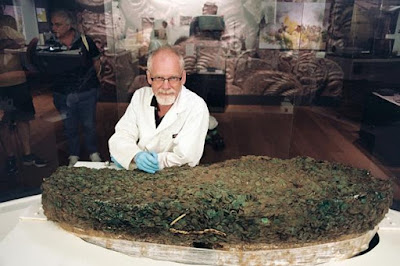
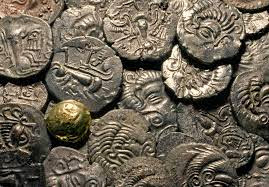
The last coins from an ancient Celtic hoard discovered in a field in Jersey were removed from the conglomerate they were buried in in 2020. Dating from around 30-50 BC, the collection of 69,347 coins was six times larger than any other similar Celtic artifacts and also included jewellery, beads and fabric. The hoard was probably buried by a tribe of Curiosilitae Celts. Historians believe they were fleeing Gaul to avoid Julius Caesar's armies around 50 to 60 BC.
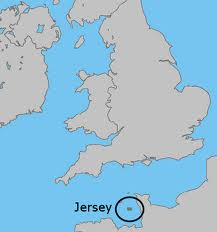
The Jersey Hoard (Grouville Hoard) is a hoard of late Iron Age and Roman coins discovered in June 2012. It was discovered in a field in the parish of Grouville on the east side of Jersey in the Channel Islands.
Jersey Heritage's conservation team have been excavating an area known to contain gold jewelery. One end of a solid gold torc was uncovered. The find follows the discovery of two other solid gold torcs - one gold-plated and one of an unknown alloy - along with a silver brooch and a crushed sheet gold tube.
At least 50,000 coins dating back to the time of Julius Caesar were found in a field in Jersey. The Roman and Celtic coins, which date from the 1st Century BC, were found by two metal detector enthusiasts. Archaeologists said the hoard weighed about three quarters of a tonne.
It is the first hoard of coins found in the island for more than 60 years. Several hoards of Celtic coins have been found in Jersey before but the largest was in 1935 at La Marquanderie when more than 11,000 were discovered.
This is the world's biggest Celtic coin hoard ever, and was a significant part of a tribe's wealth. It is also one of the world's biggest coin hoards and certainly the biggest coin hoard found in Britain. The value of the hoard was estimated at up to £10m when it was first removed from the ground.
Circa A.D. 103 to 111 gold aureus of Trajan. The coin was struck at Rome and depicts a laureate and draped bust of Trajan on its obverse. Trajan also appears on the reverse, where he is standing facing left, a scroll in his left hand, extending his right hand to two children standing with their arms raised toward him. The inscription below, ALIM ITAL, is a reference to the alimenta. Graded Very Fine the coin made $2,000 in 2020.
TRAJAN AR silver denarius. Annona standing, child at her feet. ALIM ITAL, Alimenta Italia.
Alimentary grants (alimenta) were a form of state support in Italy for citizen children, initiated by Emperor Nerva and expanded under Trajan. Unlike previous grain doles, which were privately funded and limited to Rome, the new initiative was a state-funded subsidy at regular intervals for children all across Italy. Trajan’s pride in the alimenta led to a series of coins in gold, silver and bronze to commemorate it. This program continued under his successor and lasted into the mid-third century.
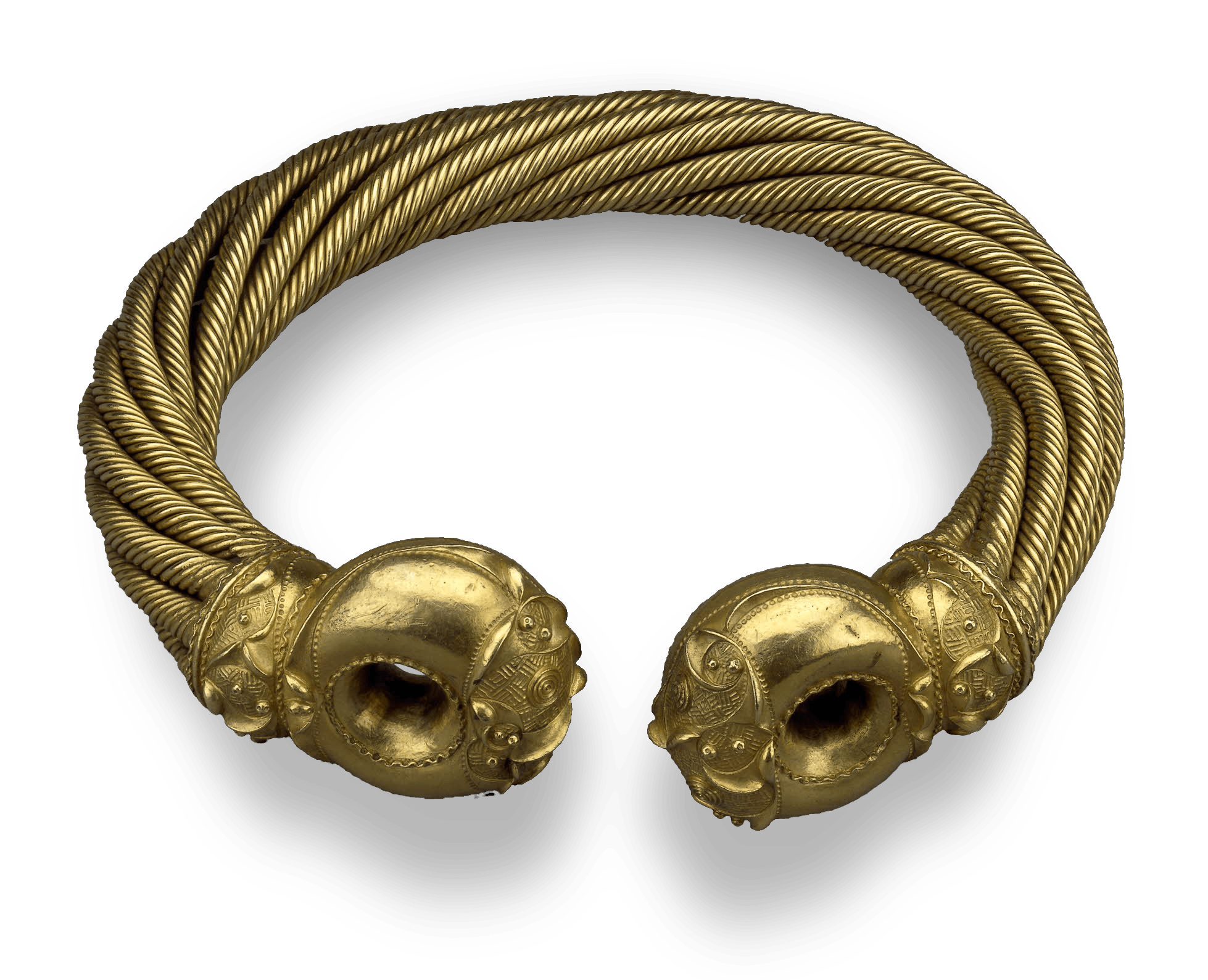
The Great Torc from Snettisham or Snettisham Great Torc is a large Iron Age torc or neck ring in electrum, from the 1st century BC.
It is one of the finest pieces of early Celtic art known. It was the most spectacular object in the Snettisham Hoard, found in 1950 near the village of Snettisham in Norfolk, East Anglia. The perfectly intact torc is noted for its high level of craftsmanship and artistry. Soon after its discovery it was acquired by the British Museum.
It had been buried with a bracelet and a French coin, which helped date the torc to around 75 BC.
The hoard consists of metal, jet and more than 150 gold/silver/copper alloy torc fragments, more than 70 of which form complete torcs. The Great Torc weighs slightly more than 1 kg and is mostly made of gold alloyed with a small fraction of silver. The torc was made in two ways: complex threads of metal were grouped into ropes and twisted around each other to create the crescent shaped necklace; the ends of the torc were cast in moulds with La Tène designs and welded onto the metal ropes to create the whole composition. It has been conjectured that the area around Snettisham may have been connected with royalty from the Iceni tribe. The Great torc from Snettisham could belong to no one else.
Research by the British Museum reveals the wear patterns in the torcs, the chemical composition of the metal and the cut marks that reduced many of them to fragments. One hypothesis suggests the deliberate destruction of valuable items was a form of votive offering.
The Coggalbeg hoard is an Early Bronze Age hoard of three pieces of Irish gold jewellery dating to 2300–2000 BC. It was found in a bog at Coggalbeg, County Roscommon in 1945, and consists of a gold lunula and two small gold discs. It's thought that the objects were ritually deposited as an offering to gods. The lunula is of the "Classical" type, considered the earliest and finest of three types of lunula. Of the estimated 100 lunula known in Western Europe, some 80 originate in Ireland.
The priceless gold was first discovered by farmer Hubert Lannon. He found it in a bog while cutting turf and kept it at home. In March 2010, two men pleaded guilty to burglary and were given three-year suspended sentences. Working with police, curators from the National Museum’s Irish Antiquities Division found out that the jewelry had been left in a dumpster in Dublin. The police had hours to locate the dumpster before the trash would be collected. The detectives waded through a dumpster and found the treasures. The necklace and two discs are among the most important archaeological discoveries in Ireland for many years.