 | The form of the iconic open-faced helmet originated in the Peloponnese during the 8th and 7th centuries BC. The find was made during the exploration of the cave tomb in Zakotarac, located on the Pelješac peninsula, in southern Dalmatia, Croatia. The tomb was for a warrior buried in the 4th century BC. Part of the warrior’s skull appears to be visible from the openings of the helmet. The helmet is one of only about forty such helmets that have ever been found. Archaeologists also discovered a trove of ancient weapons, including spears and knives. Two other people were buried along with the warrior, including a woman, who was found wearing a bronze bracelet. |

Friday, August 7, 2026
Rare Greek-Illyrian helmet discovered
A very rare bronze Greek-Illyrian helmet, used in Greece during the time of the Greco-Persian Wars, was discovered in a rock-cut tomb in Dalmatia, Croatia in 2020.

Thursday, August 6, 2026
Golden Man of Saka
The Golden Man is a Kazak warrior costume that dates to about 300 or 400 BC. It's believed to have been worn by a high status teen-aged Scythian Prince who was killed during a battle.
 | It was found in 1969 in a Scythian tomb about 60km east of Almaty, near Yesik. It is made out of more than 4,000 gold pieces, many of them finely worked with animal motifs.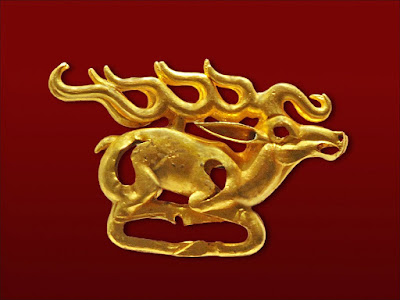  |   |
 |   |
Gold ring of Scipio Barbatus
 | This gold and carnelian signet ring was found on the skeletal finger of Scipio Barbatus (337 BC – 270 BC) inside his sarcophagus, when the Tomb of the Scipios was discovered in 1780. It is the only Roman ring that can be matched to a known Roman owner. |
Health God Asclepius
  | A 2.2m marble statue group depicting the health god Asclepius together with his son and assistant Telesphoros has been unearthed during excavation work at the Aspendos Ancient City. |
 | Aspendosan is in Antalya, Turkey, 40 km east of Antalya. It's famous for the world's best-preserved Roman theater, built in 155 AD by the architect Zeno, which seats up to 10,000. It features advanced acoustics. |
Wednesday, August 5, 2026
Baiae - Las Vegas of ancient Rome
 | Baiae was a mineral springs and coastal resort on the northwest shore of the Gulf of Naples in ancient Italy. The city was named after Baius, Ulysses’ helmsman. It was fashionable for centuries during antiquity for the super-rich. The ancient Roman 'Sin City' was famed for its natural volcanic hot springs. It housed some of the empire's most luxurious baths and private saunas. (laconica) Baiae was built on the Cumaean Peninsula in the Phlegraean Fields, an active volcanic area. Baiae was notorious for its hedonism, corruption and scandal. Roman poet Sextus Propertius once described Baiae as a “vortex of luxury” and a “harbor of vice.” |
 | The bathhouses of Baiae were filled with warm mineral water directed to its pools from underground sulfur springs. Roman engineers constructed a complex system of chambers that channeled underground heat into facilities that acted as saunas. Baiae later formed part of Port Julius, the base of the western fleet of the Imperial Roman Navy. Portus Julius was built in 37 B.C. by Agrippa as Rome's first purpose-built naval base in the Campi Flegrei. Ruins were submerged by volcanic activity by the time of the Renaissance. | 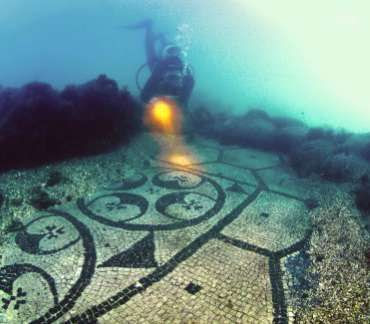 |
 | A volcanic phenomenon known as bradysism saw large portions of Baiae’s coastline—including opulent villas and bathing complexes, sink about 3 meters beneath the Gulf of Naples. | 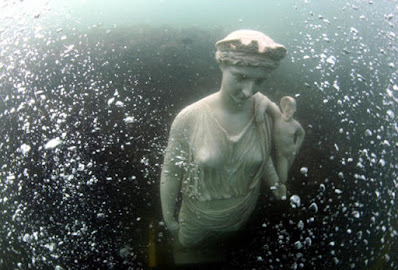 |
 | A series of dives involving historians and scientists from across the world revealed vast villas, priceless statues and breathtaking mosaics, as well as heated spas, cobbled streets and even a nymphaeum – a grotto of pleasure. The chambers of volcanic molten rock that lay beneath Baiae, providing the hot water that served the spas, were eventually its undoing. The chambers emptied as the lava found a way to escape, causing the resort to sink beneath the waves. |  |
Caligula donned purple silk robes adorned with precious stones and gold, a sword, a shield, and a crown of oak leaves. He wore what he claimed was the breastplate of Alexander the Great, that he had stolen from the conqueror’s tomb when in Alexandria.
 |   |  A palace was built in Baiae by Emperor Nero, and Hadrian died among its baths in CE 138. Cicero had a villa in Baiae. |
Coinage of King Pyrrhus
 EPIRUS. Pyrrhus (297–272 BC). Silver tetradrachm (16.56 gm). $60K in 2012. | After the particularly bloody Battle of Asculum in 279 BCE, Pyrrhus famously remarked: “If we are victorious in one more battle with the Romans, we shall be utterly ruined.” This would live forever in the phrase “Pyrrhic victory”. The silver tetradrachms were a high-value coin and were struck with dies engraved by the most skilled artisans. |
 Pyrrhos, King of Epiros, (297-272 BC.), AV Stater, 8.55g, Struck in Syracuse, 278 BC. $180k. |  To pay mercenaries needed to fight the Carthaginians, Pyrrhus produced a huge issue of gold staters and half staters at Syracuse. The finest engravers were hired to produce stunning designs. |
Tuesday, August 4, 2026
Alaska's Okmok volcano fingered after Caesar's murder
Cold, famine and unrest in ancient Rome came after the assassination of Julius Caesar in 44 BCE. New research suggests that the megaeruption of Alaskan volcano Okmok was to blame.
 | An inexplicable cooling event occured in the aftermath of Caesar's death. Huge volumes of volcanic ash from the remote Okmok volcano in Alaska's Aleutian Islands is thought to be responsible. According to the ice core tests, the volcano experienced a two-year megaeruption that began in early 43 BCE, one that filled Earth's atmosphere with enough ash to significantly impact climate. Analysis of climate suggests the years after the Okmok eruption were some of the coldest in the northern hemisphere over the past 2,500 years. |
 | The researchers' climate models indicate that temperatures were seven degrees Celsius below normal during the summer and autumn after the eruption in 43 BCE. The Okmok eruption is one of the largest in the past 2,500 years. |  |
The Circus Maximus
 | In AD 121, on the anniversary of Rome's founding, Hadrian inaugurated new games and chariot races at the Circus Maximus. A rare aureus commemorates the event, providing an absolute date of 874 years since the founding of Rome. |
 | The crucible of Roman chariot racing was the Circo Massimo, or Circus Maximus. Chariot racing was fast and dangerous. According to the historian Livy, the inaugural events and wooden seating were instituted by Tarquinius Priscus in the sixth century BC. |
 |  |
| Races began when the sponsor dropped his napkin and ended seven laps later. A race consisted of 13 turns of the spina, totalling seven laps of the Circus Maximus, run counterclockwise. Those who didn't get maimed or killed and finished in the top three won prizes. Crashes were called naufragia ('shipwreck'). Drivers who became entangled in a crash risked being trampled or dragged along the track by their horses. Most commonly raced were four-horse chariots, known as quadrigae. Drivers (aurigae) wrapped the reins around their waists to steer with weight shifts, holding a knife (falx) to cut themselves free if needed. The two middle horses provided the primary pulling power, while the outer horses were steered. |
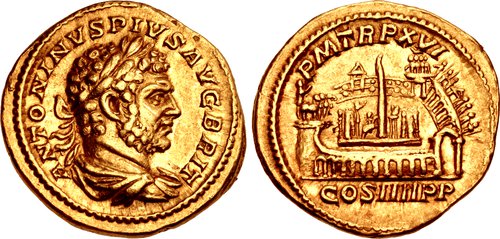 | Caracalla. AD 198-217. AV Aureus Rome mint. Struck AD 213. Near EF. Extremely rare with 4 known and an important architectural type. Est $75,000. Sold for $140,000. |
Mysteries of the ancient Maltese
At 313 sq km, Malta is one of the world’s smallest and most densely populated countries. The Mediterranean island is also home to the world’s oldest freestanding structures and oldest enduring mysteries.
Malta’s megaliths are older than Stonehenge and the Egyptian pyramids. These supersized temples date to between 5500 and 2500 BC. Soil erosion and climate conditions worsened, as evidenced by the different types of pollen in the soil, the diminishing number of tree remains and the human bones wracked with dietary deficiencies.
 |  Inhabited for over 7,000 years, Malta has been settled by Phoenicians, Greeks, Romans, Byzantines, the Muslim Emirate of Sicily, and Crusaders under the Holy Roman Empire. |
 | The island people constructed elaborate sites, such as the Ġgantija temple complex, and their buildings are among the earliest free-standing buildings known. There is no skeletal evidence of violent death and no fortifications. Instead the society appears to have survived through cooperation and sharing. But, after 1,500 years, they were gone. | 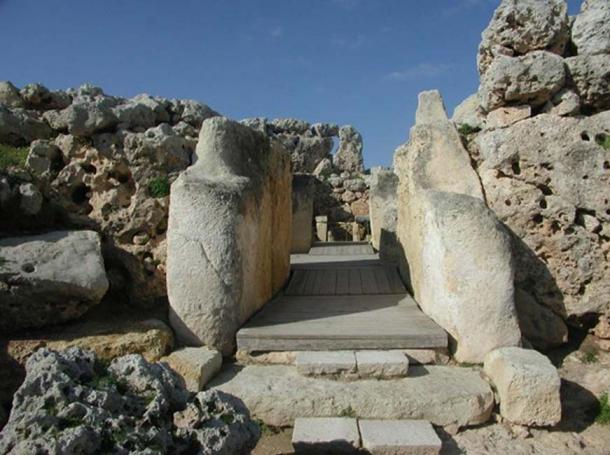 |
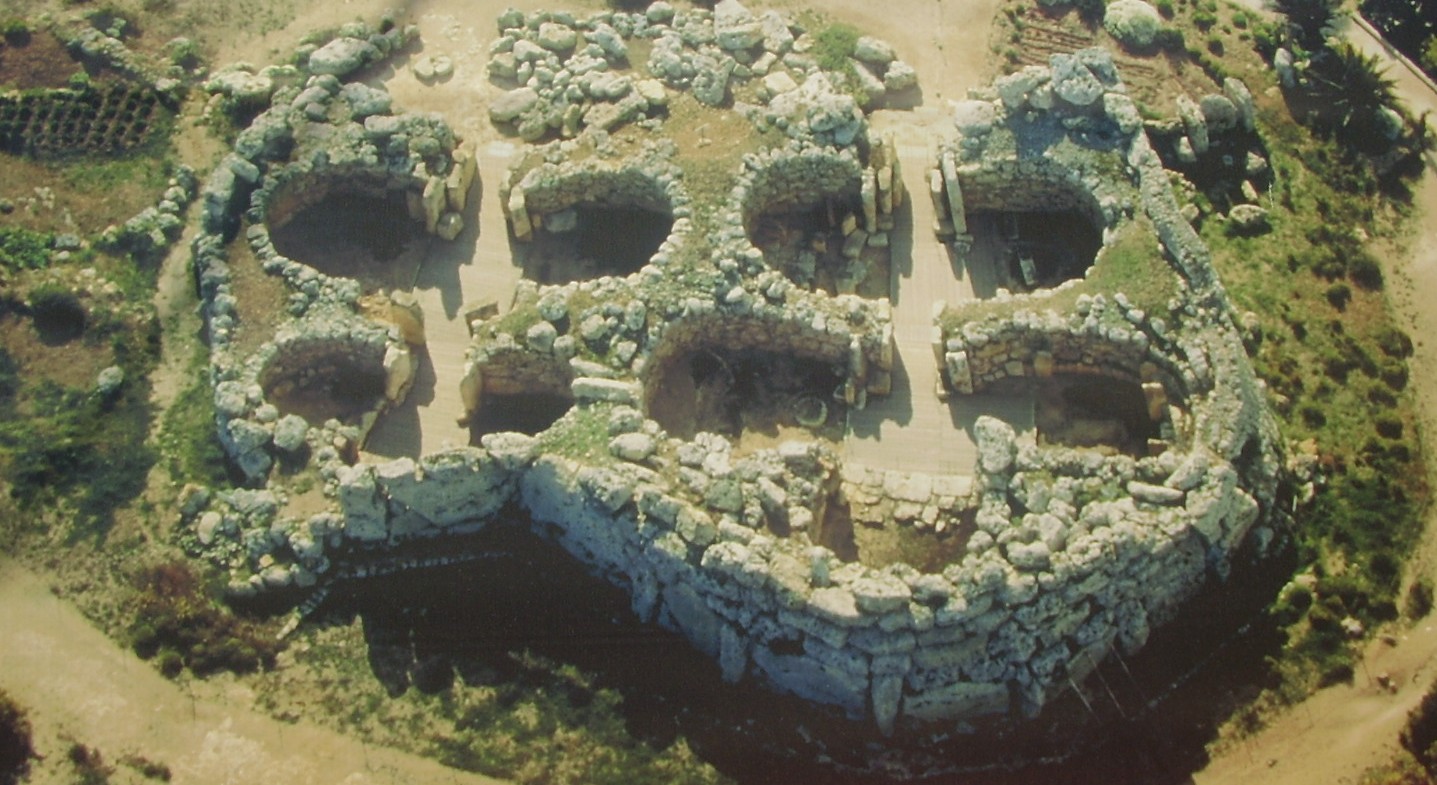
 | In the final centuries, between 2600 BC and 2400 BC, half of those dying were children. |  A catastrophic climate event around 2350 BC was the final blow. |
Marble head found in dig Dionysus
 | The white marble head unearthed during excavations at the Roman Forum on 24 May 2019 is believed to represent a male deity, most likely Dionysus. Initially it was thought that the head - with its feminine features and thick, wavy hairstyle - represented a female goddess. A band around its head decorated with a "typically Dionysian flower, the corymb, and ivy", proves it to be Dionysus. The slightly larger-than-life head has been dated from the first century BC to the fifth century AD. He is better known as Bacchus to the Romans. |
Dionysus is the god of the grape-harvest, winemaking and wine, of fertility, ritual madness, religious ecstasy, and theatre in ancient Greek religion and myth. |  |
Monday, August 3, 2026
Rare Roman horse race mosaic
 |
 Scenes from a chariot race are depicted in a rare Roman mosaic excavated in rural Cyprus in 2017. Dating from the 4th Century AD, it is in Akaki, a village not far from Nicosia. Only a handful of similar mosaics - showing a hippodrome race - have been found at ancient Roman sites. The ornate 26-metre-long (85ft) mosaic was probably part of a wealthy man's villa. | 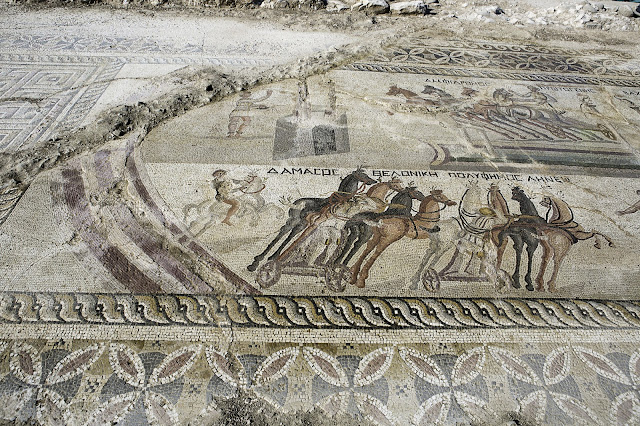 |
 A Roman hippodrome (circus) was a long, open-air stadium built for chariot and horse racing, social events, and imperial ceremonies. The oblong arenas featured a straight start/finish line, curved turning ends (metae), and a central dividing barrier (spina). |   |
Subscribe to:
Posts (Atom)